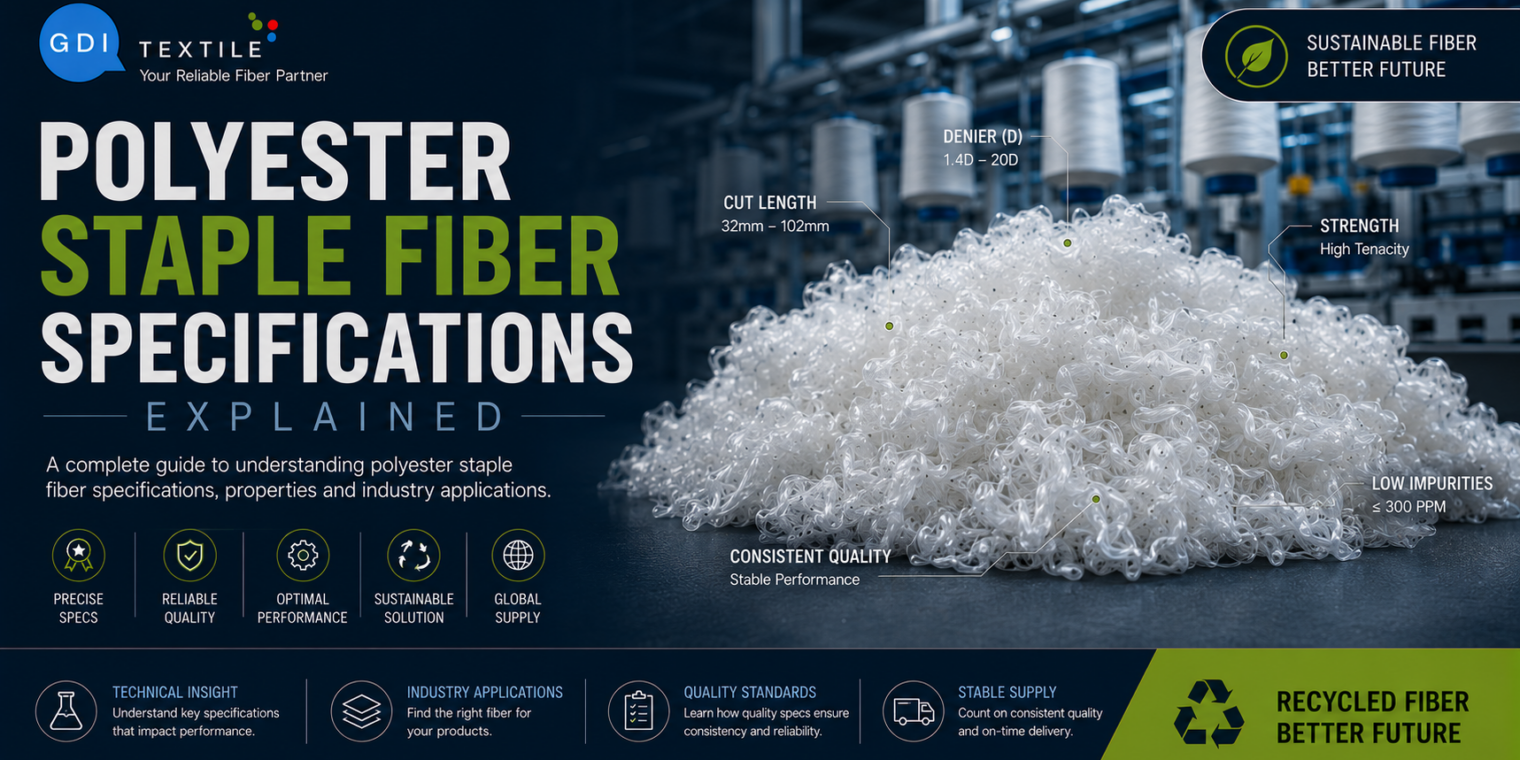
Understanding Denier, Cut Length, Crimp, Strength, and Other Critical Parameters
Sustainability has become a defining factor in the global textile industry. International brands, retailers, and manufacturers are no longer evaluating suppliers based only on price. When purchasing polyester staple fiber, many buyers focus primarily on price. However, experienced manufacturers know that the technical specifications of polyester staple fiber have a much greater impact on production efficiency, product quality, and long-term manufacturing costs.
Before selecting technical specifications, many buyers first need to understand what polyester microfiber actually is and how it differs from conventional polyester fibers. If you’re new to the material, read our guide on What is Microfiber Staple Fiber?
Whether you produce yarn, nonwoven fabrics, automotive interiors, home textiles, or cleaning products, selecting the correct fiber specifications is essential for achieving consistent production and meeting customer expectations.
Even small differences in denier, cut length, crimp, or fiber finish can affect:
- Machine performance
- Product quality
- Material waste
- Production efficiency
- Customer satisfaction
This guide explains the most important polyester staple fiber specifications every B2B buyer should understand before placing an order.
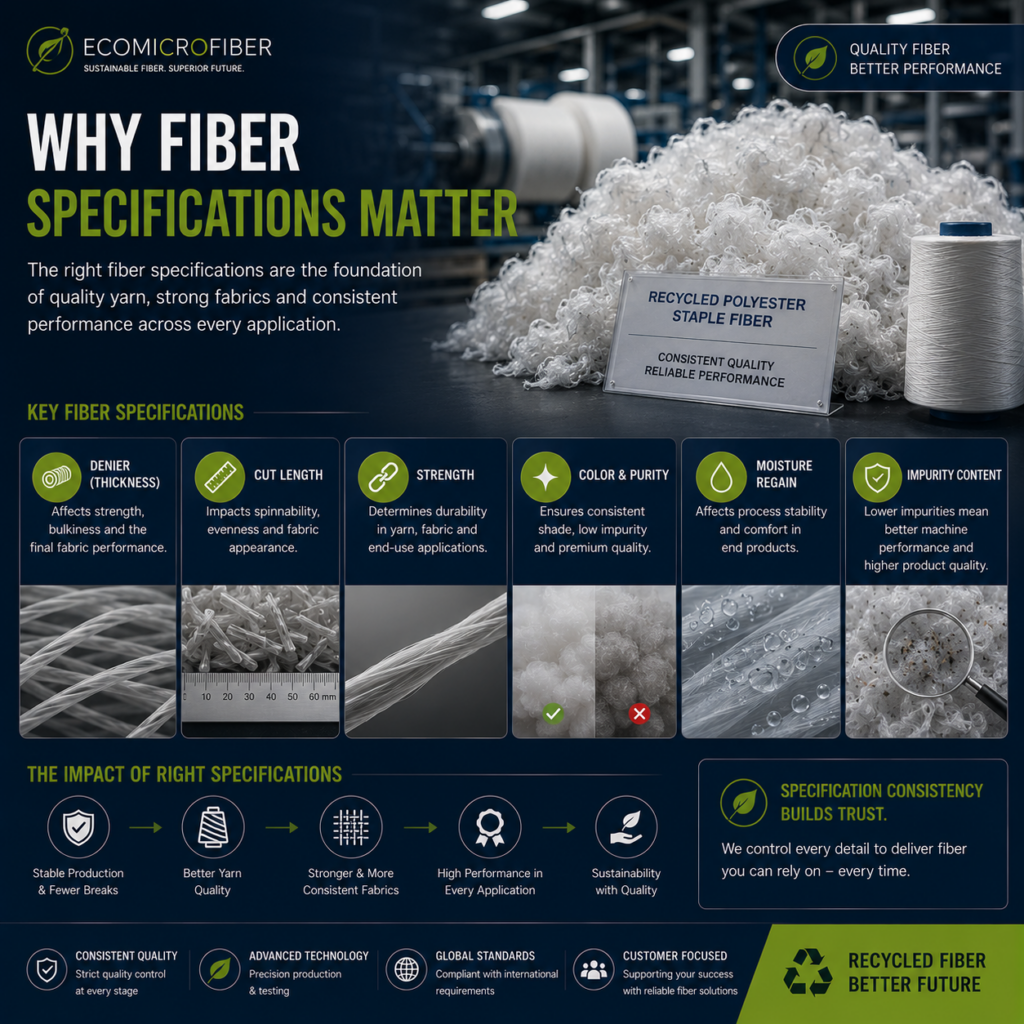
Why Fiber Specifications Matter
Polyester staple fiber is not a standardized commodity.
Different applications require different fiber characteristics.
For example:
A spinning mill may prioritize:
- Uniform denier
- High tensile strength
- Stable crimp
A nonwoven manufacturer may focus on:
- Web formation
- Bonding performance
- Fiber openness
Meanwhile, a cleaning cloth manufacturer often requires:
- Ultra-fine microfiber
- Excellent absorption
- Soft hand feel
Choosing incorrect specifications may increase waste, reduce machine efficiency, and create inconsistent finished products.
1. Denier (D)
Denier is one of the most important specifications.
It measures the thickness of an individual fiber.
Lower Denier
Examples:
- 0.8D
- 0.9D
- 1.0D
- 1.2D
Characteristics:
- Softer
- Higher absorption
- Better surface area
- Suitable for microfiber products
Typical applications:
- Cleaning cloths
- Towels
- Premium knit fabrics
- Fine yarn
If your primary application is spinning, choosing the correct denier is only one part of the decision. Learn more in our guide to Best Microfiber for Yarn Spinning.
Higher Denier
Examples:
- 3D
- 6D
- 7D
- 15D
Characteristics:
- Stronger
- Better resilience
- Higher bulk
Applications:
- Filling
- Furniture
- Automotive
- Nonwoven
- Cushion products
2. Cut Length
Cut length refers to the physical length of each staple fiber after cutting.
Common sizes include:
- 32 mm
- 38 mm
- 51 mm
- 64 mm
- 76 mm
Choosing the correct cut length is critical because it influences:
- Yarn formation
- Web uniformity
- Machine efficiency
- Fiber cohesion
Different industries require different fiber lengths. For example, nonwoven manufacturers often prioritize web formation over yarn performance. Read more in Microfiber for Nonwoven Manufacturing.
Typical Recommendations
| Application | Typical Cut Length |
|---|---|
| Ring Spinning | 38 mm |
| Open-End Spinning | 32–38 mm |
| Nonwoven | 38–64 mm |
| Automotive Felt | 64 mm |
| Filling Fiber | 64–76 mm |
3. Fiber Strength
Fiber strength determines how well polyester performs during processing.
Higher strength offers:
- Fewer yarn breaks
- Better web stability
- Longer product life
Weak fibers may cause:
- Production interruptions
- Higher waste
- Customer complaints
Always request tensile strength data from your supplier.
4. Elongation
Elongation measures how much a fiber stretches before breaking.
Balanced elongation helps:
- Improve spinning stability
- Reduce breakage
- Increase process efficiency
Too little elongation can make fibers brittle.
Too much elongation may reduce yarn stability.
5. Crimp
Crimp is the wave-like shape added to staple fibers.
It improves:
- Fiber cohesion
- Carding performance
- Yarn spinning
- Web formation
Without proper crimp, fibers become difficult to process.
6. Oil Finish
Oil finish is applied during production to improve processing.
A good finish helps:
- Reduce static electricity
- Improve fiber lubrication
- Reduce friction
- Increase machine efficiency
Poor oil finish often leads to machine stoppages and lint generation.
Besides oil finish, buyers should also evaluate denier consistency, tensile strength, lint generation, and absorption before placing bulk orders. Our article How to Test Microfiber Quality Before Buying explains the complete evaluation process.
7. Moisture Content
Although polyester absorbs very little moisture naturally, moisture content during storage and transportation still affects handling.
Excess moisture may result in:
- Packaging issues
- Weight inconsistencies
- Storage problems
Professional suppliers monitor moisture carefully before shipment.
8. Color Consistency
Colors consistency is especially important for:
- White fiber
- Black fiber
- Dope-dyed products
Colors variation may increase dyeing costs or reduce the appearance of finished products.
9. Impurity Level
High-quality polyester staple fiber should contain minimal contamination.
Impurities can include:
- Foreign particles
- Dust
- Unmelted polymer
- Colored contaminants
Low impurity levels improve:
- Machine efficiency
- Product quality
- Customer satisfaction
10. Siliconized vs Non-Siliconized Fiber
Siliconized Fiber
Benefits:
- Better softness
- Higher resilience
- Improved loft
Applications:
- Pillows
- Cushions
- Toys
- Quilts
Non-Siliconized Fiber
Benefits:
- Better friction
- Easier bonding
- Lower cost
Applications:
- Yarn spinning
- Nonwoven
- Automotive
- Cleaning textiles
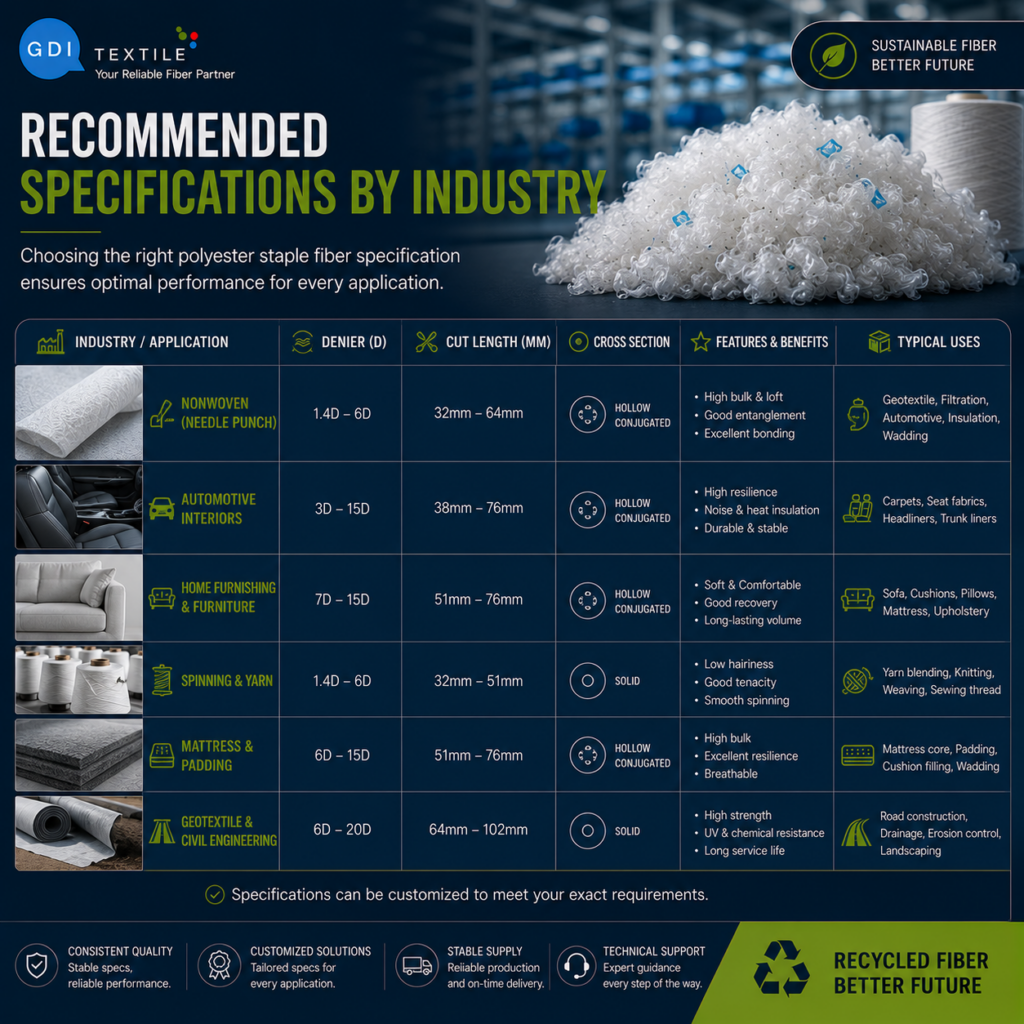
Recommended Specifications by Industry
Yarn Spinning
Typical requirements:
- 1.2D–1.5D
- 38 mm cut length
- Uniform denier
- Good crimp
Cleaning Cloth Manufacturing
Typical requirements:
- Ultra-fine microfiber
- High absorption
- Soft surface
- Stable quality
Nonwoven Production
Common specifications:
- 1.5D–6D
- 38–64 mm
- Good web formation
- Stable bonding performance
Automotive Applications
Preferred characteristics:
- High durability
- Good resilience
- Consistent color
- Stable mechanical performance
Questions Buyers Should Ask Suppliers
Before placing an order, consider asking:
- What denier options are available?
- What cut lengths do you produce?
- Can you provide a Technical Data Sheet (TDS)?
- Is batch-to-batch consistency controlled?
- Can you provide samples for production trials?
- What quality inspection procedures are used?
These questions help reduce procurement risk and improve production consistency.
Selecting the right specification is only part of successful sourcing. Choosing a reliable manufacturing partner is equally important. Read our guide on How to Choose a Reliable Recycled Polyester Staple Fiber Supplier.
Conclusion
Understanding polyester staple fiber specifications is essential for selecting the right material and optimizing manufacturing performance.
Instead of evaluating suppliers based only on price, buyers should carefully review technical specifications such as:
- Denier
- Cut length
- Strength
- Crimp
- Oil finish
- Moisture
- Color consistency
Working with an experienced supplier that provides stable specifications and reliable technical support can improve product quality, reduce waste, and strengthen long-term competitiveness.
If you are looking for a trusted supplier of recycled polyester staple fiber, Eco Micro Fiber is ready to support your business with consistent quality and dependable global supply.
If you are still comparing recycled and virgin materials, you may also find our comparison guide Virgin Polyester vs Recycled Polyester useful before making your sourcing decision.
Contact us today to request technical data sheets, samples, or a customized quotation.
Why Choose Eco Micro Fiber?
At Eco Micro Fiber, we manufacture and supply high-quality recycled polyester staple fiber for global B2B customers.
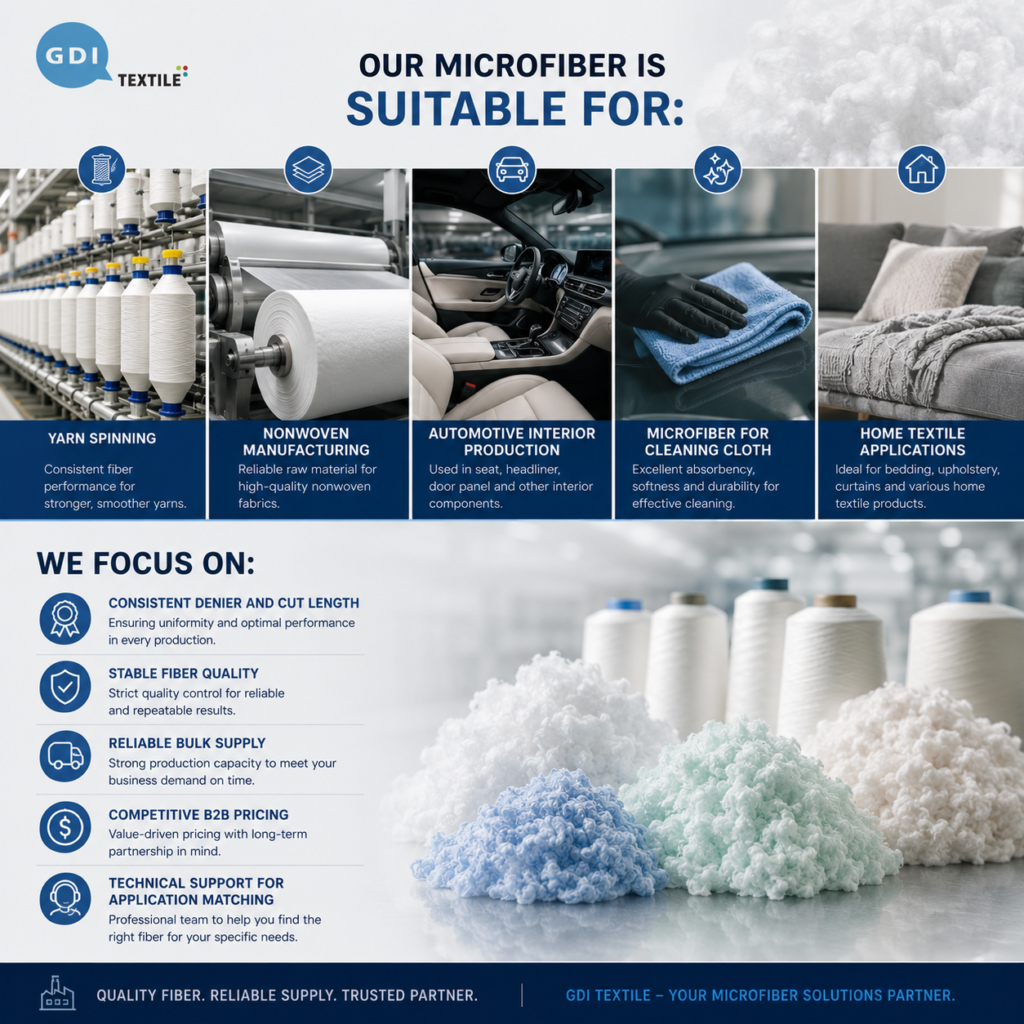
Our products are suitable for:
- Yarn spinning
- Nonwoven production
- Cleaning textiles
- Automotive interiors
- Home textile applications
We focus on:
- Consistent fiber quality
- Stable denier and cut length
- Reliable export service
- Competitive B2B pricing
- Long-term customer partnerships
Our objective is to help customers achieve consistent production quality while reducing operational risk.
If you are looking for a trusted recycled polyester fiber supplier, our team is ready to support your production needs.
Contact Us:
Email: [email protected]
Tel/WhatsApp: +84981527216
Contact us today to request technical specifications or product samples.