A Complete B2B Guide for Textile, Nonwoven, and Industrial Buyers
As global demand for high-performance and sustainable textile materials continues to grow, microfiber staple fiber has become one of the most important raw materials in modern manufacturing.
From yarn spinning and nonwoven production to automotive interiors and cleaning textiles, microfiber staple fiber is widely used because of its softness, durability, absorption performance, and versatility.
However, many buyers, sourcing managers, and even manufacturers still do not fully understand what microfiber staple fiber is, how it differs from conventional polyester fiber, and why it has become such a critical material in today’s textile industry.
This guide explains everything B2B buyers need to know about microfiber staple fiber, including:
- what it is
- how it is produced
- its key characteristics
- common applications
- benefits for manufacturers
- important buying considerations
Whether you are sourcing for spinning, nonwoven, automotive, or cleaning applications, understanding microfiber staple fiber can help you make better purchasing decisions and improve product performance.
What is Microfiber Staple Fiber?
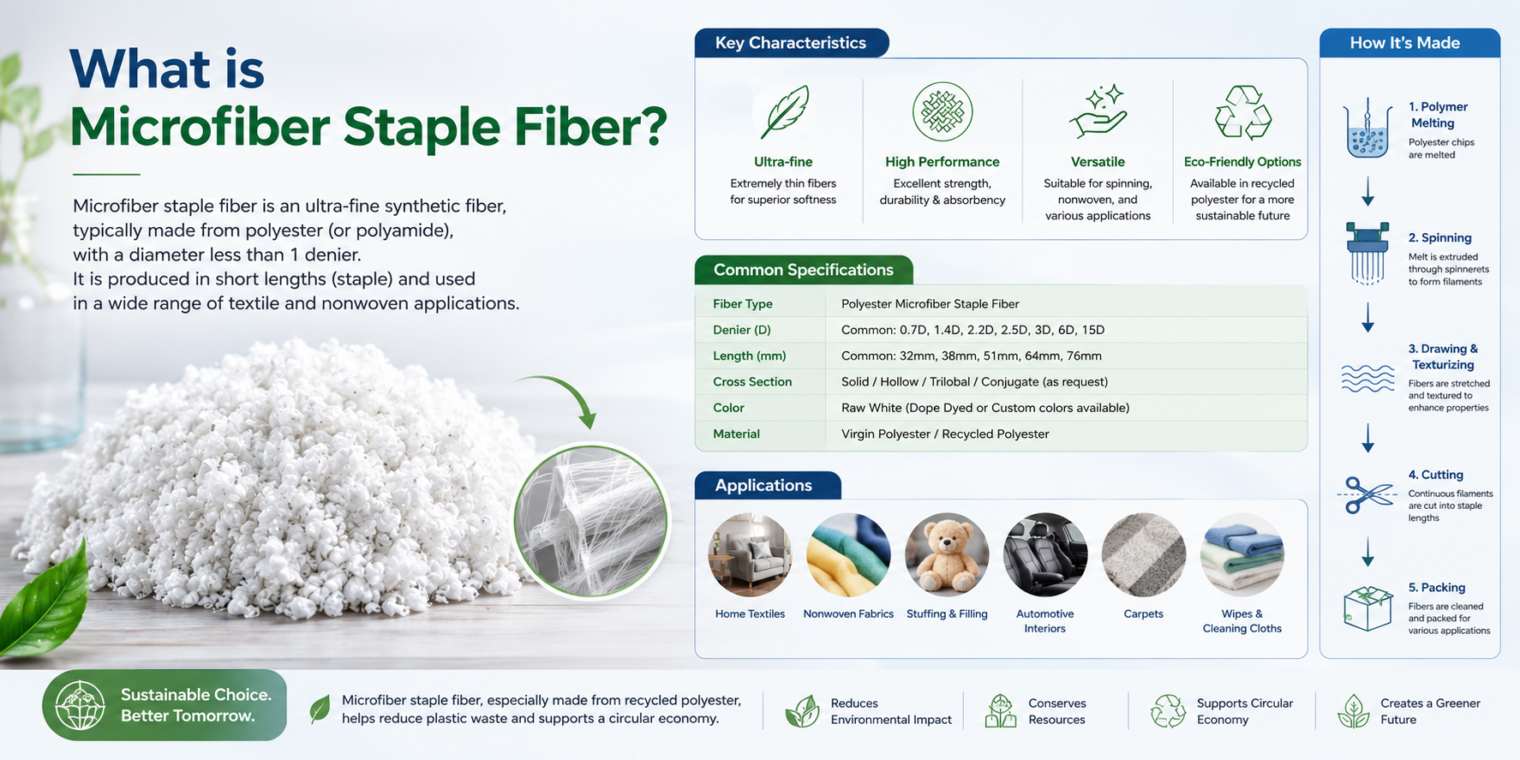
Microfiber staple fiber is a type of extremely fine synthetic staple fiber, usually made from polyester or polyester-based recycled materials.
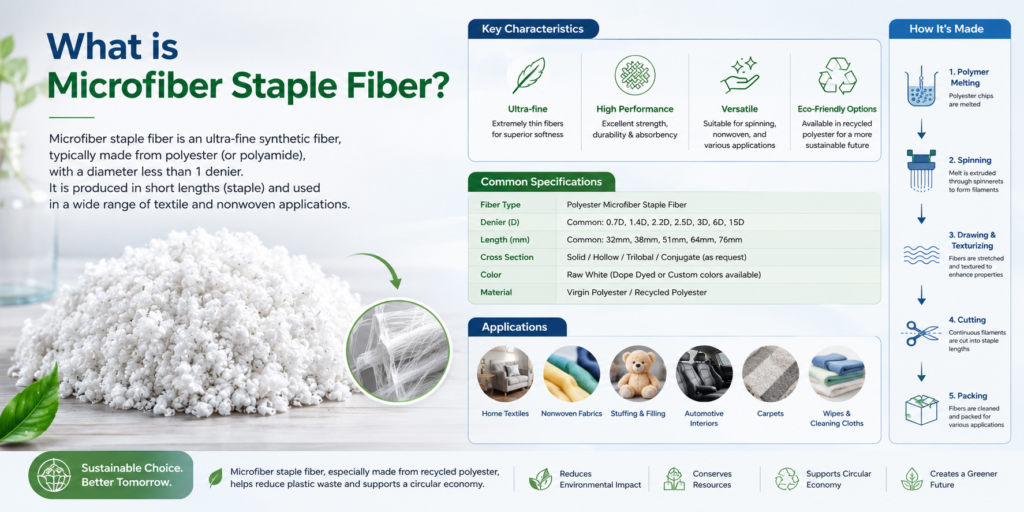
The term “microfiber” refers to the fiber’s very small diameter, typically below 1 denier or around 1.2–1.5 denier depending on the application.
Compared to conventional polyester staple fiber, microfiber has:
- much finer structure
- larger surface area
- softer texture
- better absorption performance
- improved cleaning capability
The term “staple fiber” means the fiber is produced in short cut lengths, rather than continuous filament form.
These short fibers are widely used in:
- yarn spinning
- nonwoven manufacturing
- felt production
- industrial textile applications
Understanding the Difference Between Staple Fiber and Filament Fiber
One common point of confusion among buyers is the difference between staple fiber and filament fiber.
Staple Fiber
- Short-cut fibers
- Processed through spinning systems
- Used to produce yarns and nonwoven materials
Filament Fiber
- Continuous long fibers
- Used directly in weaving or knitting
- Common in apparel and technical fabrics
Microfiber staple fiber is preferred in many industrial applications because it provides:
- better process flexibility
- improved softness
- easier blending with other fibers
- excellent absorption properties
What Makes Microfiber Different from Standard Polyester Fiber?
The biggest difference between microfiber and standard polyester fiber is the fiber fineness.
Standard Polyester Fiber
- thicker fiber diameter
- lower surface area
- more rigid structure
Microfiber Staple Fiber
- ultra-fine fiber diameter
- much larger surface area
- softer and smoother feel
Because microfiber fibers are finer, they create materials with:
- enhanced softness
- higher density
- improved liquid absorption
- better dust and dirt capture
This is why microfiber is widely used in cleaning products and high-performance textiles.
How Microfiber Staple Fiber is Produced
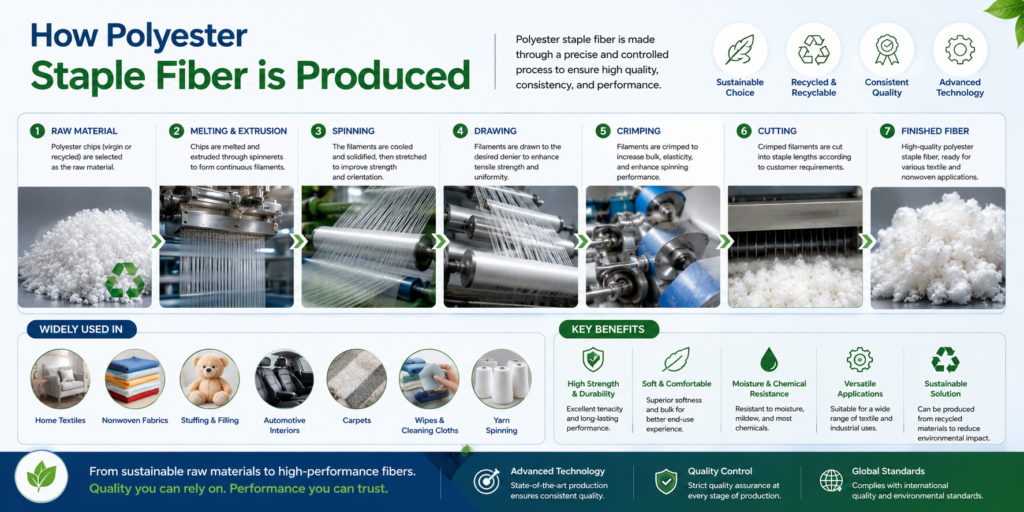
Microfiber staple fiber is typically produced through several stages.
1. Raw Material Preparation
The raw material may come from:
- virgin polyester
- recycled PET bottles
- recycled polyester waste
Today, many manufacturers prefer recycled microfiber because of sustainability requirements.
2. Melt Spinning Process
The polyester material is melted and extruded through extremely fine spinnerets to create very thin fibers.
The diameter control during this stage is critical because microfiber performance depends heavily on fine denier consistency.
3. Drawing and Crimping
The fibers are stretched to improve strength and may be crimped to improve:
- cohesion
- spinning behavior
- web formation in nonwoven production
4. Cutting into Staple Length
The fibers are cut into specific staple lengths depending on the application.
Different industries require different cut lengths for optimal processing performance.
Key Characteristics of Microfiber Staple Fiber
Microfiber staple fiber offers several advantages that make it highly attractive for textile and industrial manufacturing.
1. Superior Softness
Because microfiber fibers are extremely fine, they create fabrics and materials with a much softer feel compared to conventional polyester.
This is important for applications such as:
- towels
- knit fabrics
- automotive interiors
- cleaning cloths
Softness is one of the main reasons buyers choose microfiber.
2. High Absorption Performance
The large surface area created by ultra-fine fibers allows microfiber to absorb liquids much more effectively than standard polyester.
This makes microfiber ideal for:
- microfiber for cleaning cloth
- floor mops
- towels
- industrial wipes
Microfiber products can often absorb multiple times their own weight in water.
3. Excellent Cleaning Efficiency
Microfiber is highly effective at trapping:
- dust
- grease
- dirt
- microscopic particles
Because of this, microfiber has become the dominant material in the global cleaning textile industry.
4. Lightweight Structure
Despite its strong performance, microfiber remains lightweight.
This provides advantages in:
- automotive applications
- home textiles
- nonwoven products
- wearable textiles
Lightweight materials help improve comfort and reduce material usage.
5. Good Durability
High-quality microfiber staple fiber can maintain strong durability even after repeated use and washing.
This is important for industrial and reusable applications.
Major Applications of Microfiber Staple Fiber
Microfiber staple fiber is used across multiple industries due to its versatility.
1. Yarn Spinning
One of the largest applications is yarn production.
Microfiber staple fiber is used to produce:
- microfiber yarn for towels
- blended yarn with cotton or viscose
- fine yarn for knit fabrics
- cleaning textile yarn
The fine structure allows spinning mills to create softer and more absorbent yarns.
2. Nonwoven Manufacturing
Microfiber is widely used in nonwoven production because of its:
- web formation capability
- filtration performance
- absorption properties
Applications include:
- cleaning wipes
- industrial wipes
- filtration materials
- disposable cloths
3. Cleaning Products
The cleaning industry is one of the biggest consumers of microfiber.
Microfiber staple fiber is commonly used for:
- microfiber for cleaning cloth
- floor mop materials
- kitchen towels
- industrial cleaning fabrics
Its ability to trap dust and absorb liquids makes it ideal for cleaning applications.
4. Automotive Interior
Automotive manufacturers increasingly use microfiber in:
- car carpets
- felt materials
- headliners
- acoustic insulation
The fiber provides:
- durability
- lightweight structure
- insulation performance
5. Home Textile Applications
Microfiber staple fiber is also used in:
- bedding materials
- upholstery fabrics
- towels
- household textile products
Its soft texture and performance characteristics make it suitable for consumer textile markets.
Why Recycled Microfiber is Growing Rapidly
Today, many buyers specifically search for recycled microfiber staple fiber instead of virgin polyester microfiber.
This is driven by several factors:
- sustainability requirements
- ESG goals
- recycled material demand
- carbon reduction targets
Recycled microfiber helps manufacturers:
- reduce environmental impact
- support circular economy systems
- meet global buyer expectations
For many international customers, recycled material usage is now part of procurement requirements.
Key Specifications Buyers Should Consider
When purchasing microfiber staple fiber, buyers should evaluate several technical factors.
Important Specifications Include:
- denier
- cut length
- fiber strength
- crimp
- oil content / finish
- color consistency
The correct specification depends on the intended application.
For example:
Microfiber for cleaning cloth
Needs:
- softness
- high absorption
- durability
Microfiber for spinning
Needs:
- stable denier
- proper cut length
- good cohesion
Microfiber for nonwoven
Needs:
- strong web formation
- process stability
Common Challenges Buyers Face
While microfiber offers many benefits, buyers may still face challenges such as:
- inconsistent quality between shipments
- unstable denier
- poor process performance
- unreliable supply capacity
This is why supplier selection is extremely important in B2B sourcing.
Choosing the Right Microfiber Staple Fiber Supplier
A reliable supplier should provide:
- consistent specifications
- stable production quality
- technical support
- reliable delivery capacity
- clear communication
In large-scale manufacturing, consistency matters more than low pricing alone.
Conclusion
Microfiber Staple Fiber has become one of the most important materials in modern textile manufacturing.
Its:
- softness
- absorption capability
- cleaning performance
- versatility
- sustainability advantages
make it suitable for a wide range of industrial applications.
For B2B buyers, understanding microfiber staple fiber is essential for selecting the right material and staying competitive in evolving global markets.
As demand for sustainable and high-performance textiles continues to grow, microfiber staple fiber will remain a key material for future manufacturing.
If you are looking for a reliable supplier of microfiber staple fiber, Eco Micro Fiber is ready to support your business.
Contact us today to request technical specifications, samples, or quotations.
Eco Micro Fiber – Supporting Your Transition to Sustainable Materials
At Eco Micro Fiber, we supply high-quality recycled microfiber staple fiber designed for industrial textile applications.
Our microfiber is suitable for:
- yarn spinning
- nonwoven manufacturing
- automotive interior production
- microfiber for cleaning cloth
- home textile applications
We focus on:
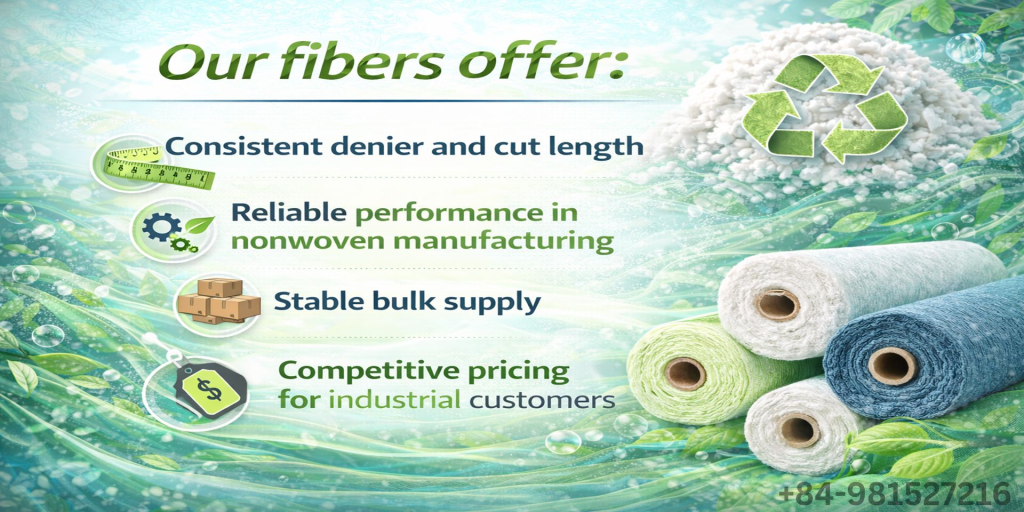
- consistent denier and cut length
- stable fiber quality
- reliable bulk supply
- competitive B2B pricing
- technical support for application matching
We understand that switching materials is a strategic decision, and we are here to support your business at every stage.
If you are looking for a trusted recycled micro fiber supplier, our team is ready to support your production needs.
Contact Us:
Email: [email protected]
Tel/WhatsApp: +84981527216
Contact us today to request technical specifications or product samples.