Everything You Need to Know About Recycled Polyester Staple Fiber, Manufacturing, Applications, Specifications, Sustainability, and Global Sourcing
What Is Recycled Polyester Staple Fiber?
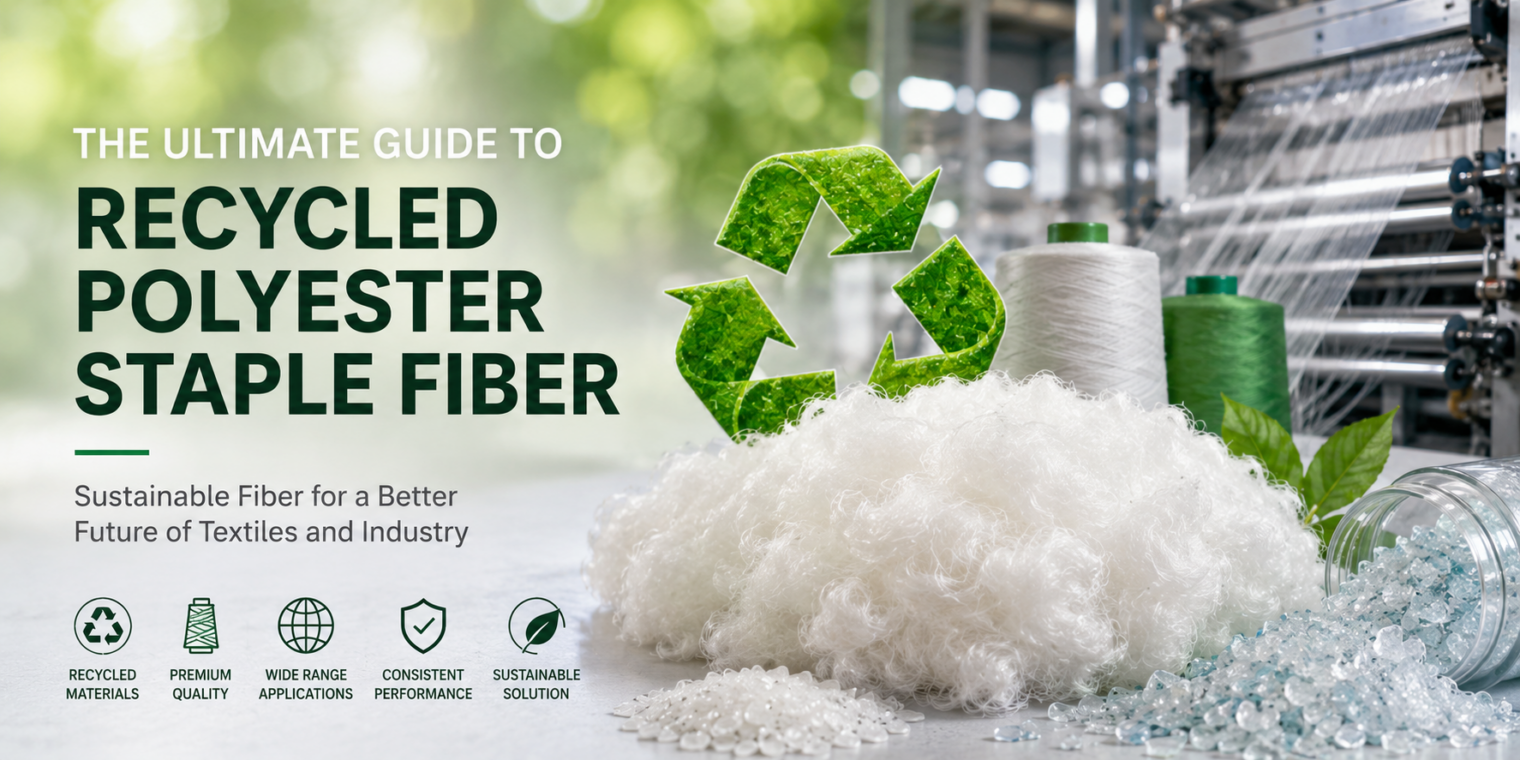
The textile industry is undergoing a major transformation as manufacturers around the world seek more sustainable, efficient, and cost-effective materials. Among the innovations driving this change, Recycled Polyester Staple Fiber (RPSF) has become one of the most important raw materials for modern textile production.
Produced from recycled polyethylene terephthalate (PET) materials—primarily post-consumer plastic bottles and post-industrial polyester waste—RPSF offers manufacturers an opportunity to reduce environmental impact without compromising product quality or production efficiency.
Today, recycled polyester staple fiber is widely used across numerous industries, including:
- Yarn spinning
- Nonwoven manufacturing
- Automotive interiors
- Home textiles
- Mattress and furniture filling
- Geotextiles
- Cleaning products
- Industrial filtration
- Acoustic insulation
As global brands continue increasing their sustainability commitments, demand for recycled polyester fiber is growing rapidly across Europe, North America, Japan, South Korea, and many emerging markets.
For textile manufacturers, switching to recycled polyester is no longer simply an environmental decision—it has become a strategic business advantage.
Why This Guide Matters
If you search online for information about recycled polyester staple fiber, you’ll often find fragmented articles focusing on only one topic, such as:
- Manufacturing processes
- Product specifications
- Environmental benefits
- Applications
- Supplier selection
While each topic is valuable, buyers and manufacturers frequently need a complete understanding before making sourcing decisions.
This guide brings together all the essential knowledge about recycled polyester staple fiber in one comprehensive resource.
Whether you are:
- A procurement manager evaluating new suppliers
- A textile engineer selecting fiber specifications
- A spinning mill looking for consistent raw materials
- A nonwoven manufacturer developing new products
- An importer sourcing recycled fiber internationally
this guide will help you better understand the material, its performance, and its commercial value.
What You Will Learn
This guide covers every major aspect of recycled polyester staple fiber, including:
- What recycled polyester staple fiber is
- How recycled polyester fiber is manufactured
- The differences between virgin and recycled polyester
- Fiber specifications such as denier, cut length, crimp, and tensile strength
- Major industrial applications
- Sustainability advantages
- Quality inspection methods
- International certifications
- How to select a reliable supplier
- Frequently asked questions from global buyers
Each section is designed to provide practical insights that manufacturers and sourcing professionals can apply in real-world purchasing decisions.
Why Recycled Polyester Staple Fiber Is Becoming the Industry Standard
For decades, virgin polyester dominated the global textile market because of its durability, versatility, and competitive cost.
However, today’s market is changing rapidly due to several factors:
Growing Sustainability Requirements
International brands are increasingly committed to reducing their environmental footprint by incorporating recycled materials into their supply chains.
Many apparel companies, automotive manufacturers, and home textile brands now require recycled content as part of their sourcing policies.
Circular Economy Initiatives
Governments and industries worldwide are promoting circular economy models that encourage recycling and responsible resource management.
Instead of sending plastic bottles to landfills, recycled PET can be transformed into high-quality textile fibers that remain in productive use for many years.
Technological Improvements
Modern recycling technology has significantly improved fiber quality.
Today’s recycled polyester staple fiber offers:
- Excellent tensile strength
- Stable denier
- Consistent cut length
- Reliable processability
- Long product life
These improvements allow recycled polyester staple fiber to meet the demanding requirements of industrial manufacturing.
Market Competitiveness
Using recycled polyester not only supports sustainability goals but also helps manufacturers strengthen their market position.
Products made with recycled materials often attract environmentally conscious buyers and comply more easily with customer sustainability programs.
As environmental regulations continue to evolve, manufacturers adopting recycled materials early will be better prepared for future market expectations.
The Growing Global Demand for Recycled Polyester Staple Fiber
The global demand for recycled polyester staple fiber has increased steadily over the past decade.
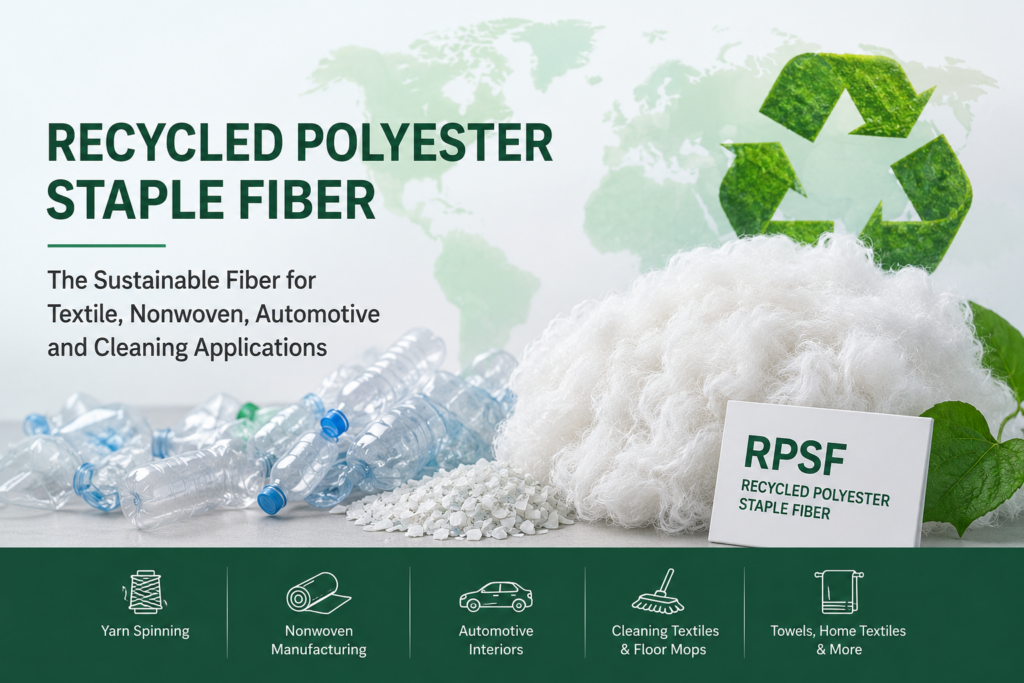
Several industries are driving this growth:
Textile and Apparel
Brands are incorporating recycled polyester into clothing, sportswear, uniforms, and fashion accessories.
Home Textiles
Manufacturers increasingly use recycled polyester for:
- Bedding
- Upholstery
- Curtains
- Decorative fabrics
Nonwoven Industry
Recycled polyester has become a preferred material for:
- Needle-punched fabrics
- Industrial wipes
- Filtration media
- Geotextiles
Automotive Manufacturing
Vehicle manufacturers are expanding the use of recycled materials in:
- Carpets
- Headliners
- Acoustic insulation
- Interior trim components
Cleaning Products
One of the fastest-growing applications is microfiber cleaning products, where recycled microfiber provides:
- High water absorption
- Effective dust removal
- Long-lasting durability
- Reduced environmental impact
This broad range of applications continues to expand the global market for recycled polyester staple fiber.
Who Should Read This Guide?
This guide has been written specifically for B2B professionals, including:
- Textile manufacturers
- Yarn spinning mills
- Nonwoven producers
- Automotive component manufacturers
- Home textile suppliers
- Cleaning product manufacturers
- Procurement managers
- Importers and distributors
- Product development engineers
- Sustainability teams
Whether you are new to recycled polyester or already sourcing recycled fiber, this guide provides practical information to support better technical and commercial decisions.
How to Use This Guide
You do not need to read this guide from beginning to end.
Each section can be used independently depending on your interests.
For example:
- If you want to understand production technology, continue to Part 2: Manufacturing Process.
- If you are comparing technical parameters, jump to Part 4: Polyester Staple Fiber Specifications.
- If you are evaluating suppliers, read Part 8: Buying Guide.
- If sustainability is your priority, explore Part 6: Sustainability.
Together, these sections create a comprehensive knowledge base for anyone involved in sourcing, manufacturing, or developing products with recycled polyester staple fiber.
How Recycled Polyester Staple Fiber Is Manufactured
Recycled Polyester Staple Fiber (RPSF) begins its journey as discarded plastic rather than virgin petroleum. Through a carefully controlled manufacturing process, used PET bottles and polyester waste are transformed into high-quality fibers suitable for textile, nonwoven, automotive, and industrial applications.
Modern recycling technology has made it possible to produce recycled polyester fibers with excellent consistency, durability, and performance. When managed correctly, the manufacturing process ensures that recycled fibers can meet the demanding quality requirements of global manufacturers.
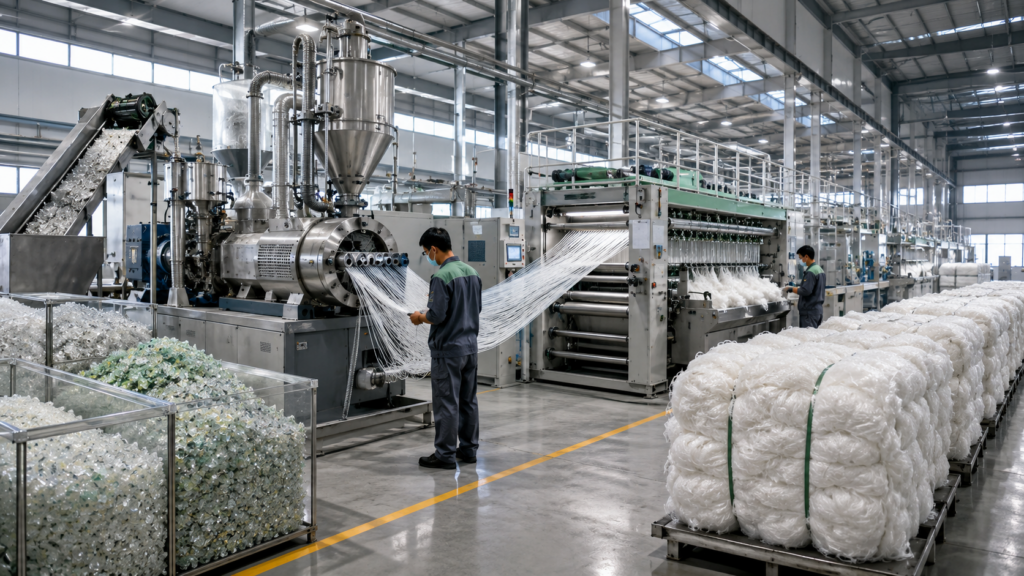
This section explains each stage of the production process, from collecting waste materials to producing finished polyester staple fiber.
Step 1 – Collection of PET Bottles and Polyester Waste
The manufacturing process starts with sourcing recyclable raw materials.
The most common sources include:
- Post-consumer PET beverage bottles
- Food-grade PET containers
- Post-industrial polyester waste
- Textile production scraps
- Polyester yarn waste
Among these, clear PET bottles are the preferred raw material because they produce cleaner and brighter white fibers after recycling.
Maintaining a stable supply of high-quality recycled raw materials is essential for producing consistent polyester staple fiber.
Step 2 – Sorting and Separation
After collection, the materials are transported to recycling facilities for sorting.
During this stage, recyclable materials are separated according to:
- Color
- Polymer type
- Contamination level
- Bottle quality
Labels, bottle caps, aluminum rings, adhesives, and foreign materials are removed before further processing.
Accurate sorting improves both fiber quality and production efficiency.
For manufacturers producing white recycled polyester fiber, strict color separation is especially important to achieve uniform brightness.
Step 3 – Washing and Cleaning
Clean raw material is one of the most important factors affecting recycled fiber quality.
PET bottles are thoroughly washed using industrial cleaning systems to remove:
- Dust
- Dirt
- Oils
- Food residue
- Labels
- Adhesives
- Organic contaminants
Multiple washing stages are often used, including:
- Pre-washing
- Hot washing
- Chemical washing
- Fresh water rinsing
Proper cleaning reduces impurities and helps improve the strength and appearance of the final fiber.
Step 4 – Crushing into PET Flakes
Once cleaned, the bottles are mechanically shredded into small PET flakes.
These flakes typically measure between 8 and 15 millimeters.
Uniform flake size improves:
- Drying efficiency
- Melting consistency
- Extrusion stability
At this stage, advanced recycling systems may also remove remaining metal particles or fine contaminants using magnetic separators and optical sorting equipment.
The cleaner the PET flakes, the higher the quality of the recycled polyester fiber.
Step 5 – Drying the PET Flakes
PET is highly sensitive to moisture during melting.
Before extrusion, the flakes are dried using industrial drying equipment to reduce moisture content to very low levels.
Proper drying helps prevent:
- Polymer degradation
- Reduced fiber strength
- Inconsistent viscosity
- Surface defects
Controlling moisture is a critical quality control step in polyester fiber manufacturing.
Step 6 – Melting and Extrusion
The dried PET flakes are transferred into an extrusion system where they are heated to temperatures of approximately 260–280°C until they become molten polymer.
The molten polyester is then filtered to remove microscopic impurities before passing through a spinneret, a precision metal plate containing hundreds or thousands of tiny holes.
As the molten polymer exits the spinneret, it forms continuous polyester filaments.
The diameter of each filament is carefully controlled according to the desired denier.
This stage has a direct influence on:
- Fiber uniformity
- Surface quality
- Tensile strength
- Final product consistency
Step 7 – Cooling and Solidification
Immediately after extrusion, the newly formed filaments are cooled using controlled air flow.
Rapid and uniform cooling allows the polymer to solidify while maintaining a stable molecular structure.
Proper cooling contributes to:
- Better dimensional stability
- Improved mechanical properties
- Uniform fiber appearance
Any inconsistency during this stage may result in uneven denier or reduced strength.
Step 8 – Drawing (Fiber Stretching)
The cooled filaments are stretched several times their original length.
This process, known as drawing, aligns the polymer molecules inside the fiber.
Drawing significantly improves:
- Tensile strength
- Elasticity
- Dimensional stability
- Processability during spinning
The drawing ratio is carefully controlled depending on the intended application of the fiber.
For example, microfiber designed for fine yarns may require different drawing conditions than fibers intended for automotive felt.
Step 9 – Crimping
After drawing, the filaments are passed through a crimping machine that creates a three-dimensional wave pattern.
Crimping improves:
- Fiber cohesion
- Bulkiness
- Spinning performance
- Carding efficiency
- Web formation in nonwoven production
Without sufficient crimp, staple fibers become more difficult to process during downstream manufacturing.
The crimp level is adjusted according to customer requirements and end-use applications.
Step 10 – Heat Setting
Following crimping, fibers undergo heat setting to stabilize their physical structure.
Heat setting helps the fibers retain:
- Crimp shape
- Mechanical stability
- Dimensional consistency
This process also minimizes shrinkage during subsequent textile processing.
Step 11 – Cutting into Staple Fiber
The continuous filaments are then cut into specific staple lengths.
Common cut lengths include:
| Cut Length | Typical Applications |
|---|---|
| 32 mm | Open-end spinning |
| 38 mm | Ring spinning |
| 51 mm | Blended yarns |
| 64 mm | Nonwoven & automotive |
| 76 mm | Filling & insulation |
Selecting the correct cut length depends on the customer’s manufacturing process and product requirements.
Step 12 – Quality Inspection
Before packaging, every production batch should undergo comprehensive quality inspection.
Typical quality checks include:
- Denier measurement
- Cut length consistency
- Tensile strength
- Elongation
- Crimp level
- Moisture content
- Color consistency
- Oil finish
- Impurity level
Strict fibers quality control helps ensure stable production performance for customers.
Step 13 – Packaging and Storage
Finished fibers are compressed into export bales using hydraulic baling equipment.
Standard packaging generally includes:
- PP woven bale wrapping
- Moisture protection
- Product labels
- Batch identification
- Traceability information
The bales are then stored in clean, dry warehouses before being loaded into shipping containers.
Proper packaging protects fiber quality during long-distance international transportation.
Quality Control Throughout the Manufacturing Process
High-quality recycled polyester staple fiber depends not only on advanced machinery but also on rigorous quality management.
Professional manufacturers monitor every stage of production, including:
- Raw material inspection
- PET flake cleanliness
- Melt filtration
- Denier control
- Fiber drawing ratio
- Crimp consistency
- Final laboratory testing
This continuous monitoring helps ensure consistent quality from one shipment to the next.
How Modern Manufacturing Supports Sustainability
One of the greatest advantages of recycled polyester manufacturing is its contribution to a circular economy.
By converting discarded PET bottles into valuable textile fibers, manufacturers help:
- Reduce plastic waste
- Lower dependence on virgin petroleum
- Decrease landfill volume
- Support responsible resource management
Many facilities also invest in:
- Water recycling systems
- Energy-efficient equipment
- Waste reduction programs
- Environmental management systems
These improvements make recycled polyester staple fiber an increasingly sustainable choice for textile manufacturers worldwide.
Why Manufacturing Quality Matters for Buyers
Understanding the manufacturing process helps buyers evaluate suppliers more effectively.
When discussing projects with a potential supplier, buyers should ask about:
- Raw material sourcing
- Washing technology
- Extrusion equipment
- Quality inspection procedures
- Production capacity
- Batch consistency
A transparent manufacturing process is often a strong indicator of a supplier’s commitment to quality and long-term reliability.
Transition to the Next Section
Now that you understand how recycled polyester staple fiber is produced, the next step is to explore the different types of polyester staple fiber available on the market.
In Part 3 – Types of Polyester Staple Fiber, we will compare:
- Virgin Polyester Staple Fiber
- Recycled Polyester Staple Fiber
- Solid Fiber
- Hollow Fiber
- Conjugated Fiber
- Siliconized Fiber
- Non-Siliconized Fiber
- Microfiber
Understanding these differences will help you select the right fibers material for your specific manufacturing application.
Types of Polyester Staple Fiber
Understanding the Different Types of Polyester Staple Fiber
Polyester staple fiber is not a single standardized material. Manufacturers can produce different fiber types by changing the raw material, cross-section, fiber structure, surface treatment, denier, cut length, and manufacturing process.
For B2B buyers, understanding these differences is essential. The right polyester staple fiber can improve production efficiency, product performance, and overall cost control. Choosing the wrong fiber, however, may result in poor web formation, unstable spinning, excessive waste, or inconsistent final products.
The main categories include:
- Virgin polyester staple fiber
- Recycled polyester staple fiber
- Solid polyester fiber
- Hollow polyester fiber
- Conjugated fiber
- Siliconized fiber
- Non-siliconized fiber
- Polyester microfiber
Each type has different characteristics and is designed for specific applications.
1. Virgin Polyester Staple Fiber
Virgin polyester staple fiber is produced from newly manufactured polyester polymer rather than recycled materials.
Because the polymer has not previously been used in another product, virgin polyester provides highly controlled raw material properties.
Typical advantages include:
- Consistent fiber quality
- Stable mechanical performance
- Good tensile strength
- Reliable processing
- Wide specification availability
Virgin polyester staple fiber is commonly used in:
- Yarn spinning
- Nonwoven production
- Automotive textiles
- Home textiles
- Filling materials
- Industrial fabrics
However, virgin polyester depends on fossil-based raw materials and does not directly contribute to recycling post-consumer PET waste.
As sustainability requirements become increasingly important, many manufacturers are evaluating recycled polyester as an alternative.
For a detailed comparison, see Virgin Polyester vs Recycled Polyester: Which is Better for Your Business?
2. Recycled Polyester Staple Fiber
Recycled polyester staple fiber, commonly known as RPSF, is produced from recycled PET materials.
Typical raw materials include:
- Used PET bottles
- Post-industrial polyester waste
- Polyester production scraps
- Recycled PET flakes
The recycling process converts these materials into new polyester fiber suitable for a wide range of industrial applications.
High-quality recycled polyester staple fiber can provide:
- Good tensile strength
- Stable denier
- Consistent cut length
- Good durability
- Reliable processability
Its most important advantage is that it supports a more circular approach to polyester production.
RPSF is widely used in:
- Yarn spinning
- Nonwoven fabrics
- Automotive interiors
- Cleaning textiles
- Mattress filling
- Furniture padding
- Geotextiles
- Insulation materials
For international buyers, certification and traceability can also be important. Depending on the target market and customer requirements, buyers may request recycled content certification such as the Global Recycled Standard (GRS).
Learn more in GRS Certified Recycled Polyester Fiber: Why It Matters for Global Textile Buyers.
3. Solid Polyester Staple Fiber
Solid fiber has a dense polymer structure throughout its cross-section.
Compared with hollow fiber, solid polyester staple fiber generally provides:
- Good strength
- Stable structure
- Reliable durability
- Consistent processing
Solid fiber is widely used where mechanical performance and structural stability are important.
Typical applications include:
Yarn Spinning
Solid polyester can be processed into different yarn types depending on denier and cut length.
Nonwoven Manufacturing
It can be used for:
- Needle-punched nonwoven
- Industrial fabrics
- Automotive felt
- Geotextiles
Automotive Applications
Solid fiber can provide the durability required for:
- Automotive carpets
- Interior felt
- Acoustic materials
- Trunk liners
Cleaning Textiles
Fine solid polyester fibers can also be used in microfiber products where softness and surface area are important.
4. Hollow Polyester Staple Fiber
Hollow polyester staple fiber contains an internal void or hollow structure.
This design changes the physical characteristics of the fiber and can provide:
- Higher bulk
- Better loft
- Lightweight structure
- Good resilience
- Improved insulation properties
Hollow fiber is particularly useful when manufacturers need volume without significantly increasing material weight.
Common applications include:
- Pillows
- Cushions
- Quilts
- Mattress filling
- Furniture padding
- Insulation
- Soft toys
Hollow fiber is generally more appropriate for filling and insulation applications than for very fine spinning applications.
5. Conjugated Polyester Staple Fiber
Conjugated fiber is manufactured using two or more polymer components within the same fiber.
One common design is bicomponent fiber, where different polymers are arranged in specific cross-sectional structures.
The purpose is to create special thermal, mechanical, or bonding characteristics.
Conjugated polyester fiber is commonly used in:
- Thermal bonding nonwoven
- Automotive components
- Mattress materials
- Furniture padding
- Insulation
- High-performance technical textiles
Its ability to activate under controlled heating makes it particularly useful in applications where manufacturers want fibers to bond without using traditional chemical adhesives.
For buyers, the exact polymer combination and melting characteristics should be confirmed with the supplier before production.
6. Siliconized Polyester Staple Fiber
Siliconized polyester staple fiber is treated with a silicone-based finish to modify its surface characteristics.
The treatment can provide:
- Softer hand feel
- Better smoothness
- Improved fiber separation
- Higher resilience
- Better loft
This type of fiber is especially popular in filling applications.
Common uses include:
- Pillows
- Cushions
- Quilts
- Bedding
- Furniture
- Soft toys
For example, a furniture manufacturer producing premium cushions may prefer siliconized hollow polyester fiber because it combines bulk, softness, and resilience.
7. Non-Siliconized Polyester Staple Fiber
Non-siliconized polyester staple fiber does not receive a silicone treatment designed to increase surface slipperiness.
Depending on the production process, this can provide different friction and bonding characteristics.
Non-siliconized fiber is commonly considered for:
- Yarn spinning
- Nonwoven production
- Automotive felt
- Industrial textiles
- Certain cleaning textile applications
The correct finish depends heavily on the downstream manufacturing process.
A fiber that is ideal for pillow filling may not be the best choice for a spinning mill.
Therefore, buyers should always specify the final application when requesting a quotation.
8. Polyester Microfiber
Polyester microfiber is a very fine polyester fiber with a much lower denier than conventional staple fiber.
The extremely fine fiber diameter creates a high surface-area-to-weight ratio.
This gives microfiber several important characteristics:
- Soft hand feel
- Excellent surface coverage
- High absorption potential
- Effective dust and dirt capture
- Fine fabric structure
Microfiber is particularly important in cleaning textiles.
Typical applications include:
- Microfiber cleaning cloths
- Floor mops
- Kitchen towels
- Industrial wipes
- Car cleaning cloths
- Polishing textiles
It is also used in:
- Towels
- Fine yarns
- Knit fabrics
- Home textiles
- Automotive interiors
When microfiber is produced from recycled polyester, it combines the functional advantages of fine fiber with the sustainability benefits of recycled raw materials.
For manufacturers targeting the cleaning textile market, see Why Microfiber is Perfect for Cleaning Products.
Recycled Microfiber vs Conventional Recycled Polyester Staple Fiber
Not all recycled polyester fibers are microfiber.
This distinction is important for buyers.
Recycled polyester staple fiber is a broad category that can cover many different deniers and applications.
Recycled microfiber refers specifically to much finer fibers.
For example:
| Characteristic | Standard RPSF | Recycled Microfiber |
|---|---|---|
| Fiber fineness | Medium to coarse | Very fine |
| Softness | Good | Excellent |
| Surface area | Moderate | High |
| Absorption potential | Application-dependent | High |
| Cleaning performance | Limited | Excellent |
| Typical applications | Filling, nonwoven, yarn | Cleaning cloth, towels, fine textiles |
The correct choice depends on the final product rather than simply choosing the finest fiber available.
How to Choose the Right Polyester Staple Fiber
B2B buyers should evaluate several factors before placing an order.
Application
Start with the final application.
Are you producing:
- Yarn?
- Nonwoven?
- Automotive carpet?
- Cleaning cloth?
- Mattress filling?
- Sofa padding?
- Geotextile?
The answer will determine the appropriate fiber structure.
Denier
Denier controls fiber fineness.
Fine denier is generally preferred for:
- Soft textiles
- Cleaning cloths
- Towels
- Fine yarn
Higher denier may be better for:
- Filling
- Automotive applications
- Structural nonwoven
- Cushioning
For a more detailed explanation, read Polyester Staple Fiber Specifications Explained.
Cut Length
Cut length affects downstream processing.
For spinning, shorter or medium staple lengths may be appropriate depending on the spinning system.
For nonwoven and filling applications, longer fibers may provide different web or bulk characteristics.
Always match cut length with your production equipment.
Fiber Cross-Section
Buyers may also need to consider whether they require:
- Solid fiber
- Hollow fiber
- Conjugated fiber
The cross-section can significantly affect:
- Bulk
- Resilience
- Insulation
- Bonding
- Mechanical properties
Surface Finish
The fiber finish can influence:
- Friction
- Softness
- Static behavior
- Carding
- Bonding
- Processing efficiency
This is why buyers should communicate their intended application clearly when requesting samples.
Choosing Fiber According to Application
A simplified guide is shown below:
| Application | Common Fiber Type |
| Yarn spinning | Solid staple fiber / microfiber |
| Microfiber cleaning cloth | Fine polyester microfiber |
| Towels | Fine microfiber |
| Nonwoven | Solid / conjugated staple fiber |
| Automotive carpet | Solid recycled staple fiber |
| Automotive felt | Solid or specialty fiber |
| Mattress filling | Hollow / siliconized fiber |
| Sofa & cushion filling | Hollow / siliconized fiber |
| Insulation | Hollow / conjugated fiber |
| Geotextile | Suitable solid staple fiber |
These are general guidelines. The optimal specification should always be confirmed through sampling and production trials.
Why Fiber Selection Matters for B2B Buyers
Selecting the correct polyester staple fiber is not simply a technical decision.
It affects the entire production chain.
The wrong fiber can lead to:
- Higher material waste
- Machine downtime
- Poor product consistency
- Higher energy consumption
- Additional processing
- Customer complaints
The right fiber can help manufacturers achieve:
- Stable production
- Better final-product performance
- Lower waste
- More predictable manufacturing costs
- Better customer satisfaction
For this reason, fiber selection should be treated as an important part of product development and procurement.
What Should Buyers Request From Suppliers?
Before ordering recycled polyester staple fiber, buyers should ask suppliers for a detailed Technical Data Sheet (TDS).
Important information may include:
- Fiber type
- Raw material
- Denier
- Cut length
- Tensile strength
- Elongation
- Crimp
- Moisture
- Oil finish
- Color
- Cross-section
- Siliconized or non-siliconized status
- Packaging
- Minimum order quantity
Buyers should also request samples before placing a full container order.
A sample should ideally be tested under actual production conditions.
Recycled Polyester Staple Fiber for Different Industries
The growing versatility of recycled polyester means that manufacturers can use different fiber structures to serve a wide range of industries.
Spinning Mills
Need stable fiber specifications and suitable staple length for yarn production.
Nonwoven Manufacturers
Need fibers that provide good web formation, bonding, and structural stability.
Cleaning Textile Manufacturers
Need fine fibers with excellent softness and liquid-handling characteristics.
Automotive Suppliers
Need durable fibers suitable for carpets, felt, acoustic insulation, and interior components.
Furniture and Mattress Manufacturers
Often require high-bulk, resilient filling fibers.
This diversity is one reason recycled polyester staple fiber has become such an important industrial material.
Conclusion
Understanding the different types of polyester staple fiber is essential for making the right purchasing decision.
The major categories include:
- Virgin polyester staple fiber
- Recycled polyester staple fiber
- Solid fiber
- Hollow fiber
- Conjugated fiber
- Siliconized fiber
- Non-siliconized fiber
- Polyester microfiber
Each type offers different characteristics and is suited to different applications.
For manufacturers seeking sustainable raw materials, recycled polyester staple fiber provides a practical way to combine performance, versatility, and recycled content.
However, there is no single fiber specification that is best for every application.
The right solution depends on:
- End use
- Denier
- Cut length
- Fiber structure
- Surface finish
- Processing equipment
- Required product performance
The next step is to understand these technical specifications in greater detail.
Continue to Part 4 – Polyester Staple Fiber Specifications, where we examine denier, cut length, tensile strength, elongation, crimp, moisture, finish, color, and other parameters that B2B buyers should evaluate before purchasing.
Part 4 – Polyester Staple Fiber Specifications
Understanding Recycled Polyester Staple Fiber Specifications
When purchasing recycled polyester staple fiber, price is only one part of the decision.
For manufacturers, the technical specifications of the fiber can directly influence production efficiency, machine performance, material consumption, and the quality of the finished product.
A spinning mill may need a fine fiber with stable denier and suitable cut length. A nonwoven manufacturer may prioritize crimp, fiber cohesion, and bonding performance. An automotive supplier may require a combination of strength, resilience, bulk, and consistent color.
This is why buyers should evaluate recycled polyester staple fiber specifications before comparing suppliers based only on price.
The most important specifications include:
- Denier
- Cut length
- Tensile strength
- Elongation
- Crimp
- Moisture content
- Oil finish
- Color
- Impurity level
- Fiber structure
- Shrinkage
- Fiber consistency
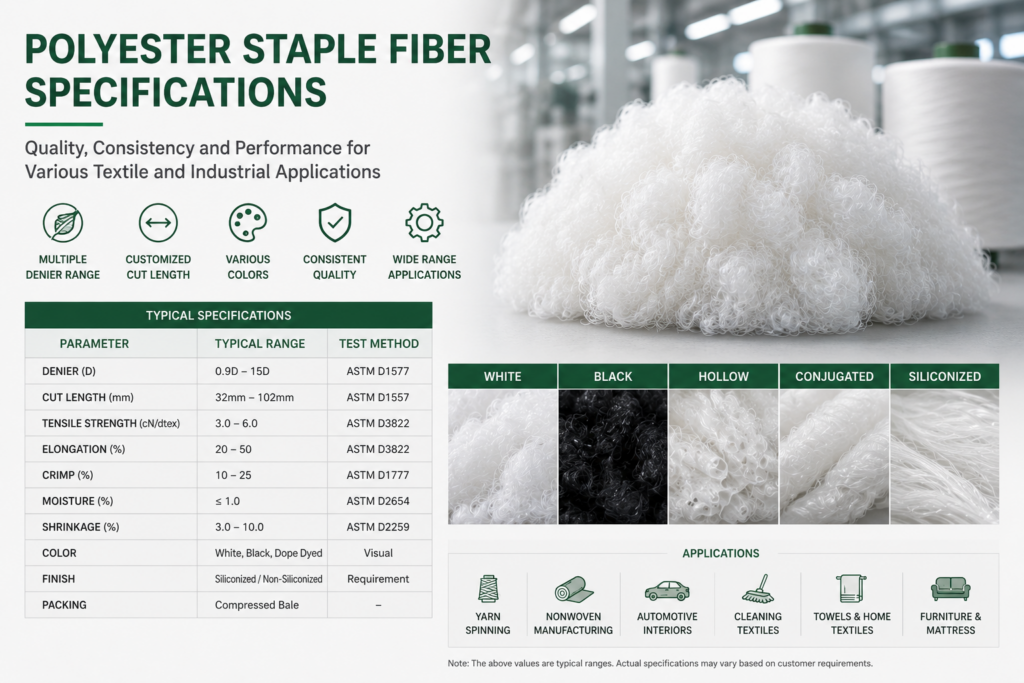
Understanding these parameters helps buyers choose the right material for their production process.
1. Denier
Denier is one of the most important specifications when purchasing polyester staple fiber.
It describes the fineness or linear density of the fiber.
In simple terms, a lower denier means a finer fiber, while a higher denier means a thicker fiber.
For example:
- 1.0D = fine fiber
- 1.4D = fine fiber
- 3D = medium fiber
- 6D = relatively coarse fiber
- 15D = coarse fiber
The exact performance depends on the fiber structure and manufacturing process, but denier is an important starting point when selecting material.
Why Denier Matters
Fiber fineness affects several properties, including:
- Softness
- Surface area
- Coverage
- Bulk
- Fabric hand feel
- Processing characteristics
Fine fibers generally provide greater surface area per unit weight.
This is particularly useful for microfiber applications.
For example, a fine recycled polyester microfiber can be used to manufacture:
- Cleaning cloths
- Towels
- Mops
- Fine yarn
- Soft textile fabrics
Higher-denier fibers may be preferred for:
- Automotive materials
- Filling
- Cushioning
- Structural nonwoven
- Insulation
Therefore, buyers should never select denier independently from the final application.
2. Cut Length
Cut length refers to the length of each individual staple fiber.
Common polyester staple fiber cut lengths include:
- 32 mm
- 38 mm
- 51 mm
- 64 mm
- 76 mm
The ideal length depends on the manufacturing process.
Cut Length for Yarn Spinning
Spinning mills need fiber lengths that are compatible with their spinning system and equipment.
For many applications, approximately 32–38 mm staple lengths are commonly considered for certain spinning processes.
The correct length can help improve:
- Fiber cohesion
- Yarn formation
- Spinning stability
- Yarn strength
- Production efficiency
However, the optimum specification depends on the spinning technology and yarn construction.
Cut Length for Nonwoven Manufacturing
Nonwoven manufacturers may use different staple lengths depending on:
- Carding equipment
- Web formation
- Needle punching
- Thermal bonding
- Final product requirements
Longer fibers can provide different web characteristics and may improve fiber entanglement in certain applications.
3. Tensile Strength
Tensile strength measures how much force a fiber can withstand before breaking.
It is particularly important for applications where the fiber must survive mechanical processing.
Good tensile strength can contribute to:
- Reduced fiber breakage
- Better spinning performance
- Improved nonwoven strength
- Higher product durability
For B2B buyers, tensile strength should be evaluated together with elongation rather than considered independently.
4. Elongation
Elongation describes how much a fiber can stretch before breaking.
A fiber with suitable elongation can better withstand mechanical stress during processing.
In yarn spinning, balanced tensile strength and elongation can help reduce fiber breakage.
In nonwoven applications, these characteristics may influence the mechanical performance of the final material.
The ideal range depends on the fiber’s intended application and production process.
5. Crimp
The crimp refers to the wave-like structure introduced into staple fibers.
Crimp is particularly important because staple fibers need sufficient cohesion during downstream processing.
Proper crimp can improve:
- Fiber cohesion
- Carding
- Web formation
- Bulk
- Resilience
- Spinning performance
For nonwoven manufacturers, crimp can influence how fibers form and hold together within the web.
For spinning mills, appropriate crimp can improve fiber control during processing.
Therefore, crimp should be included in the technical evaluation when selecting a recycled polyester staple fiber supplier.
6. Moisture Content
Polyester is naturally hydrophobic, but moisture content still matters during production, storage, and transportation.
Excessive moisture can affect:
- Fiber weight
- Packaging
- Processing behavior
- Storage stability
In polymer recycling and fiber production, moisture control is especially important before extrusion because PET is sensitive to hydrolysis at high temperatures.
For finished staple fiber, buyers should ensure that moisture is controlled consistently from batch to batch.
7. Oil Finish
The fiber surface is commonly treated with a finish to improve processing performance.
The finish may influence:
- Friction
- Fiber-to-fiber interaction
- Static electricity
- Lubrication
- Carding
- Spinning
A properly controlled finish can help fibers move through machinery more efficiently.
However, the ideal finish depends on the application.
For example, fiber intended for spinning may require different surface characteristics from fiber designed for thermal-bonded nonwoven.
Buyers should therefore communicate their production process to the supplier rather than simply asking for the lowest or highest finish level.
8. Color
Color consistency is an important commercial specification, particularly when purchasing white or black recycled polyester fiber.
For white fiber, buyers may evaluate:
- Whiteness
- Brightness
- Color uniformity
- Batch consistency
For black fiber, important factors can include:
- Color depth
- Uniformity
- Shade consistency
Color variation can affect the appearance of finished products and may increase downstream processing requirements.
For manufacturers producing products in large volumes, consistent color from shipment to shipment is especially important.
9. Impurity Level
Impurity control is critical when producing recycled polyester staple fiber.
Potential contaminants may include:
- Dust
- Foreign fibers
- Plastic contaminants
- Metal particles
- Labels
- Residual adhesives
- Other polymers
High-quality recycling systems use multiple control stages to reduce these contaminants.
Low impurity levels can help improve:
- Fiber appearance
- Machine performance
- Production efficiency
- Finished product consistency
For buyers, impurity control is an important indicator of manufacturing quality.
10. Fiber Structure
Polyester staple fiber can be produced with different structures.
Common examples include:
- Solid fiber
- Hollow fiber
- Conjugated fiber
Each structure has different characteristics.
Solid Fiber
Often selected for:
- Yarn
- Nonwoven
- Automotive materials
- Industrial textiles
Hollow Fiber
Commonly used for:
- Pillows
- Cushions
- Mattresses
- Insulation
- Filling
Conjugated Fiber
Often used where thermal bonding or specialized performance is required.
Choosing the correct structure can significantly affect final product performance.
11. Siliconized vs Non-Siliconized
Surface treatment can further change the behavior of polyester staple fiber.
Siliconized Fiber
Silicone treatment can improve:
- Softness
- Smoothness
- Fiber separation
- Loft
- Resilience
It is commonly used in filling applications.
Non-Siliconized Fiber
Depending on the finish and application, non-siliconized fiber may be more suitable for certain:
- Spinning applications
- Nonwoven products
- Automotive materials
- Industrial textiles
The correct option depends on the downstream manufacturing process.
12. Shrinkage
Shrinkage refers to the dimensional change of the fiber when exposed to heat or other processing conditions.
It can be particularly important for:
- Automotive textiles
- Nonwoven products
- Thermal-bonded materials
- Technical textiles
Controlled shrinkage helps manufacturers achieve predictable dimensions in the finished product.
For applications involving heat treatment, buyers should discuss shrinkage requirements with their supplier before ordering.
13. Fiber Length Distribution
Cut length alone does not tell the entire story.
Manufacturers should also consider how consistently the fibers are cut.
A stable fiber length distribution can improve:
- Spinning performance
- Web formation
- Fiber cohesion
- Finished-product consistency
If a buyer requires a specific cut length, it is useful to ask the supplier how fiber length is controlled during production.
14. Denier Consistency
Average denier is important, but denier consistency can be even more important for industrial production.
For example, a product specified as 1.4D should maintain consistent fineness throughout the production batch.
Significant variation can affect:
- Yarn quality
- Fabric appearance
- Absorption
- Weight
- Machine performance
For long-term supply contracts, batch-to-batch consistency should therefore be one of the buyer’s key evaluation criteria.
15. How Specifications Change According to Application
There is no universal polyester staple fiber specification that works for every product.
The ideal specification depends on the final application.
Yarn Spinning
Typical priorities include:
- Fine or appropriate denier
- Suitable cut length
- Stable denier
- Good tensile strength
- Suitable crimp
- Controlled finish
The objective is to achieve stable fiber processing and consistent yarn quality.
Nonwoven Manufacturing
Important parameters may include:
- Fiber length
- Denier
- Crimp
- Strength
- Thermal properties
- Bonding characteristics
The ideal specification depends on whether the nonwoven is needle-punched, thermally bonded, or produced through another process.
Automotive Interiors
Automotive manufacturers often require:
- Consistent denier
- Appropriate strength
- Good resilience
- Controlled shrinkage
- Stable color
- Low impurity levels
These requirements are important for applications such as:
- Car carpets
- Automotive felt
- Headliners
- Acoustic insulation
- Trunk liners
Cleaning Textiles
Microfiber cleaning textiles products require much finer fibers.
Important characteristics include:
- Very fine denier
- Soft hand feel
- High surface area
- Good absorption characteristics
- Stable fiber quality
These characteristics help microfiber cleaning products capture dust and liquid efficiently.
Mattress and Furniture Filling
Filling applications often prioritize:
- High bulk
- Resilience
- Softness
- Loft retention
- Fiber separation
Hollow and siliconized polyester staple fibers are commonly considered for these applications.
16. How to Read a Polyester Staple Fiber Technical Data Sheet
When a supplier sends a TDS, buyers should not only look at the headline specification.
A typical technical data sheet may include:
| Parameter | What It Tells the Buyer |
|---|---|
| Fiber Type | Material category |
| Denier | Fiber fineness |
| Cut Length | Staple length |
| Tensile Strength | Resistance to breaking |
| Elongation | Stretch before breaking |
| Crimp | Fiber cohesion and bulk |
| Moisture | Water content |
| Finish | Surface characteristics |
| Color | Visual consistency |
| Shrinkage | Dimensional stability |
| Packaging | Shipping format |
The buyer should compare the complete specification rather than focusing on only one number.
17. Why Consistency Is More Important Than a Single Test Result
A supplier may provide an excellent laboratory sample, but long-term buyers need more than one good sample.
For B2B manufacturing, consistency across multiple shipments is critical.
A reliable supplier should be able to maintain:
- Stable denier
- Stable cut length
- Stable color
- Stable strength
- Stable crimp
- Stable finish
Consistent specifications allow manufacturers to maintain stable production conditions.
This can reduce:
- Machine adjustments
- Production waste
- Quality problems
- Downtime
- Customer complaints
For large-volume buyers, consistency can ultimately be more valuable than a small difference in purchase price.
18. What Buyers Should Ask Before Ordering
Before purchasing recycled polyester staple fiber, buyers should request:
Technical Information
- Technical Data Sheet
- Fiber specifications
- Recommended applications
- Testing standards
Quality Information
- Batch inspection results
- Color consistency information
- Production quality control procedures
Commercial Information
- MOQ
- Packaging
- Lead time
- Container loading quantity
- Payment terms
- Shipping terms
Sustainability Information
Depending on the target market:
- Recycled content information
- Certification documents
- Traceability information
- Environmental documentation
A professional supplier should be able to provide clear information before the buyer commits to a large order.
19. Sample Testing Before Bulk Purchase
Technical specifications on paper are important, but actual production testing is even more valuable.
Before placing a large order, buyers should ideally test samples using their own production equipment.
For example:
Spinning Mill
Test:
- Carding
- Drawing
- Spinning
- Yarn strength
- Yarn evenness
Nonwoven Manufacturer
Test:
- Web formation
- Needle punching
- Thermal bonding
- Tensile performance
- Thickness
Cleaning Textile Manufacturer
Test:
- Absorption
- Softness
- Cleaning performance
- Durability
- Washing resistance
This approach allows buyers to evaluate not only the fiber itself but also how it performs in their actual manufacturing environment.
20. Specification Checklist for B2B Buyers
Before approving a recycled polyester staple fiber supplier, buyers should check:
Fiber
- Denier
- Cut length
- Fiber type
- Fiber structure
Mechanical Properties
- Tensile strength
- Elongation
- Crimp
Surface Properties
- Oil finish
- Siliconized / non-siliconized
- Static behavior
Appearance
- Color
- Whiteness
- Impurity level
Processing
- Moisture
- Shrinkage
- Production consistency
Commercial
- MOQ
- Packaging
- Lead time
- Export capability
This checklist can be used when comparing different recycled polyester staple fiber suppliers.
Recycled Polyester Staple Fiber Specifications: What Matters Most?
There is no single specification that determines whether a fiber is good or bad.
Instead, Recycled Fiber buyers should evaluate the entire combination of:
Denier + Cut Length + Strength + Elongation + Crimp + Finish + Color + Impurity + Consistency
The correct combination depends on the final application.
For example, a 1.4D × 38 mm recycled polyester microfiber may be highly suitable for a particular fine textile or cleaning application, while a 6D × 64 mm fiber may be more appropriate for automotive or nonwoven applications.
This is why experienced suppliers should understand the buyer’s application before recommending a specification.
Working With a Recycled Polyester Fiber Supplier
A good fiber supplier should not simply quote a price based on a specification.
They should understand:
- What the fiber will be used for
- What equipment the buyer operates
- What performance the final product requires
- Which specifications are critical
- Which parameters can be adjusted
This application-based approach can help manufacturers avoid purchasing material that looks correct on paper but performs poorly in production.
For more information, see our guide on How to Choose a Reliable Recycled Polyester Staple Fiber Supplier.
Conclusion
Understanding recycled polyester staple fiber specifications is essential for making informed purchasing decisions.
Key parameters include:
- Denier
- Cut length
- Tensile strength
- Elongation
- Crimp
- Moisture
- Oil finish
- Color
- Impurity level
- Fiber structure
- Shrinkage
- Consistency
However, the best specification depends on the final application.
A spinning mill, nonwoven producer, automotive supplier, and cleaning textile manufacturer may all require completely different fiber characteristics.
For this reason, B2B buyers should evaluate technical specifications together with actual production performance, quality consistency, supplier reliability, and sustainability requirements.
The next section of this guide will move from technical specifications to practical applications.
In Part 5 – Applications of Recycled Polyester Staple Fiber, we will explore how recycled polyester fiber is used in yarn spinning, nonwoven manufacturing, automotive interiors, cleaning textiles, home textiles, mattresses, furniture, geotextiles, and other industrial applications.
Part 5 – Applications of Recycled Polyester Staple Fiber
Where Is Recycled Polyester Staple Fiber Used?
Recycled Polyester Staple Fiber (RPSF) has become an important raw material across the global textile and industrial manufacturing industries.
Its combination of durability, versatility, processability, and recycled content allows manufacturers to use it in many different products.
Depending on denier, cut length, fiber structure, crimp, finish, and other technical properties, recycled polyester staple fiber can be engineered for applications ranging from fine yarn and microfiber cleaning cloths to automotive carpets, nonwoven materials, furniture filling, and industrial textiles.
Today, common applications include:
- Yarn spinning
- Nonwoven manufacturing
- Cleaning textiles
- Towels and microfiber fabrics
- Automotive interiors
- Car carpets
- Automotive felt
- Furniture and sofa padding
- Mattress filling
- Home textiles
- Geotextiles
- Insulation
- Industrial textiles
The most important point for B2B buyers is that one fiber specification does not fit every application.
A spinning mill may require a different fiber from an automotive supplier, while a cleaning textile manufacturer may need an ultra-fine microfiber.
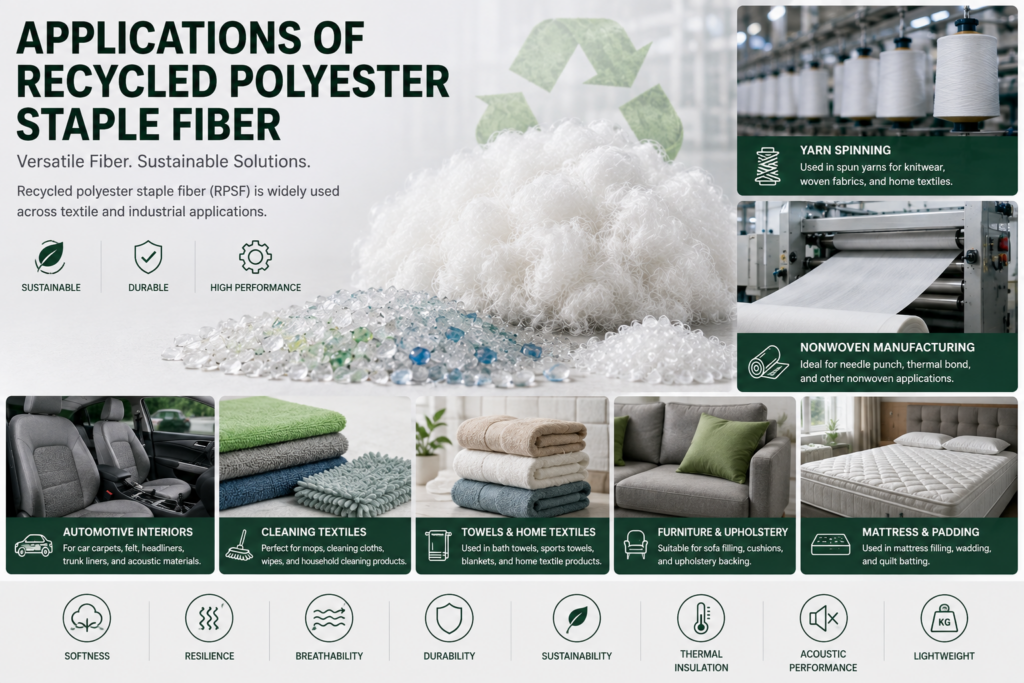
Understanding the relationship between fiber specifications and end-use applications is therefore essential when sourcing recycled polyester staple fiber.
1. Recycled Polyester Staple Fiber for Yarn Spinning
Yarn spinning is one of the most established applications for polyester staple fiber.
Recycled polyester can be processed into yarn for a wide range of textile products, either as 100% recycled polyester yarn or as part of a blended yarn system.
Typical applications include:
- Microfiber yarn
- Polyester yarn
- Blended yarn
- Knitting yarn
- Weaving yarn
- Cleaning textile yarn
- Home textile yarn
The appropriate fiber specification depends on the spinning system and the desired yarn properties.
Important parameters include:
- Denier
- Cut length
- Tensile strength
- Elongation
- Crimp
- Finish
- Fiber consistency
Fine recycled polyester fibers can be particularly useful for applications where softness and surface coverage are important.
For example, recycled microfiber can be processed into yarn for:
- Towels
- Cleaning cloths
- Fine fabrics
- Sports textiles
- Home textiles
For spinning mills, stable fiber quality is critical.
Variations in denier, length, strength, or finish can affect carding, drawing, spinning stability, yarn evenness, and final product quality.
For a more detailed discussion, see Applications of Recycled Micro Fiber in Yarn Spinning.
2. Recycled Polyester for Nonwoven Manufacturing
Nonwoven manufacturing is another major application for recycled polyester staple fiber.
Unlike conventional woven or knitted fabrics, nonwoven materials are produced by mechanically, thermally, or chemically bonding fibers together.
Recycled polyester can be used in different nonwoven production technologies, including:
- Needle-punched nonwoven
- Thermal-bonded nonwoven
- Acoustic materials
- Filtration materials
- Industrial felt
- Automotive nonwoven
- Geotextile materials
The required fiber specification depends on the manufacturing process.
Important considerations include:
- Fiber length
- Denier
- Crimp
- Strength
- Thermal properties
- Fiber cohesion
For needle-punched nonwoven, appropriate fiber length and crimp can contribute to better web formation and fiber entanglement.
For thermally bonded products, the manufacturer may require specialty fibers with suitable thermal characteristics.
Recycled polyester nonwoven materials are increasingly used because they can combine functional performance with recycled content.
Learn more in Recycled Micro Fiber for Nonwoven Manufacturing.
3. Recycled Microfiber for Cleaning Cloths
Cleaning products are one of the most interesting applications for recycled microfiber.
Microfiber consists of extremely fine fibers that provide a high surface-area-to-weight ratio.
This structure allows microfiber fabrics to effectively interact with:
- Dust
- Dirt
- Water
- Oils
- Fine particles
Recycled microfiber can be used in:
- Cleaning cloths
- Floor mops
- Kitchen towels
- Industrial wipes
- Car cleaning cloths
- Glass cleaning cloths
- General-purpose cleaning textiles
The combination of fine fiber structure and recycled polyester content makes this material attractive to manufacturers targeting both performance and sustainability.
For cleaning products, buyers should pay particular attention to:
- Denier
- Fiber fineness
- Absorption
- Softness
- Surface structure
- Color
- Durability
- Washing resistance
A supplier should be able to provide samples so manufacturers can evaluate the fiber under their own production conditions.
For more information, see Why Microfiber is Perfect for Cleaning Products.
4. Recycled Polyester for Towels and Face Towels
Microfiber is also widely used in towel production.
Fine polyester fibers can help create fabrics with:
- Soft hand feel
- High surface area
- Good liquid handling
- Fast drying
- Lightweight construction
Applications include:
- Face towels
- Hand towels
- Sports towels
- Hair towels
- Cleaning towels
- Car detailing towels
For manufacturers supplying hospitality, sports, beauty, and cleaning markets, recycled microfiber can provide a way to incorporate recycled content into finished textile products.
When developing towel products, manufacturers should evaluate:
- Fiber fineness
- Absorption
- Fabric construction
- Softness
- Washing durability
- Color fastness
The fiber specification should always be selected according to the final fabric construction rather than simply choosing the lowest available denier.
5. Recycled Polyester in Automotive Interior Applications
The automotive industry is rapidly increasing the use of recycled materials.
Vehicle manufacturers and Tier 1 and Tier 2 suppliers are looking for materials that provide:
- Durability
- Lightweight performance
- Cost efficiency
- Consistent quality
- Recycled content
Recycled polyester staple fiber can be used in several automotive interior components.
Typical applications include:
- Car carpets
- Automotive felt
- Headliners
- Trunk liners
- Acoustic insulation
- Interior backing materials
- Wheel-arch liners
For automotive applications, fiber selection is highly dependent on the final component.
Manufacturers may prioritize:
- Tensile strength
- Resilience
- Dimensional stability
- Thermal behavior
- Color consistency
- Low impurity levels
In addition, automotive suppliers often require strict batch consistency because their manufacturing processes operate at high volumes.
Read more about this topic in Recycled Micro Fiber in Automotive Interior Applications.
6. Recycled Polyester for Car Carpets
Car carpets are an important application within automotive textiles.
Recycled polyester can be incorporated into:
- Automotive carpet
- Carpet backing
- Trunk carpeting
- Floor mats
- Interior textile components
The material needs to provide an appropriate balance of:
- Strength
- Abrasion resistance
- Dimensional stability
- Processability
- Appearance
Depending on the construction, recycled polyester may be combined with other fibers or materials.
For automotive carpet manufacturers, the consistency of fiber supply is particularly important because variations in raw material can affect production performance.
7. Recycled Polyester for Automotive Felt
Automotive felt is used for various interior and functional components.
It can provide:
- Sound absorption
- Cushioning
- Protection
- Insulation
- Structural support
Recycled polyester staple fiber is suitable for certain felt applications because of its durability and ability to form nonwoven structures.
Potential applications include:
- Trunk liners
- Interior panels
- Under-carpet insulation
- Acoustic components
- Wheel-arch materials
The optimal fiber depends on the final manufacturing process, including needle punching, thermal bonding, or other methods.
8. Recycled Polyester for Furniture and Sofa Padding
Furniture manufacturers also use polyester staple fiber for padding and cushioning.
Applications include:
- Sofa padding
- Chair cushions
- Decorative cushions
- Upholstery
- Furniture filling
For filling applications, manufacturers often prioritize:
- Bulk
- Resilience
- Softness
- Loft retention
- Recovery after compression
Hollow and siliconized polyester fibers may be particularly suitable for products where softness and volume are important.
Recycled versions can help furniture manufacturers increase the recycled content of their products while maintaining the desired filling characteristics.
9. Recycled Polyester for Mattress Filling
Mattress manufacturers require materials that provide comfort, resilience, and long-term stability.
Polyester staple fiber can be used in:
- Mattress padding
- Quilting
- Mattress insulation
- Cushion layers
- Mattress filling
The desired properties may include:
- Softness
- Resilience
- Bulk
- Recovery
- Dimensional stability
Depending on the mattress construction, manufacturers may use different fiber structures and blends.
For example, hollow fiber can provide high loft and lightweight bulk, while specialty fibers may be used to improve bonding or structural stability.
10. Recycled Polyester for Home Textiles
The home textile industry is another important market for recycled polyester.
Applications include:
- Bedding
- Blankets
- Curtains
- Upholstery
- Decorative textiles
- Cushions
- Quilts
Recycled polyester provides manufacturers with a flexible raw material that can be incorporated into products targeting sustainability-conscious consumers.
For international brands, recycled content can also support sustainability claims when appropriate certification and traceability requirements are met.
11. Recycled Polyester for Geotextiles
Geotextiles are technical textile materials used in civil engineering and construction.
Recycled polyester can be used in selected geotextile applications because of its:
- Strength
- Durability
- Resistance to environmental conditions
- Processability into nonwoven structures
Potential applications include:
- Soil stabilization
- Drainage
- Filtration
- Separation
- Erosion control
Needle-punched polyester nonwoven is commonly considered for various geotextile applications.
However, technical requirements can vary significantly depending on the project.
Geotextile manufacturers should therefore evaluate:
- Tensile strength
- Thickness
- Weight
- Fiber length
- Needle-punch density
- Dimensional stability
12. Recycled Polyester for Industrial Wipes
Industrial cleaning and maintenance operations require durable wiping materials.
Recycled polyester microfiber can be used to manufacture:
- Industrial wipes
- Workshop cloths
- Machinery cleaning cloths
- Automotive maintenance wipes
- Precision cleaning textiles
Fine microfiber structures can help improve surface contact and cleaning performance.
For industrial applications, manufacturers may also prioritize:
- Low lint
- High durability
- Chemical resistance
- Washing resistance
- Consistent fabric construction
Different industries may require different microfiber specifications depending on the cleaning process.
13. Recycled Polyester for Insulation and Acoustic Materials
Recycled polyester can also be used in acoustic and insulation products.
The fiber can be formed into nonwoven structures designed to help manage:
- Sound
- Vibration
- Thermal insulation
Potential applications include:
- Automotive acoustic insulation
- Building insulation
- Interior acoustic panels
- Equipment insulation
Fiber characteristics such as denier, density, structure, and bonding behavior can affect the performance of the final material.
For technical applications, manufacturers should evaluate the finished nonwoven rather than relying only on the fiber specification.
14. Recycled Polyester for Wadding
Wadding is used in many textile and industrial products.
Applications include:
- Quilting
- Jackets
- Blankets
- Mattress padding
- Furniture
- Protective materials
Recycled polyester staple fiber can provide:
- Lightweight structure
- Bulk
- Resilience
- Easy processing
- Consistent thickness
Different wadding products require different fiber types.
For example, a lightweight quilt may require different properties from a high-density furniture padding product.
15. Choosing Fiber Specifications for Different Applications
The correct fiber should always be selected based on the end product.
A simplified guide is:
| Application | Important Fiber Characteristics |
|---|---|
| Yarn spinning | Denier, cut length, strength, crimp, finish |
| Fine yarn | Fine denier, consistency, softness |
| Cleaning cloth | Fine microfiber, surface area, absorption, softness |
| Towels | Fine fiber, softness, liquid handling |
| Floor mops | Fine fiber, durability, absorption |
| Nonwoven | Denier, cut length, crimp, strength |
| Automotive carpet | Strength, resilience, consistency |
| Automotive felt | Fiber cohesion, strength, bonding |
| Furniture filling | Bulk, loft, resilience, softness |
| Mattress filling | Bulk, resilience, recovery |
| Geotextile | Strength, durability, fiber length |
| Acoustic insulation | Structure, density, bonding characteristics |
This table is a starting point rather than a universal specification guide.
The correct fiber specification should be confirmed through product testing and production trials.
16. Why Application-Specific Fiber Selection Matters
One of the most common mistakes in B2B fiber purchasing is choosing material based solely on price.
Two fibers may have similar prices but behave very differently during production.
For example:
A 1.4D × 38 mm recycled polyester fiber may be suitable for a fine textile or microfiber application, while a 6D × 64 mm fiber may be more appropriate for a completely different industrial application.
Likewise, a siliconized hollow fiber that performs well in a pillow may not be suitable for yarn spinning.
This is why experienced buyers evaluate:
Application → Machine → Fiber Specification → Finished Product
rather than:
Price → Purchase
17. Recycled Polyester Staple Fiber for Global B2B Manufacturing
The diversity of applications makes recycled polyester staple fiber attractive to international manufacturers.
Different industries can use different fiber specifications while maintaining a common recycled polyester raw material platform.
For suppliers, this means being able to support customers across multiple industries is increasingly valuable.
A capable recycled polyester fiber supplier should understand the requirements of:
- Spinning mills
- Nonwoven factories
- Automotive suppliers
- Cleaning textile manufacturers
- Furniture factories
- Mattress producers
- Home textile companies
- Industrial textile manufacturers
Technical knowledge is particularly important when developing new products.
18. How Buyers Should Evaluate Fiber for Their Application
Before fiber purchasing, buyers should provide their supplier with as much application information as possible.
Useful information includes:
- Final product
- Manufacturing process
- Existing fiber specification
- Required denier
- Required cut length
- Machine type
- Target product performance
- Monthly consumption
- Required color
- Certification requirements
The more information a buyer provides, the easier it is for the supplier to recommend a suitable specification.
19. Testing Before Full-Scale Production
Samples should be tested before a large commercial order.
For example:
Spinning
Evaluate:
- Carding
- Drawing
- Yarn formation
- Yarn strength
- Yarn evenness
- Breakage rate
Nonwoven
Evaluate:
- Web formation
- Fiber distribution
- Needle punching
- Bonding
- Tensile strength
- Thickness
Cleaning Textile
Evaluate:
- Absorption
- Cleaning efficiency
- Softness
- Lint
- Washing durability
Automotive
Evaluate:
- Strength
- Dimensional stability
- Abrasion
- Thermal performance
- Acoustic performance
Testing the actual finished product provides much more useful information than evaluating the fiber only by appearance.
20. Why Recycled Polyester Is Expanding Across Industries
The broad application range of recycled polyester staple fiber is one of its biggest advantages.
Manufacturers can use recycled polyester in products that require:
- Durability
- Lightweight construction
- Consistent performance
- Cost efficiency
- Recycled content
At the same time, increasing demand for sustainable materials is encouraging more manufacturers to evaluate recycled alternatives.
This combination of performance and sustainability is helping recycled polyester move beyond traditional textile applications into automotive, construction, industrial, and technical markets.
Recycled Polyester Staple Fiber Application Checklist
When selecting fiber for a new project, buyers should ask:
Product
- What is the final product?
- What performance is required?
- What recycled content is needed?
Production
- What machine will process the fiber?
- What spinning or nonwoven technology is used?
- What fiber specification is currently working?
Technical
- What denier is required?
- What cut length is required?
- What strength and elongation are needed?
- Is crimp important?
- Is siliconized or non-siliconized fiber required?
Commercial
- What is the monthly consumption?
- What packaging is preferred?
- What shipment frequency is required?
- What is the target price?
Sustainability
- Is certification required?
- Is traceability required?
- Does the finished product need verified recycled content?
This information allows suppliers to provide a more accurate technical and commercial proposal.
Conclusion
Recycled polyester staple fiber has become a versatile raw material for modern manufacturing.
Its applications extend across:
- Yarn spinning
- Nonwoven manufacturing
- Cleaning cloths
- Floor mops
- Towels
- Automotive carpets
- Automotive felt
- Acoustic insulation
- Furniture padding
- Mattress filling
- Home textiles
- Geotextiles
- Industrial wipes
- Wadding
However, successful production depends on selecting the correct fiber specification for each application.
The ideal fiber is determined by the relationship between:
Fiber Specification + Manufacturing Process + Finished Product Requirements
For B2B buyers, this means the lowest-priced fiber is not necessarily the most economical option. A stable fiber that performs consistently can reduce waste, machine adjustments, production interruptions, and quality problems.
The next section will focus on one of the strongest reasons manufacturers are switching to recycled polyester: sustainability.
In Part 6 – Sustainability Benefits of Recycled Polyester Staple Fiber, we will examine plastic waste reduction, resource efficiency, circular manufacturing, carbon considerations, recycled content, certification, and how recycled polyester supports more sustainable textile production.
Conclusion
Understanding polyester staple fiber specifications is essential for selecting the right material and optimizing manufacturing performance.
Instead of evaluating suppliers based only on price, buyers should carefully review technical specifications such as:
- Denier
- Cut length
- Strength
- Crimp
- Oil finish
- Moisture
- Color consistency
Working with an experienced supplier that provides stable specifications and reliable technical support can improve product quality, reduce waste, and strengthen long-term competitiveness.
If you are looking for a trusted supplier of recycled polyester staple fiber, Eco Micro Fiber is ready to support your business with consistent quality and dependable global supply.
If you are still comparing recycled and virgin materials, you may also find our comparison guide Virgin Polyester vs Recycled Polyester useful before making your sourcing decision.
Contact us today to request technical data sheets, samples, or a customized quotation.
Why Choose Eco Micro Fiber?
At Eco Micro Fiber, we manufacture and supply high-quality recycled polyester staple fiber for global B2B customers.
Our products are suitable for:
- Yarn spinning
- Nonwoven production
- Cleaning textiles
- Automotive interiors
- Home textile applications
We focus on:
- Consistent fiber quality
- Stable denier and cut length
- Reliable export service
- Competitive B2B pricing
- Long-term customer partnerships
Our objective is to help customers achieve consistent production quality while reducing operational risk.
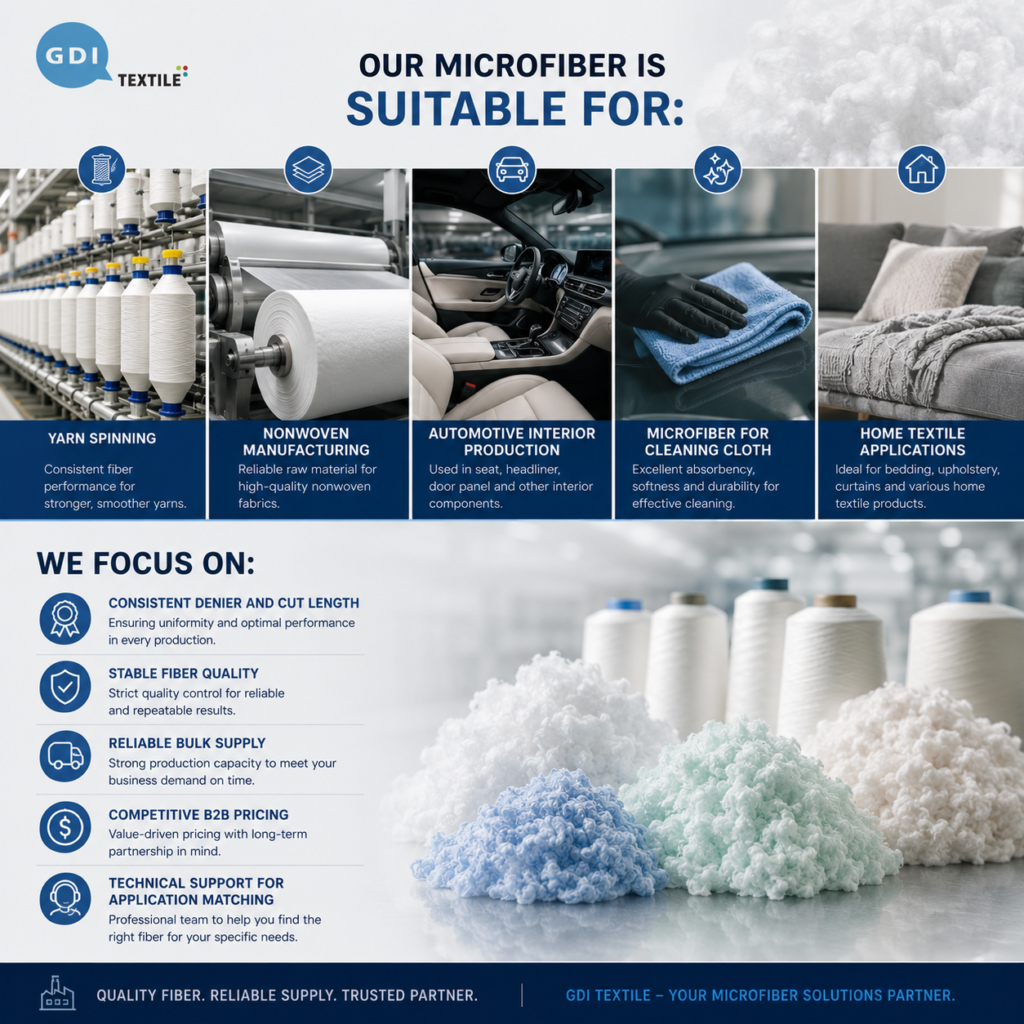
If you are looking for a trusted recycled polyester fiber supplier, our team is ready to support your production needs.
Contact Us:
Email: [email protected]
Tel/WhatsApp: +84981527216
Contact us today to request technical specifications or product samples.