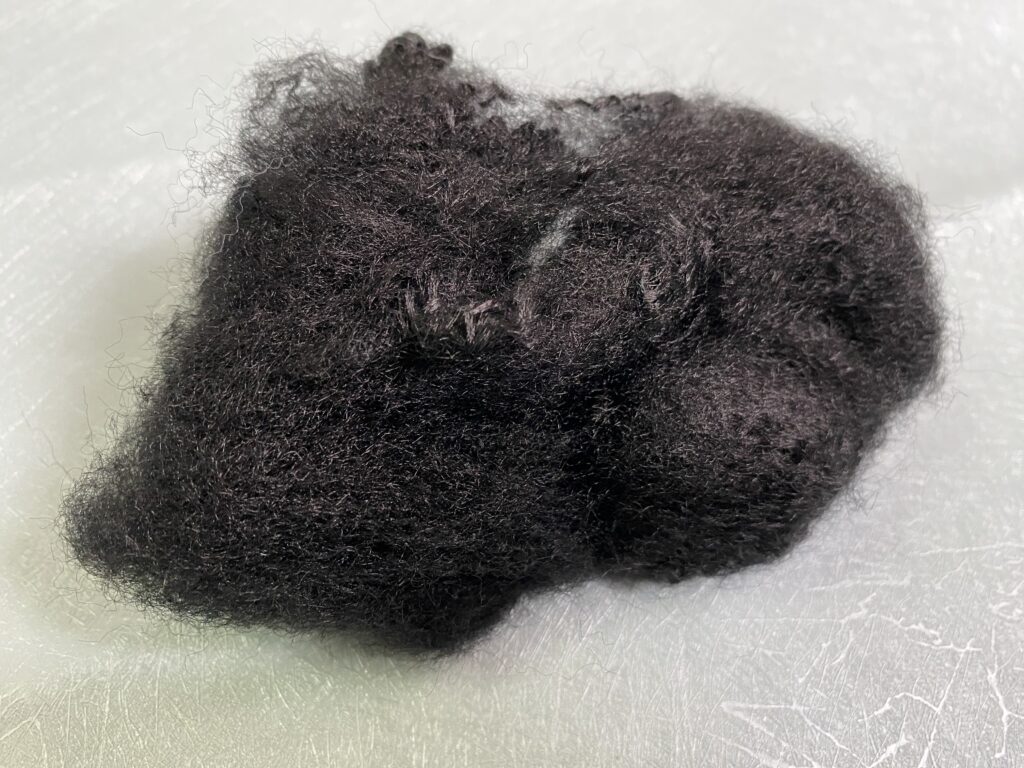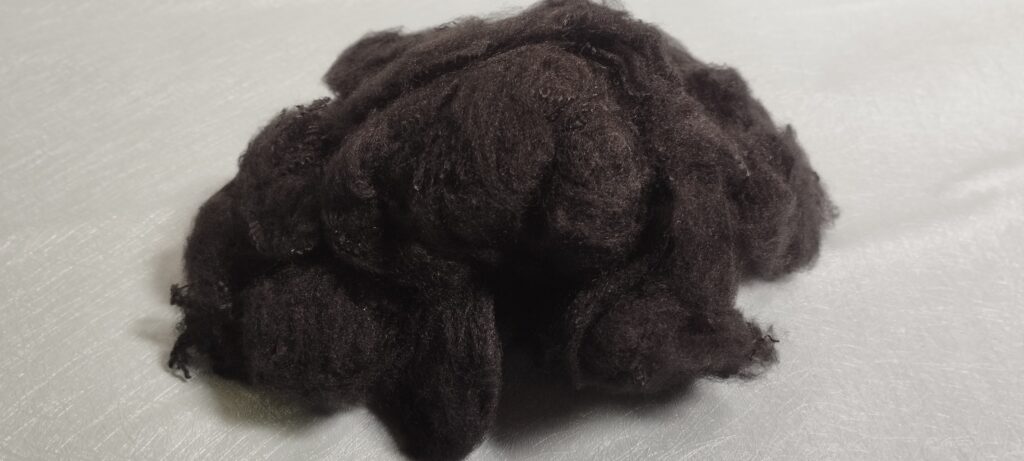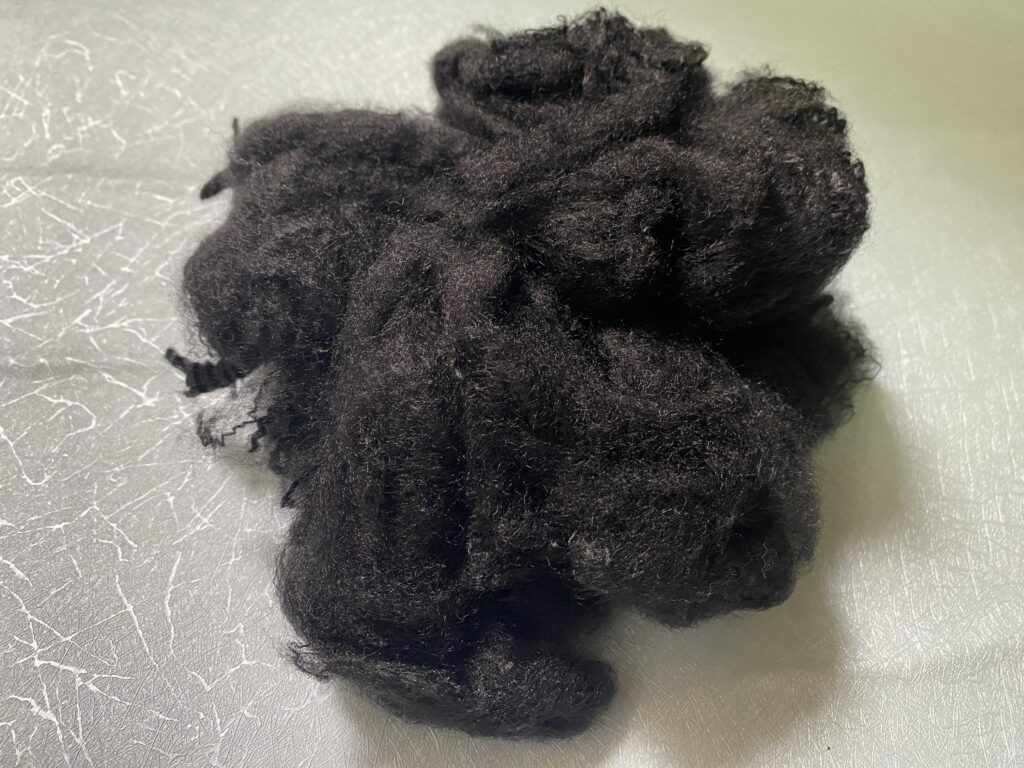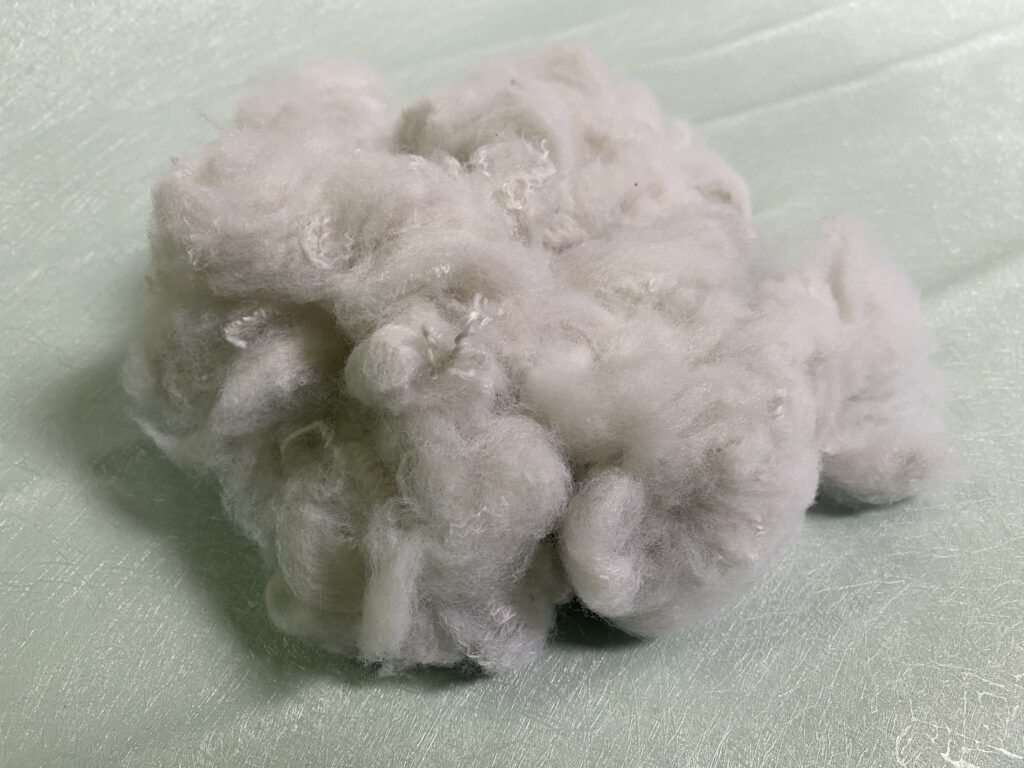
Furniture manufacturers require materials that deliver consistent comfort, durability, processing performance, and cost efficiency.
From sofa cushions and upholstered chairs to furniture padding and protective nonwoven layers, polyester staple fiber plays an important role in many furniture manufacturing processes.
As manufacturers explore recycled raw materials, recycled polyester staple fiber (RPSF) offers an alternative to virgin polyester fiber for selected furniture and upholstery applications.
However, choosing the right fiber requires more than comparing prices or selecting a standard denier.
Fiber structure, cut length, crimp, resilience, surface finish, and production consistency can influence how the material performs during filling, padding, and nonwoven manufacturing.
This guide explains how recycled polyester staple fiber has used in furniture and upholstery, which technical properties matter most, and how manufacturers can evaluate suitable fiber grades before purchasing.
1. What Is Recycled Polyester Staple Fiber for Furniture?
Recycled polyester staple fiber is a synthetic fiber manufactured from recycled polyester feedstock.
During production, recycled polyester will process into fibers that will cut to specified lengths and supplied in different fineness grades, colors, and structures.
Depending on the fiber type and manufacturing process, RPSF may be used in:
- Sofa cushion filling
- Decorative pillow filling
- Upholstery padding
- Furniture wadding
- Nonwoven furniture components
- Protective layers
- Selected acoustic and insulation materials
Different furniture components require different material characteristics.
For example, loose cushion filling may prioritize loft and resilience, while needle-punched upholstery padding may require suitable fiber cohesion and mechanical integrity.
Therefore, fiber selection should begin with the intended application rather than a general product description.
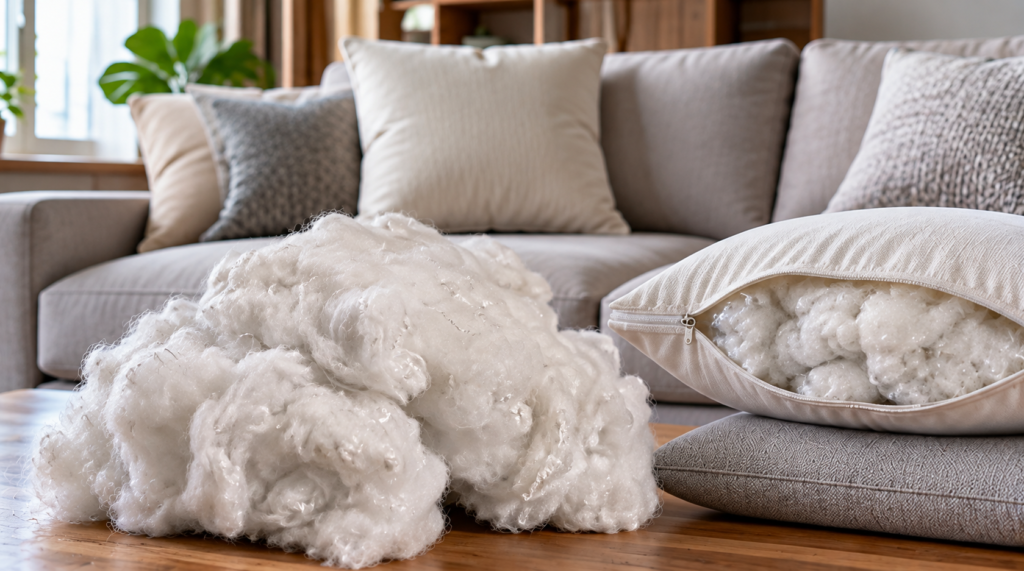
2. Main Applications of Recycled Polyester Fiber in Furniture Manufacturing
2.1 Sofa Cushion Filling
Sofa cushions may contain different combinations of polyurethane foam, polyester fiber, feathers, or other filling materials.
Polyester staple fiber is commonly considered for cushion filling and wrapping applications.
Depending on the cushion design, polyester fiber can contribute to:
- Softness
- Bulk and loft
- Cushion shape
- Surface comfort
- Filling distribution
However, the finished cushion’s resilience and durability depend on the complete construction.
A cushion containing recycled polyester fiber does not automatically provide the same performance as one containing virgin polyester fiber.
Material suitability will confirm through product testing.
2.2 Decorative Pillow Filling
Decorative pillows often require soft, lightweight filling materials that can maintain an acceptable shape during use.
Polyester staple fiber may be processed into loose filling or other filling structures.
Important considerations include:
- Fiber softness
- Opening behavior
- Bulk
- Compression recovery
- Filling uniformity
- Surface finish
Hollow polyester fibers and siliconized fibers will evaluate for certain pillow filling applications.
However, solid recycled polyester staple fiber may also be suitable for selected products depending on the desired characteristics.
2.3 Upholstery Padding
Upholstery padding will use between furniture covering materials and structural components such as foam, springs, or frames.
Polyester fiber will incorporate into wadding, batting, or other padding structures.
These layers can help provide:
- Surface cushioning
- Smoother upholstery appearance
- Separation between materials
- Protection of underlying components
- Additional comfort characteristics
The appropriate fiber grade depends on how the padding is manufactured and used.
2.4 Furniture Nonwoven Materials
Recycled polyester staple fiber can be evaluated for certain furniture nonwoven applications.
Examples include:
- Needle-punched felt
- Upholstery backing
- Protective nonwoven layers
- Furniture padding sheets
- Selected structural textile components
Nonwoven manufacturers should consider fiber dimensions, crimp, tensile properties, cleanliness, and equipment compatibility.
2.5 Acoustic and Insulation Components
Some furniture and interior products incorporate textile structures designed to influence sound absorption or provide insulation.
Recycled polyester fiber may be used in suitable nonwoven constructions.
However, acoustic performance depends on the finished material’s thickness, density, porosity, airflow resistance, and installation conditions.
Fiber type alone does not establish sound absorption performance.
3. Solid vs. Hollow Polyester Fiber for Furniture
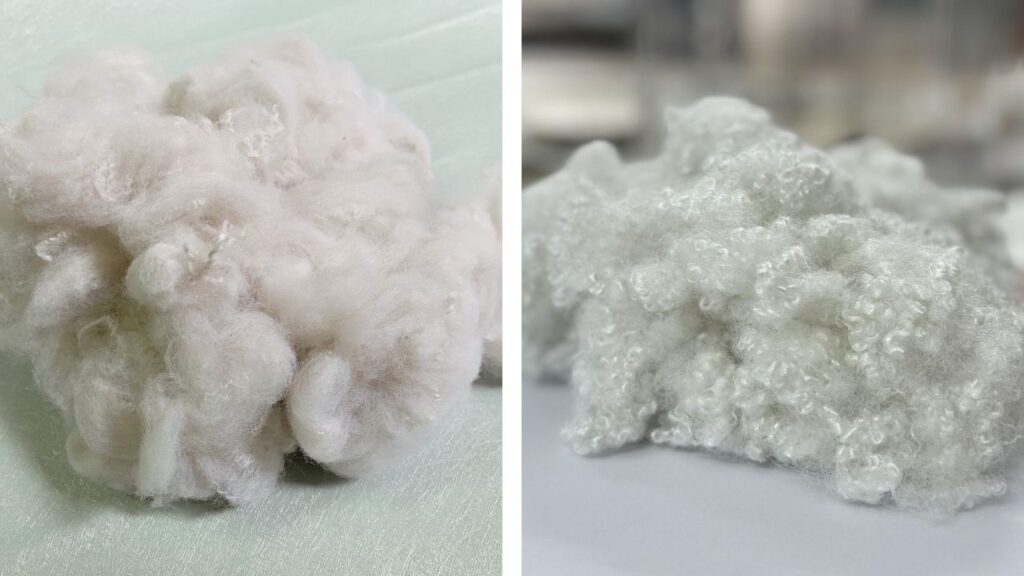
One of the most important purchasing decisions is whether to use solid or hollow polyester staple fiber.
Although both materials are polyester fibers, their cross-sectional structures differ.
Solid Polyester Staple Fiber
Solid polyester staple fiber has a substantially solid cross-section.
Depending on its fineness, crimp, finish, and other properties, it may be evaluated for:
- Upholstery padding
- Needle-punched furniture nonwovens
- Furniture backing materials
- Selected cushion filling applications
- Protective textile layers
Solid fiber can be a practical option when the application does not require the particular characteristics of hollow fiber.
Hollow Polyester Staple Fiber
Hollow polyester staple fiber contains one or more internal voids within its cross-section.
This structure can influence fiber bulk and the behavior of filling materials.
Hollow fibers may be considered for:
- Soft cushion filling
- Decorative pillows
- Selected high-loft padding
- Other applications requiring particular bulk characteristics
However, hollow structure alone does not guarantee better resilience or comfort.
Crimp, fiber fineness, finish, and product construction remain important.
Solid vs. Hollow Fiber Comparison
| Parameter | Solid Polyester Fiber | Hollow Polyester Fiber |
|---|---|---|
| Cross-section | Substantially solid | Contains internal voids |
| Common applications | Nonwovens, padding, selected filling | Filling, high-loft padding, selected nonwovens |
| Bulk characteristics | Depend on grade and construction | Hollow structure can contribute to bulk |
| Resilience | Depends on fiber properties | Depends on fiber properties |
| Processing | Application-dependent | Application-dependent |
| Fiber selection | Based on technical requirements | Based on technical requirements |
Buyer takeaway: Solid and hollow polyester fibers should be evaluated according to the finished furniture component rather than assuming one structure is universally superior.
4. How Fiber Denier Affects Furniture and Upholstery Performance
Denier describes the linear density of an individual fiber.
A lower denier indicates a finer fiber, while a higher denier indicates a coarser fiber.
Different denier grades can influence softness, bulk, fiber cohesion, and processing behavior.
Fine-Denier Polyester Fiber
Fine-denier polyester staple fibers may be evaluated for applications requiring relatively fine textile structures.
For example, grades such as 1.4D may be considered for compatible textile and nonwoven processes.
However, very fine fiber is not automatically necessary for all upholstery applications.
Medium-Denier Polyester Fiber
Grades such as 3D and 6D may be evaluated for selected padding and nonwoven constructions.
Their suitability depends on fiber structure, crimp, cut length, and manufacturing equipment.
Coarser Polyester Fiber
Coarser grades, including 15D, may be considered for applications where their structural characteristics are appropriate.
However, a higher denier does not automatically guarantee greater cushion resilience or longer service life.
Practical Fiber Denier Comparison
| Fiber Grade | Relative Fineness | Potential Evaluation Areas |
|---|---|---|
| 1.4D | Fine | Fine textile structures and selected nonwovens |
| 3D | Medium | Upholstery padding and selected nonwovens |
| 6D | Coarser | Selected padding and filling constructions |
| 15D | Much coarser | Selected filling or structural applications |
These examples are intended for preliminary material evaluation.
Final suitability must be confirmed through manufacturing trials.
5. Choosing the Right Fiber Cut Length
Fiber cut length affects how polyester staple fiber behaves during opening, carding, blending, and other manufacturing processes.
Common commercial cut lengths include:
- 38mm
- 51mm
- 64mm
- 76mm
However, the appropriate cut length depends on the production equipment and intended application.
Shorter Fibers
Shorter staple fibers may be suitable for certain carding systems and fine textile structures.
However, very short fibers may create challenges in applications requiring greater fiber entanglement.
Longer Fibers
Longer staple fibers may be evaluated for selected nonwoven and filling processes.
They can influence fiber cohesion and material structure, but excessive fiber length may cause opening or carding difficulties in incompatible equipment.
Questions Buyers Should Ask
Before selecting a fiber cut length, confirm:
- What manufacturing process will be used?
- What fiber lengths can the equipment handle?
- Is the fiber intended for loose filling or bonded padding?
- What finished-product characteristics are required?
- Has the proposed cut length been tested in production?
The best fiber length is determined by processing compatibility and finished-product requirements, not by furniture application alone.
6. Why Crimp Matters in Furniture Polyester Fiber
Crimp refers to the wave-like shape introduced into polyester staple fibers during manufacturing.
It can influence fiber cohesion, bulk, opening behavior, and the characteristics of the finished material.
For furniture applications, crimp may be particularly relevant to cushion filling and padding production.
Crimp and Fiber Bulk
Crimped fibers can form structures containing spaces between individual fibers.
This can contribute to bulk and loft, depending on the material construction.
Crimp and Compression Recovery
Crimp characteristics can influence how a fiber assembly responds to compression.
However, finished-product compression recovery also depends on fiber structure, density, bonding, and other manufacturing variables.
Crimp and Nonwoven Processing
In carded and needle-punched nonwoven production, crimp can influence fiber cohesion and web formation.
Manufacturers should evaluate:
- Crimp frequency
- Crimp stability
- Fiber opening behavior
- Web formation performance
- Batch consistency
The relevant crimp characteristics should be agreed upon according to the application.
7. Fiber Finish: Siliconized vs. Non-Siliconized Polyester Fiber
Polyester staple fibers may receive different surface finishes depending on their intended applications.
Two commonly discussed categories are siliconized and non-siliconized fibers.
Siliconized Polyester Fiber
Siliconized polyester fiber has a silicone-based surface treatment.
Depending on the grade and application, this finish can influence fiber friction, softness, and filling behavior.
It is commonly considered for selected loose-filling applications.
Non-Siliconized Polyester Fiber
Non-siliconized polyester fiber does not have the same silicone-based surface treatment.
It may be suitable for selected nonwoven, padding, and other textile manufacturing processes.
However, non-siliconized does not necessarily mean the fiber has no processing finish.
Why Finish Selection Matters
Fiber finish can affect:
- Fiber-to-fiber friction
- Fiber-to-metal friction
- Opening and carding
- Static behavior
- Filling distribution
- Bonding or downstream processing compatibility
Buyers should confirm the actual finish type rather than assuming all polyester staple fibers have identical surface characteristics.
8. Recycled Polyester Fiber for Upholstery Nonwoven Production
Nonwoven materials are widely used in furniture manufacturing.
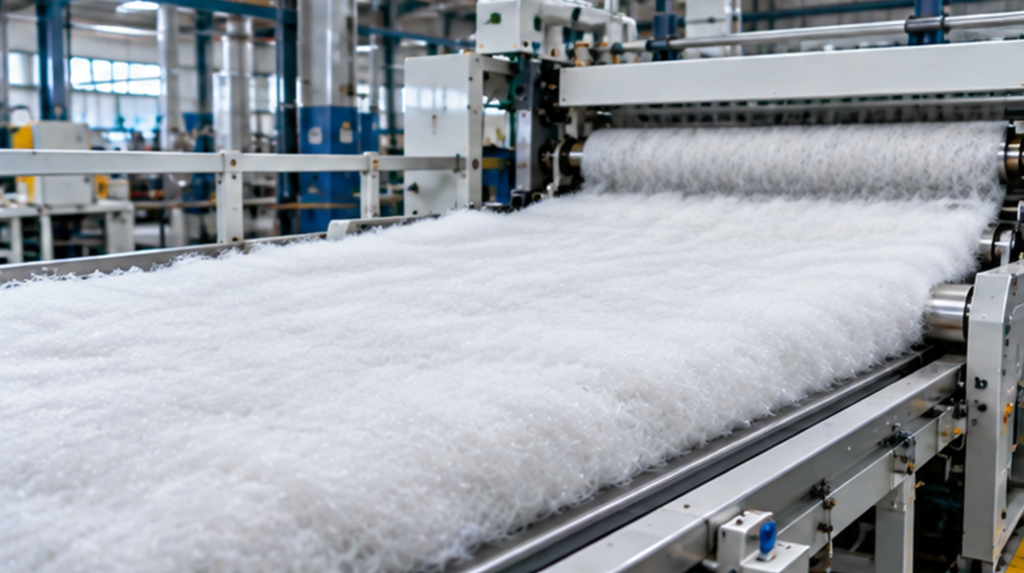
Depending on the intended product, recycled polyester staple fiber may be processed through carding, needle punching, thermal bonding, or other suitable technologies.
Needle-Punched Furniture Nonwovens
Needle punching mechanically entangles fibers using barbed needles.
The process may involve:
- Fiber opening
- Fiber blending
- Carding
- Web laying
- Needle punching
- Finishing and cutting
Important raw material properties include fiber fineness, cut length, crimp, cleanliness, and tensile characteristics.
Thermal-Bonded Padding
Some furniture padding materials are manufactured using thermal bonding.
In these processes, the fiber blend and bonding components must be compatible with the selected temperature and manufacturing conditions.
Conventional recycled polyester staple fiber should not automatically be treated as a low-melt bonding fiber.
Manufacturers should verify whether a separate bonding component or specialty fiber is required.
Finished Nonwoven Quality
Important finished-product characteristics may include:
- Thickness
- Basis weight
- Tensile strength
- Uniformity
- Compression behavior
- Surface appearance
The appropriate tests depend on the product’s intended function.
9. Important Quality Requirements for Furniture Manufacturers
Furniture manufacturers should evaluate recycled polyester staple fiber according to the characteristics that influence their production process.
| Quality Parameter | Why It Matters |
|---|---|
| Fiber denier | Influences fineness and material structure |
| Cut length | Affects opening, carding, and filling |
| Tenacity | Describes mechanical fiber properties |
| Elongation | Influences fiber behavior under tension |
| Crimp | Affects bulk, cohesion, and processing |
| Fiber finish | Influences friction and handling |
| Color | Important for appearance-sensitive products |
| Cleanliness | Helps reduce contamination-related problems |
| Moisture | Relevant to material condition and handling |
| Batch consistency | Supports repeatable production performance |
Why Cleanliness Matters
Contamination in recycled polyester staple fiber may include unwanted particles, foreign fibers, or other materials.
Depending on the application, these impurities may affect:
- Upholstery appearance
- Processing efficiency
- Machine cleaning requirements
- Finished-product quality
- Material acceptance
Buyers should establish suitable cleanliness requirements and inspection procedures.
10. What About Furniture Safety and Compliance?
Furniture manufacturers may need to meet product-specific safety, chemical, and performance requirements.
These requirements depend on the destination market, product category, intended use, and customer specifications.
Potential evaluation areas include:
- Flammability
- Restricted substances
- Odor
- Colorfastness
- Mechanical durability
- Recycled content verification
- Other applicable product requirements
A recycled polyester staple fiber Technical Data Sheet does not automatically establish compliance with furniture safety regulations.
Similarly, the use of recycled polyester does not independently prove that a finished furniture product meets environmental or chemical requirements.
Buyers should identify the applicable standards and request appropriate supporting documentation.
11. Recycled Polyester Fiber vs. Virgin Polyester Fiber for Furniture
Furniture manufacturers may consider recycled polyester staple fiber as an alternative to virgin polyester fiber.
Both materials can be processed into different fiber structures and specifications.
However, their suitability should be evaluated based on actual performance.
Important Comparison Factors
Technical properties
Compare denier, cut length, tenacity, elongation, crimp, and finish.
Processing behavior
Evaluate opening, carding, filling, and other relevant operations.
Finished-product quality
Assess comfort, resilience, appearance, and durability according to the intended application.
Material consistency
Review variation between production lots.
Commercial performance
Compare purchase price, processing cost, waste, and quality-related expenses.
Can Recycled Polyester Replace Virgin Polyester?
In selected applications, recycled polyester staple fiber may be suitable as an alternative to virgin polyester fiber.
However, replacement should be confirmed through representative samples, production trials, and finished-product testing.
A matching nominal denier and cut length does not guarantee identical performance.
12. Common Mistakes When Selecting Polyester Fiber for Furniture
Mistake 1: Choosing Fiber Based Only on Price
A lower purchase price does not always result in lower total manufacturing cost.
Poor processing performance or excessive waste can increase production expenses.
Mistake 2: Assuming Hollow Fiber Is Always Better
Hollow fiber may be useful for certain filling applications, but it is not universally superior to solid fiber.
Mistake 3: Ignoring Fiber Finish
Siliconized and non-siliconized fibers can behave differently during processing.
Mistake 4: Selecting the Wrong Cut Length
A cut length that is incompatible with the production equipment may cause processing problems.
Mistake 5: Ignoring Crimp Consistency
Variation in crimp can influence bulk, opening, and nonwoven formation.
Mistake 6: Skipping Production Trials
A fiber that looks suitable in a sample may perform differently during commercial manufacturing.
13. How to Evaluate Recycled Polyester Fiber Before Bulk Purchasing
A structured evaluation process can help furniture manufacturers reduce sourcing risk.
Step 1: Define the Application
Confirm whether the fiber will be used for cushion filling, upholstery padding, nonwoven backing, or another component.
Step 2: Identify the Required Fiber Structure
Determine whether solid, hollow, siliconized, or another fiber grade is appropriate.
Step 3: Review Technical Specifications
Check denier, cut length, crimp, tensile properties, finish, and cleanliness.
Step 4: Request Representative Samples
Ensure that the samples correspond to the proposed commercial grade.
Step 5: Conduct Production Trials
Evaluate fiber opening, processing stability, waste, and finished-product quality.
Step 6: Test the Finished Furniture Component
Review the relevant comfort, mechanical, appearance, and durability requirements.
Step 7: Confirm Commercial Terms
Discuss order quantity, packaging, delivery arrangements, quality acceptance criteria, and repeat-order requirements.
Step 8: Monitor Batch Consistency
Evaluate whether subsequent commercial lots maintain the agreed specifications.
The objective is to select a fiber that performs consistently in the manufacturer’s actual production process.
14. How to Choose the Right Polyester Fiber for Different Furniture Applications
The following table provides a preliminary selection framework.
| Furniture Application | Main Fiber Considerations | Recommended Evaluation |
|---|---|---|
| Sofa cushion filling | Structure, bulk, crimp, finish | Loft and compression recovery |
| Decorative pillows | Softness, bulk, opening, finish | Filling uniformity and resilience |
| Upholstery padding | Denier, length, crimp | Thickness and padding performance |
| Needle-punched felt | Length, crimp, tenacity | Carding and needle-punching performance |
| Furniture backing | Fiber structure and mechanical properties | Finished nonwoven quality |
| Protective layers | Fineness, cleanliness, process compatibility | Surface and mechanical performance |
| Acoustic components | Fiber structure and web construction | Finished-material acoustic testing |
These guidelines are intended for technical evaluation rather than guaranteed application-specific recommendations.
15. Recycled Polyester Staple Fiber Supply from GDI Textile
GDI Textile supplies recycled polyester staple fiber for industrial textile applications.
Furniture and upholstery manufacturers evaluating recycled polyester fiber can discuss available grades based on their production requirements.
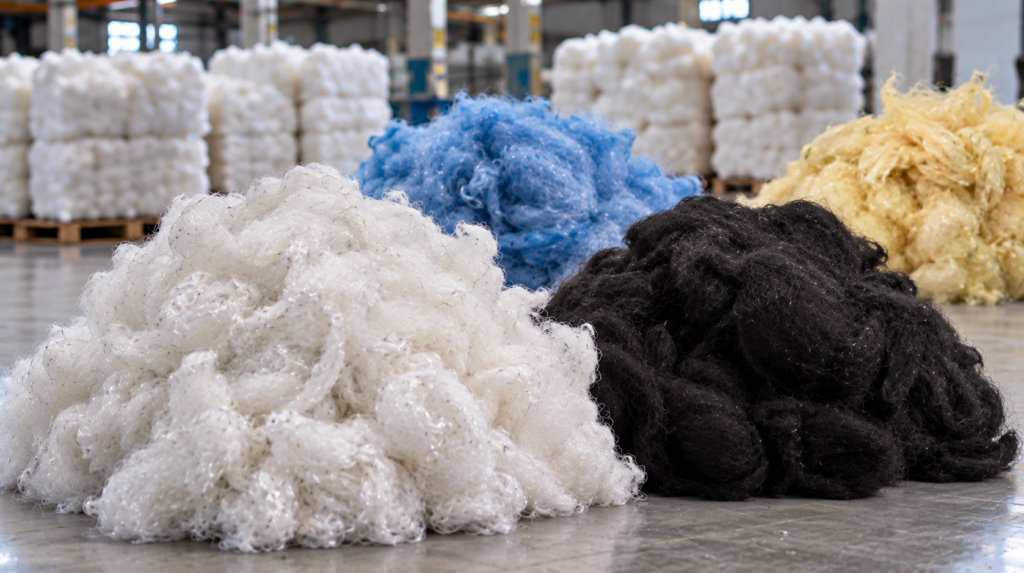
Examples of recycled polyester staple fiber specifications include:
- 1.4D × 38mm – White
- 1.4D × 38mm – Black
- 2.5D × 51mm – White
- 3D × 51mm – White
- 6D × 64mm – White
- 6D × 64mm – Black
- 15D × 76mm – White
- 15D × 76mm – Black
These are examples of fiber specifications for discussion. Their suitability for particular furniture applications will confirm through technical evaluation.
What Information Should Buyers Provide?
To help identify a suitable fiber grade, please share:
- Intended furniture application
- Required fiber denier and cut length
- Solid or hollow fiber requirement
- Siliconized or non-siliconized finish requirement
- Color requirements
- Current fiber specification or reference sample
- Estimated monthly consumption
- Destination country or port
Providing these details can support a more focused technical and commercial discussion.
Looking for Recycled Polyester Fiber for Furniture Manufacturing?
GDI Textile welcomes inquiries from furniture manufacturers, upholstery producers, nonwoven manufacturers, and industrial textile buyers.
Contact our team to discuss available recycled polyester staple fiber grades, technical requirements, sample evaluation, and export supply options.
Request Fiber Specifications & Quotation

Frequently Asked Questions
Can recycled polyester staple fiber be used for sofa cushions?
Yes. Suitable recycled polyester staple fiber grades will evaluate for sofa cushion filling, wrapping, or padding applications. Final suitability depends on the fiber structure and finished cushion requirements.
What polyester fiber is best for upholstery padding?
There is no universal best fiber grade. The appropriate material depends on padding construction, manufacturing equipment, required thickness, mechanical performance, and other specifications.
Is solid polyester fiber suitable for furniture manufacturing?
Yes. Solid polyester staple fiber may be suitable for selected upholstery padding, furniture nonwovens, backing materials, and other applications.
Is hollow polyester fiber better for cushion filling?
Hollow fiber may provide useful bulk characteristics in selected filling products. However, overall performance depends on crimp, fineness, finish, and cushion construction.
What is the difference between siliconized and non-siliconized polyester fiber?
Siliconized polyester fiber has a silicone-based surface treatment that can influence friction and filling behavior. Non-siliconized fiber does not have the same treatment and preferred for certain manufacturing processes.
Can recycled polyester fiber replace virgin fiber in furniture?
It may be possible in selected applications. Manufacturers should compare technical properties, processing behavior, and finished-product performance before making a replacement decision.
What denier is suitable for furniture padding?
Different denier grades may be suitable depending on the application. Manufacturers should evaluate fiber fineness together with cut length, crimp, structure, and production requirements.
What should buyers check before ordering recycled polyester fiber?
Buyers should review the fiber specification, intended application, quality requirements, representative samples, production trial results, and commercial supply conditions.
Conclusion
Recycled polyester staple fiber offers a material option for furniture manufacturers producing cushions, upholstery padding, nonwoven backing, and other textile components.
However, selecting the right fiber requires a clear understanding of the finished product and manufacturing process.
Fiber structure, denier, cut length, crimp, surface finish, cleanliness, and batch consistency can all influence processing behavior and final product characteristics.
For furniture and upholstery manufacturers, the most effective approach is to evaluate representative fiber samples, conduct production trials, and establish clear quality acceptance criteria before regular purchasing.
The right recycled polyester staple fiber is the one that meets the required furniture performance while supporting efficient, repeatable manufacturing.
For international buyers sourcing recycled polyester staple fiber, careful technical evaluation provides a practical foundation for reliable long-term supply.