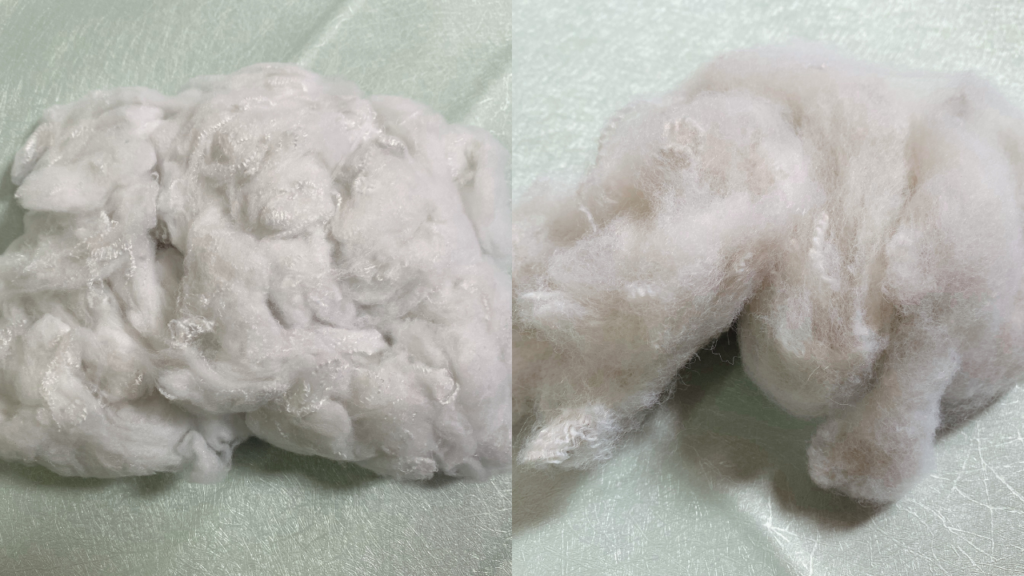
Choosing between recycled microfiber and standard polyester staple fiber is an important decision for textile manufacturers seeking the right balance of material performance, processing efficiency, and production cost.
Both materials can be manufactured from recycled polyester and used in various textile applications. However, differences in individual fiber fineness can significantly influence fiber handling, yarn structure, nonwoven formation, fabric characteristics, and processing requirements.
For spinning mills, nonwoven manufacturers, cleaning textile producers, and industrial textile buyers, selecting a finer fiber does not automatically guarantee better performance.
The most suitable material depends on the manufacturing process, required finished-product properties, and overall production economics.
This guide compares recycled microfiber vs standard polyester staple fiber, explains their technical differences, and provides practical guidance for selecting the appropriate fiber grade.
1. What Is Recycled Polyester Microfiber?
Recycled polyester microfiber refers to very fine polyester fibers manufactured from recycled polyester feedstock.
In the textile industry, microfiber is commonly associated with fibers having a linear density below approximately 1 dtex, although terminology and commercial definitions vary by market and product category.
Because 1 denier equals approximately 1.111 dtex, a fiber measuring 1 denier is approximately 1.111 dtex.
This distinction matters when reviewing supplier specifications.
Recycled Microfiber vs. Fine-Denier Polyester Fiber
The terms microfiber and fine-denier polyester staple fiber are sometimes used interchangeably in commercial discussions.
However, they are not always technically identical.
For example, 1.4D × 38mm polyester staple fiber has a nominal linear density of approximately 1.56 dtex.
Although some suppliers may commercially describe this grade as microfiber, it does not meet a strict definition based on a threshold below 1 dtex.
Therefore, buyers should always confirm the actual denier or dtex rather than relying only on the product name.
How Recycled Polyester Microfiber Is Produced
Recycled polyester staple fiber is generally produced through several manufacturing stages:
- Preparation of recycled polyester feedstock.
- Melting and filtration of the polymer.
- Extrusion through spinnerets.
- Filament cooling and drawing.
- Application of appropriate fiber finish.
- Crimping, where required.
- Cutting into specified staple lengths.
- Packaging for industrial use.
The exact production process depends on the fiber grade and manufacturing technology.
Producing very fine fibers can require careful control of extrusion, drawing, and downstream processing.
2. What Is Standard Polyester Staple Fiber?
Polyester staple fiber (PSF) consists of polyester fibers cut into specified lengths for processing into yarns, nonwoven fabrics, filling materials, and other textile products.
Standard polyester staple fiber is not defined by one universal denier range.
In commercial purchasing, the term often refers to conventional fiber grades rather than specially designated ultrafine fibers.
Common commercial specifications include:
- 1.4D × 38mm
- 2.5D × 51mm
- 3D × 51mm
- 6D × 64mm
- 15D × 76mm
These grades represent different fiber fineness and length combinations.
A 1.4D fiber is much finer than a 6D fiber, but both are polyester staple fibers.
Recycled vs. Virgin Polyester Staple Fiber
Polyester staple fiber can be manufactured using virgin or recycled polyester feedstock.
The terms recycled and virgin describe the origin of the raw material.
The terms fine-denier, microfiber, and coarse-denier describe fiber fineness.
These are separate characteristics.
A recycled polyester fiber is not necessarily finer than a virgin polyester fiber.
Likewise, a virgin polyester fiber is not automatically stronger or more suitable for a given application.
Performance depends on the actual fiber properties, manufacturing process, and quality requirements.
3. Recycled Microfiber vs Standard Polyester Staple Fiber: Comparison Table
The following table compares very fine recycled polyester staple fibers with relatively coarser conventional polyester staple fiber grades.
| Parameter | Recycled Microfiber / Very Fine Fiber | Standard / Coarser PSF |
|---|---|---|
| Raw material | Recycled polyester | Virgin or recycled polyester |
| Fiber fineness | Very fine | Varies from fine to coarse |
| Denier | Lower | Generally higher in this comparison |
| Cut length | Application-dependent | Application-dependent |
| Fiber count per unit mass | Higher | Lower |
| Specific surface area | Generally higher | Generally lower |
| Yarn applications | Fine yarns and selected blends | Broad range of yarn constructions |
| Nonwoven applications | Fine web structures and selected specialty products | Broad range of industrial nonwovens |
| Processing | May require more careful control | Depends on grade and equipment |
| Cost | Depends on grade, quality, and supply | Depends on grade, quality, and supply |
| Quality priorities | Fineness uniformity, cleanliness, finish, processing | Application-specific mechanical and physical properties |
Important: This comparison describes general tendencies, not guaranteed product performance. Fiber properties must be evaluated using actual specifications and production trials.
4. Fiber Denier: The Most Important Technical Difference
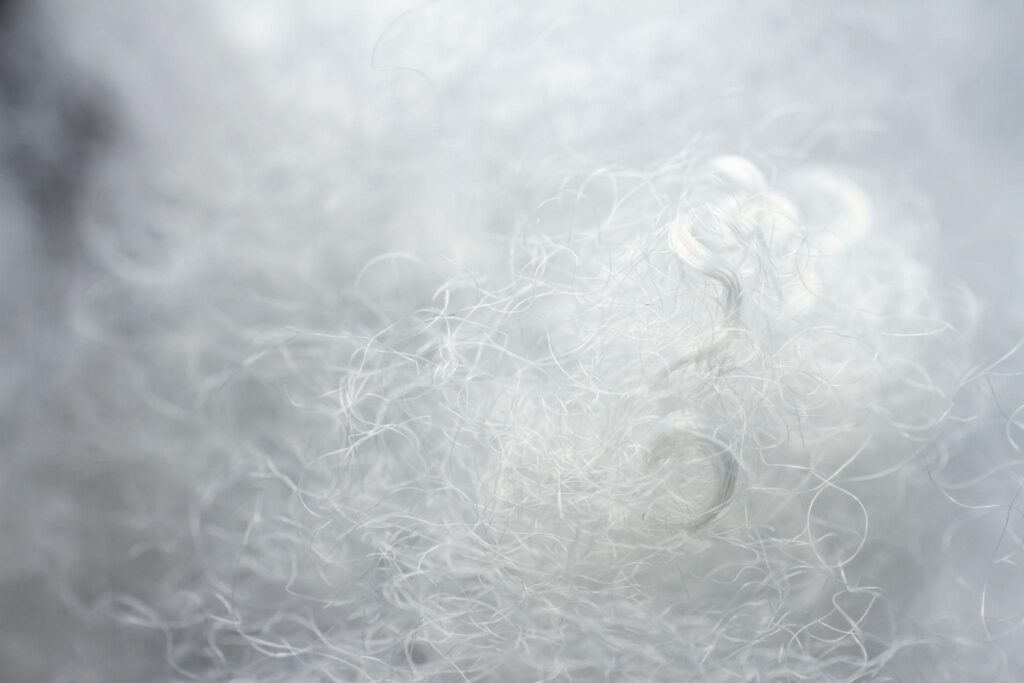
Fiber fineness is one of the main characteristics distinguishing microfiber from coarser polyester staple fiber.
Denier measures the mass in grams of 9,000 meters of fiber.
A lower denier indicates a finer individual fiber.
Understanding Fiber Fineness
| Fiber Grade | Approximate dtex | Relative Fineness |
|---|---|---|
| 0.8D | 0.89 dtex | Very fine |
| 1.0D | 1.11 dtex | Very fine |
| 1.4D | 1.56 dtex | Fine |
| 2.5D | 2.78 dtex | Medium-fine |
| 3D | 3.33 dtex | Medium |
| 6D | 6.67 dtex | Coarser |
| 15D | 16.67 dtex | Much coarser |
The classifications in this table are descriptive comparisons rather than formal universal product categories.
Why Denier Matters
At the same fiber mass, a finer denier means a greater total fiber length.
For fibers of similar density and cross-sectional shape, finer fibers also generally provide greater surface area per unit mass.
These differences can influence:
- Fiber cohesion
- Yarn formation
- Fabric softness
- Nonwoven web structure
- Fiber friction
- Opening and carding behavior
- Finished-product characteristics
However, fiber fineness alone does not determine the quality of the final product.
5. Differences in Yarn Spinning Applications
Yarn spinning is one of the applications where fiber fineness can be particularly important.
When polyester staple fibers are spun into yarn, individual fibers are assembled and twisted or otherwise consolidated into a continuous yarn structure.
The number of fibers in the yarn cross-section depends partly on the relationship between fiber fineness and yarn linear density.
Fine-Denier Fiber for Finer Yarn Counts
Finer polyester staple fibers may be useful for producing finer yarn counts because more individual fibers can be incorporated into a given yarn cross-section.
This can influence yarn formation, evenness, and mechanical behavior.
However, the actual results depend on fiber length, tenacity, elongation, crimp, finish, spinning system, and processing conditions.
Coarser Fiber for Selected Yarn Applications
Coarser polyester staple fibers may be suitable for certain heavier yarn constructions or specialized products.
The appropriate grade depends on the intended yarn characteristics and manufacturing system.
Example: Selecting Fiber for Ne 20, Ne 30, and Ne 40 Yarn
A spinning mill producing Ne 20, Ne 30, or Ne 40 yarn should not select polyester fiber solely by yarn count.
The buyer should also consider:
- Ring, rotor, or vortex spinning
- 100% polyester or blended yarn
- Fiber cut length
- Fiber strength and elongation
- Target yarn quality
- Existing equipment settings
- Production efficiency
A 1.4D × 38mm recycled polyester fiber may be evaluated for selected spinning applications, but its suitability for a particular yarn count must be established through technical review and production trials.
Buyer takeaway: Finer fiber can provide more fibers in the yarn cross-section, but successful spinning requires a balanced combination of fiber properties.
6. Recycled Microfiber vs Standard PSF in Nonwoven Manufacturing
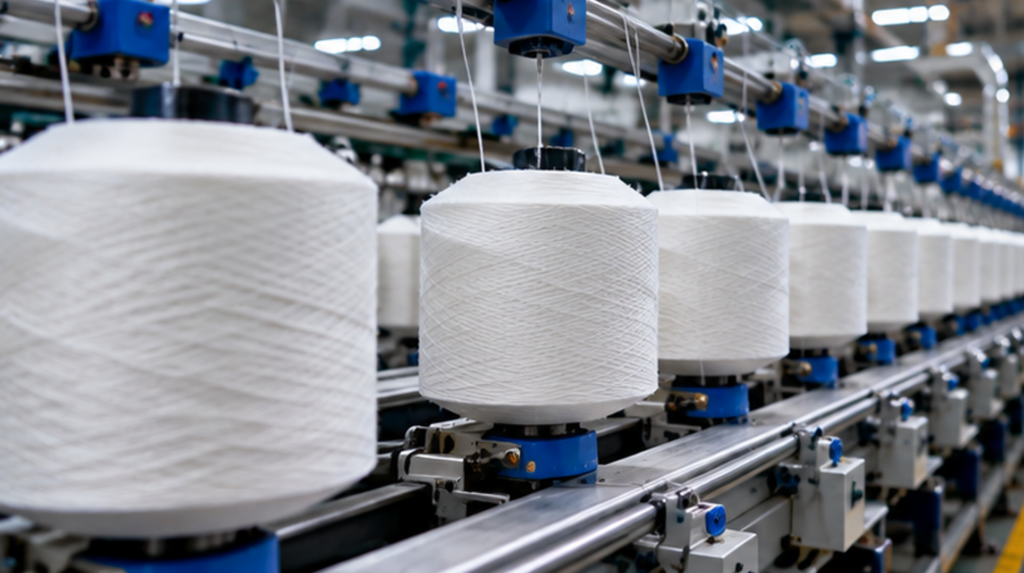
Nonwoven manufacturing uses fibers to form textile structures without conventional weaving or knitting.
Polyester staple fiber is used in several nonwoven technologies, including needle punching and selected carded thermal-bonding processes.
Fine Fibers in Nonwoven Production
Very fine polyester fibers may be evaluated for applications requiring relatively fine fiber structures.
Potential benefits can include:
- Finer web texture
- Greater fiber surface area
- Different pore structure
- Selected filtration or cleaning characteristics
- Particular softness or surface requirements
These properties depend on the finished web design and manufacturing process.
Conventional Polyester Staple Fiber in Nonwovens
Conventional polyester staple fiber grades are used in a wide range of nonwoven products.
Applications may include:
- Industrial felt
- Geotextiles
- Automotive carpet
- Trunk liners
- Mattress padding
- Furniture components
- Acoustic nonwoven structures
Depending on the product, manufacturers may prioritize fiber strength, bulk, web uniformity, processability, or cost.
Is Microfiber Always Better for Nonwovens?
No.
Very fine fibers can create additional challenges in certain opening, carding, or bonding processes.
For example, increased fiber surface area and changes in fiber friction may influence processing behavior.
A coarser fiber may be more appropriate when the target product requires different structural or mechanical characteristics.
The optimal grade should be selected according to the finished nonwoven specification.
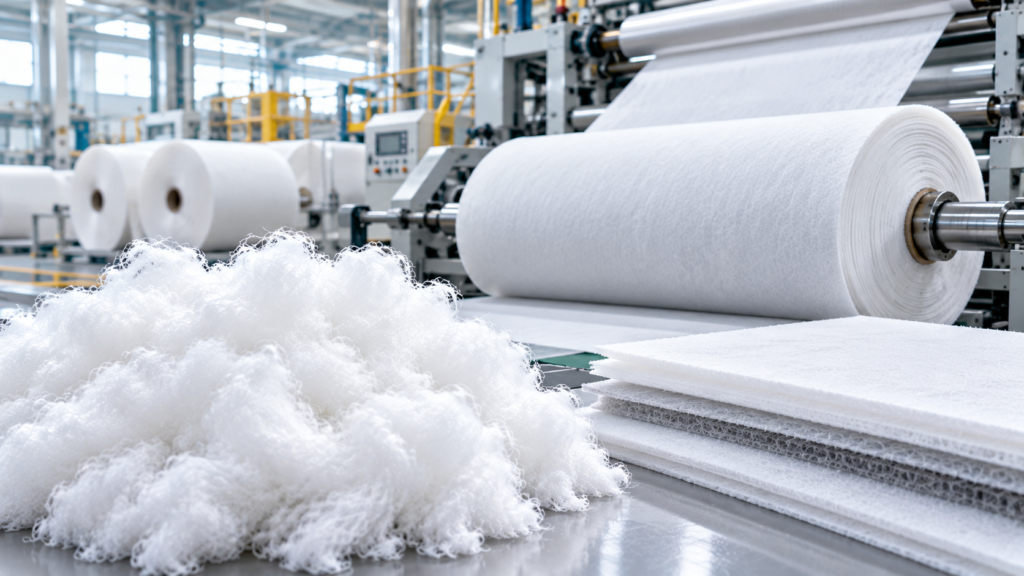
7. Which Fiber Is Better for Cleaning Textiles?
Cleaning textiles are an important market for microfiber-based materials.
However, the term microfiber cleaning cloth frequently refers to products made from fine synthetic filaments, including polyester/polyamide blends, rather than necessarily from recycled polyester staple fiber.
This distinction is important for raw material buyers.
Fine Fibers and Cleaning Performance
Fine fibers can contribute to textile structures with:
- High surface area
- Fine contact points
- Particular softness characteristics
- Specialized cleaning performance
However, cleaning effectiveness depends on more than fiber denier.
Other important factors include:
- Fiber composition
- Yarn construction
- Fabric structure
- Splitting or finishing processes
- Absorption and wetting behavior
- Lint generation
- Durability
Can Recycled Polyester Staple Fiber Be Used for Cleaning Products?
Yes, recycled polyester staple fiber may be evaluated for suitable spun-yarn or nonwoven cleaning textile applications.
However, a 100% polyester staple fiber product should not be assumed to provide the same performance as a split polyester/polyamide microfiber cloth.
Manufacturers should identify the intended textile construction before selecting raw fiber.
8. Polyester Fiber for Mattress and Padding Applications
Mattress and padding manufacturers generally evaluate fiber characteristics differently from spinning mills.
Important requirements may include:
- Bulk
- Loft
- Resilience
- Compression recovery
- Opening behavior
- Fiber finish
- Filling uniformity
Is Very Fine Microfiber Suitable for Mattress Padding?
Fine fibers may be considered for certain soft-touch or specialized filling applications.
However, very fine denier is not automatically the best choice for bulk filling.
Depending on the product, coarser solid fibers, hollow fibers, or blends may provide more suitable structural characteristics.
Why Fiber Structure Matters
A solid polyester staple fiber and a hollow polyester staple fiber may behave differently even when they have similar nominal denier.
Fiber cross-sectional structure, crimp, finish, and other properties can influence the finished filling.
For mattress manufacturing, buyers should evaluate the complete fiber specification rather than comparing microfiber and standard PSF by denier alone.
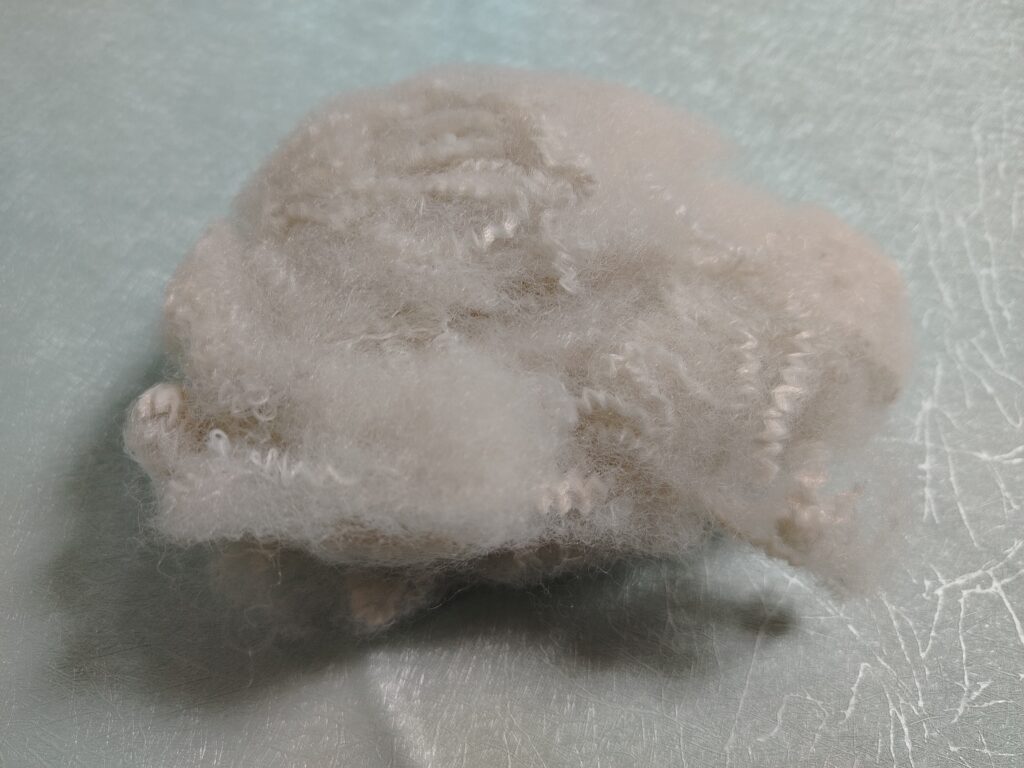
9. Fiber Strength, Elongation, and Crimp: What Changes?
Fiber fineness is important, but it not evaluate independently from mechanical properties.
Tenacity
Tenacity describes the breaking force relative to fiber linear density.
It is commonly express in units such as cN/dtex or cN/den.
Very fine polyester fiber is not automatically stronger or weaker than coarser polyester fiber.
Elongation at Break
Elongation describes how much a fiber extends before breaking.
It can influence fiber behavior during spinning, carding, and other processes.
Crimp
Crimp refers to the wave-like configuration of staple fibers.
It influences fiber cohesion, bulk, and processing characteristics.
Fiber Finish
Fiber finish can affect friction, static electricity, and machine compatibility.
When comparing different denier grades, buyers should review all these characteristics together.
A change in denier may require adjustments to other fiber properties or production settings.
10. Processing Challenges of Very Fine Recycled Polyester Fibers
Very fine recycled polyester fibers may require additional attention during manufacturing.
Fiber Opening
Finer fibers have greater total length per unit mass, which can influence how fiber masses separate during opening.
Static Electricity
Polyester fibers can develop electrostatic charges during processing.
The extent of the problem depends on environmental conditions, fiber finish, equipment, and other factors.
Carding and Drafting
Fine fibers may behave differently during carding and drafting because of changes in fiber count, friction, and cohesion.
Fiber Cleanliness
Contamination can be particularly problematic in applications requiring fine yarns or uniform nonwoven structures.
Batch Consistency
Variations in fineness, length, finish, or other properties can influence processing performance.
For buyers considering very fine recycled polyester fibers, sample testing and production trials are especially important.
11. Quality Requirements: What Buyers Should Check
When comparing recycled microfiber and standard polyester staple fiber, buyers should request technical information appropriate to their manufacturing process.
| Quality Parameter | Why Buyers Should Check It |
|---|---|
| Actual denier or dtex | Confirms fiber fineness |
| Denier variation | Helps assess fineness consistency |
| Cut length | Supports equipment compatibility |
| Length distribution | Identifies variation beyond nominal length |
| Tenacity | Evaluates mechanical characteristics |
| Elongation | Supports processing assessment |
| Crimp | Influences cohesion and bulk |
| Finish | Affects friction and processing |
| Cleanliness | Helps identify contamination risks |
| Color | Relevant to appearance requirements |
| Moisture | Relevant to material condition and handling |
| Lot identification | Supports traceability and quality review |
Buyers should distinguish between nominal specifications, typical test results, and guaranteed acceptance limits.
A Technical Data Sheet (TDS) is useful for initial comparison, while lot-specific quality records may be required for commercial approval.
12. Cost Comparison: Is Recycled Microfiber More Expensive?
Very fine recycled polyester staple fiber may carry different manufacturing costs from coarser grades.
Producing fine fibers can involve tighter process control and additional manufacturing challenges.
However, there is no universal price relationship that applies to every supplier and market.
Actual prices depend on factors such as:
- Fiber denier and cut length
- Recycled feedstock quality
- Product grade
- Production efficiency
- Quality requirements
- Order quantity
- Supply conditions
- Market demand
Compare Total Production Cost, Not Just Fiber Price
A lower purchase price does not necessarily mean lower manufacturing cost.
Buyers should consider:
Total Production Cost = Material Cost + Processing Cost + Waste + Quality-Related Costs
For example, a fiber with a lower price per kilogram may create additional costs if it causes excessive waste or frequent production adjustments.
Conversely, a finer fiber with a higher purchase price may be commercially justified when it enables the required finished-product characteristics.
The correct comparison should be based on actual production performance.
13. How to Choose Between Recycled Microfiber and Standard PSF
The following framework can help manufacturers identify the most appropriate fiber grade.
Step 1: Define the Finished Product
Is the material intended for yarn spinning, cleaning textiles, nonwovens, mattress padding, automotive components, or another application?
Step 2: Identify the Required Fiber Fineness
Determine whether very fine fiber is technically necessary.
Do not select microfiber simply because the term sounds more advanced.
Step 3: Confirm Equipment Compatibility
Review the spinning, carding, needle-punching, bonding, or filling equipment.
Step 4: Compare Technical Specifications
Evaluate denier, cut length, mechanical properties, crimp, finish, and cleanliness.
Step 5: Request Representative Samples
Ensure that the samples correspond to the proposed commercial grade.
Step 6: Conduct Production Trials
Evaluate processing stability, waste, and finished-product quality.
Step 7: Compare Commercial Performance
Review material price, processing costs, quality consistency, and supply arrangements.
Step 8: Establish Purchasing Specifications
Agree on the final fiber grade, critical tolerances, and quality acceptance requirements before regular ordering.
14. Application-Based Fiber Selection Guide
The table below provides general guidance rather than fixed technical recommendations.
| Application | Fiber Selection Considerations |
|---|---|
| Fine-count yarn spinning | Fine denier, length, tenacity, elongation, finish |
| Coarser yarn production | Fiber fineness matched to yarn structure and spinning system |
| Cleaning textiles | Fine fiber characteristics, fabric construction, lint performance |
| Needle-punched nonwovens | Denier, length, crimp, web formation |
| Automotive carpet | Fiber structure, processing, appearance, mechanical requirements |
| Mattress padding | Loft, resilience, structure, crimp, finish |
| Industrial felt | Fiber dimensions, mechanical properties, entanglement |
| Geotextiles | Fiber specifications matched to finished-product requirements |
There is no single polyester staple fiber grade that performs best across all applications.
Material selection should begin with the manufacturing process and finished-product requirements.
15. Recycled Polyester Microfiber and Staple Fiber from GDI Textile
GDI Textile supplies recycled polyester staple fiber for industrial textile applications.
Buyers evaluating fine-denier recycled polyester fiber and conventional staple fiber grades can discuss available specifications based on their manufacturing requirements.
Examples of fiber grades for technical discussion include:
- 1.4D × 38mm – White
- 1.4D × 38mm – Black
- 2.5D × 51mm – White
- 3D × 51mm – White
- 6D × 64mm – White or Black
- 15D × 76mm – White or Black
Availability and suitability has confirmed before ordering.
The 1.4D grades are commercially relevant fine-denier products, but not present as meeting a strict sub-1-dtex microfiber definition without qualification.
What Information Should Buyers Provide?
For a more accurate technical and commercial discussion, please share:
- Intended application
- Required fiber denier and cut length
- Color requirements
- Fiber structure and finish requirements
- Current material specification or reference sample
- Estimated purchasing quantity
- Destination country or port
- Critical quality requirements
Looking for Recycled Polyester Staple Fiber from Vietnam?
Contact GDI Textile to discuss available fine-denier and conventional polyester staple fiber grades, technical requirements, sample evaluation, and export supply options.
Website: https://ecomicrofiber.com/
Frequently Asked Questions
What is the difference between recycled microfiber and standard polyester staple fiber?
The main difference in this comparison is fiber fineness. Microfiber generally refers to very fine fibers, while standard polyester staple fiber includes a broad range of conventional fineness grades. Both can be produced from recycled polyester.
Is 1.4D polyester staple fiber considered microfiber?
Some suppliers commercially describe 1.4D polyester staple fiber as microfiber. However, 1.4D equals approximately 1.56 dtex and does not meet a strict microfiber definition below 1 dtex. Buyers should compare actual specifications rather than terminology alone.
Is recycled microfiber better than regular polyester fiber?
Not necessarily. Very fine fibers may be advantageous for selected applications, but coarser polyester staple fibers may be more suitable for other products. Performance depends on the application and manufacturing process.
Can recycled microfiber be used for yarn spinning?
Yes, suitable fine-denier recycled polyester staple fibers can be evaluated for yarn spinning. The correct grade depends on yarn count, spinning system, fiber properties, and production requirements.
Is microfiber always softer than standard polyester staple fiber?
Finer fibers can contribute to softer textile structures, but finished-product softness also depends on yarn construction, fabric structure, finishing, and other factors.
Can recycled polyester microfiber be used for nonwoven fabrics?
Yes. Suitable fine recycled polyester staple fibers may be processed into selected nonwoven structures. However, equipment compatibility and finished-product performance should be verified.
Which fiber is better for automotive carpet?
The appropriate grade depends on carpet construction, manufacturing equipment, mechanical requirements, appearance, and customer specifications. Microfiber is not automatically superior.
Is recycled microfiber more expensive than standard polyester fiber?
Very fine grades may involve different manufacturing costs, but pricing depends on the specific product, supplier, quality requirements, and market conditions.
Can recycled polyester staple fiber replace virgin polyester fiber?
In some applications, recycled polyester staple fiber may be evaluated as an alternative to virgin material. Replacement suitability must be confirmed through technical comparison, production trials, and applicable quality requirements.
Conclusion
Understanding the differences between recycled microfiber and standard polyester staple fiber helps manufacturers make better raw material purchasing decisions.
Fiber fineness influences the number of fibers per unit mass, fiber surface area, processing behavior, and potential finished-product characteristics.
However, denier is only one part of the technical specification.
Manufacturers should also consider cut length, tenacity, elongation, crimp, fiber finish, cleanliness, equipment compatibility, and batch consistency.
The best polyester staple fiber is not necessarily the finest or the cheapest. It is the grade that meets the required product performance with acceptable manufacturing efficiency and total cost.
For international buyers sourcing recycled polyester staple fiber products, a structured technical evaluation provides a stronger foundation for selecting suitable materials and establishing long-term supply relationships.