
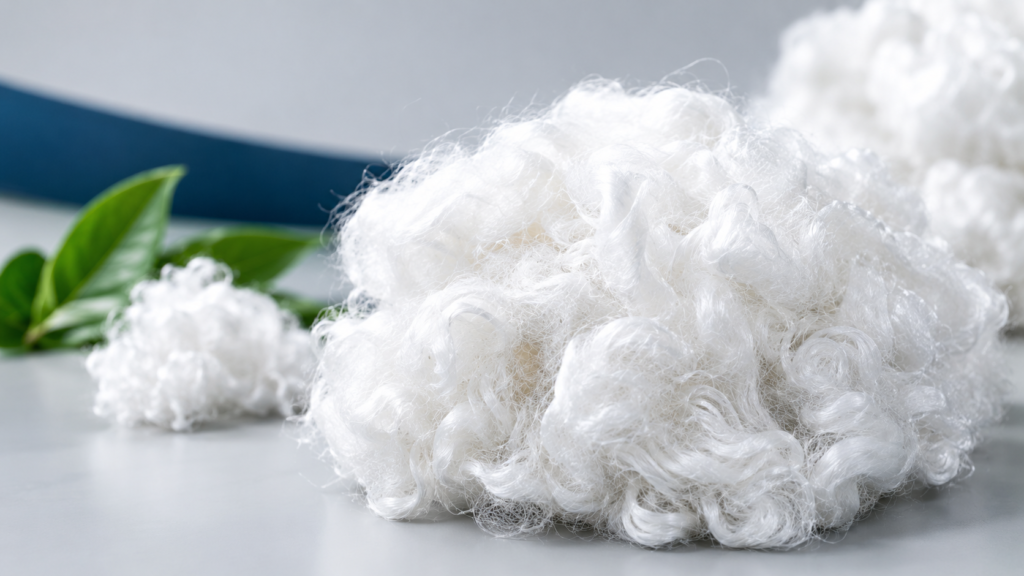
When sourcing recycled polyester staple fiber (RPSF), buyers need to understand more than the product name. Denier, cut length and color are three fundamental specification parameters that help identify the material required for a particular manufacturing process.
Choosing the wrong specification can lead to processing difficulties, material incompatibility or a finished product that does not meet the buyer’s requirements. At the same time, two suppliers quoting the same nominal denier and cut length may still offer products that differ in other characteristics.
For spinning mills, nonwoven manufacturers, mattress-padding producers and industrial textile buyers, a clear specification is the starting point for effective supplier communication and purchasing decisions.
This guide explains what denier, cut length and color mean, how these parameters influence fiber selection, and what international buyers should confirm before requesting a quotation for recycled polyester staple fiber.
Table of Contents
- What Are Recycled Polyester Staple Fiber Specifications?
- What Is Denier in Polyester Staple Fiber?
- What Is Cut Length and Why Does It Matter?
- How to Specify Fiber Color
- How Denier, Cut Length and Color Work Together
- Other Specifications Buyers Should Consider
- How to Select Specifications for Different Applications
- How to Compare Supplier Specifications
- Common Specification Mistakes
- RPSF Specification Checklist for Buyers
- Frequently Asked Questions
- Request a Quotation from Eco Micro Fiber
1. What Are Recycled Polyester Staple Fiber Specifications?
Recycled polyester staple fiber specifications describe the technical characteristics used to identify and evaluate a fiber grade.
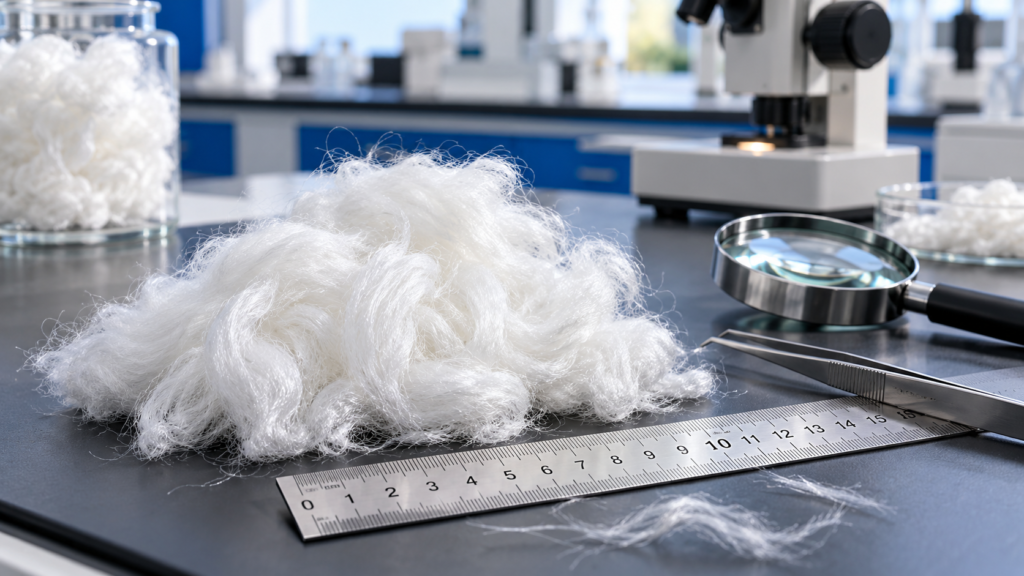
The exact specification depends on the product and its intended application. Three basic parameters are:
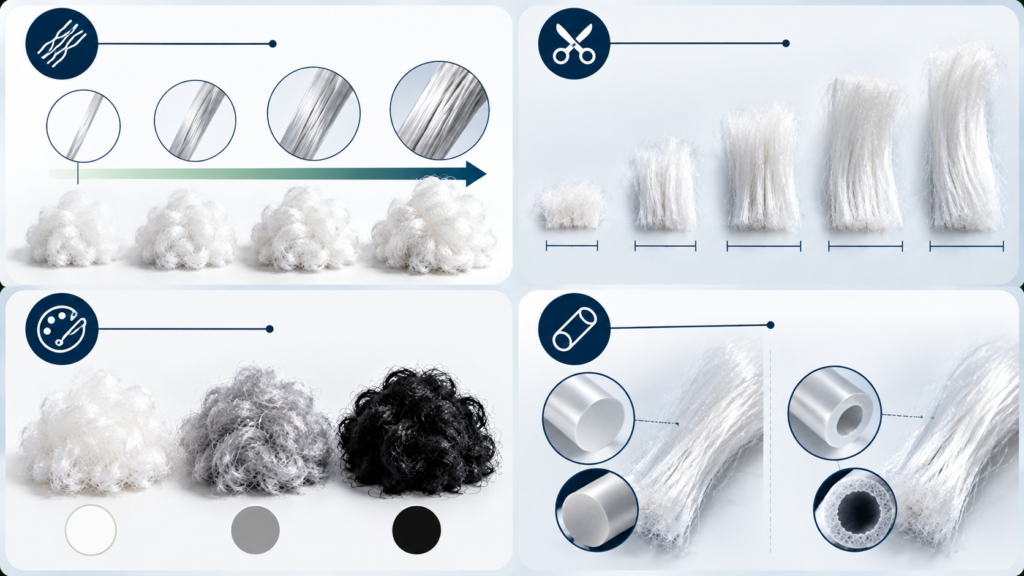
- Denier (D): The linear mass of the fiber.
- Cut length (mm): The length of the staple fiber.
- Color: The specified color of the supplied material, such as white or black.
Other parameters may also be relevant, including fiber structure, crimp, finish, moisture, contamination limits and mechanical properties. Not every parameter applies to every application, so buyers should identify which characteristics are essential to their production process.
For example, a spinning mill may need a specification compatible with its spinning system, while a nonwoven producer may have different requirements related to web formation and consolidation.
A useful specification should allow the buyer and supplier to identify the same product, agree on acceptance criteria and evaluate whether the fiber is suitable for the intended process.
Why specification accuracy matters
An incomplete inquiry can result in quotations for different fiber grades. If one supplier quotes a different cut length or color from another, comparing the prices alone may be misleading.
A clear specification helps buyers:
- Request comparable quotations.
- Reduce ambiguity during sample approval.
- Communicate technical requirements more effectively.
- Define product acceptance criteria before ordering.
- Compare delivered material against the agreed specification.
The goal is not to specify every possible parameter. It is to define the characteristics that matter to the application.
2. What Is Denier in Polyester Staple Fiber?
Denier is a unit of linear mass used to describe the fineness of a fiber or filament.
One denier corresponds to a mass of one gram per 9,000 meters of fiber. A lower denier indicates lower mass per unit length, while a higher denier indicates greater mass per unit length.
In recycled polyester staple fiber purchasing, denier is commonly included in the product grade.
Examples include:
- 1.4D
- 2.5D
- 3D
- 6D
- 15D
These are examples of nominal denier grades, not a recommendation that any one grade is suitable for every application.
2.1 How denier affects fiber selection
Denier is an important identification parameter, but it does not independently determine the final performance of a material.
A fiber’s suitability depends on the complete specification, manufacturing process and intended end use. Other characteristics, such as cut length, fiber structure and finish, may also influence how the material behaves during processing.
Buyers should therefore avoid selecting a grade based on denier alone.
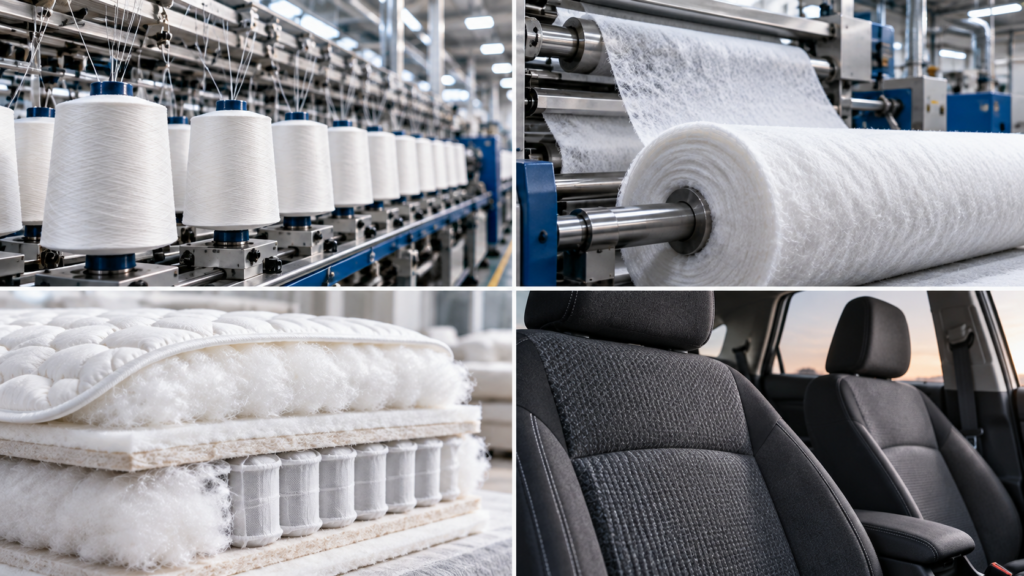
For instance, a manufacturer sourcing fiber for spinning should evaluate the proposed grade against the requirements of its spinning process and intended yarn. A manufacturer producing padding or nonwoven materials should consider the requirements of its own forming and finishing processes.
2.2 How to compare denier grades
When comparing two offers, first confirm that the denier values refer to equivalent specifications and measurement conventions.
Then ask the following questions:
- Is the stated denier nominal or subject to a specified tolerance?
- What tolerance applies to the supplied product?
- Are the cut length and color also equivalent?
- Are there additional requirements for crimp, finish or other properties?
- What technical documents are available to verify the specification?
The supplier’s actual product specification should take precedence over assumptions based on a general product description.
2.3 Denier is not the same as cut length
Denier and cut length describe different properties.
Denier describes linear mass, while cut length describes the length of the staple fiber. A product with a specified denier can be offered in different cut lengths, depending on the product range and manufacturing requirements.
Both parameters should be stated separately in a purchase inquiry.
For example, 1.4D × 38mm identifies a nominal denier of 1.4D and a cut length of 38mm. It does not, by itself, define every quality characteristic of the fiber.
Buyers looking for a specific grade can review the 1.4D × 38mm recycled polyester fiber product page for product-specific information.
3. What Is Cut Length and Why Does It Matter?
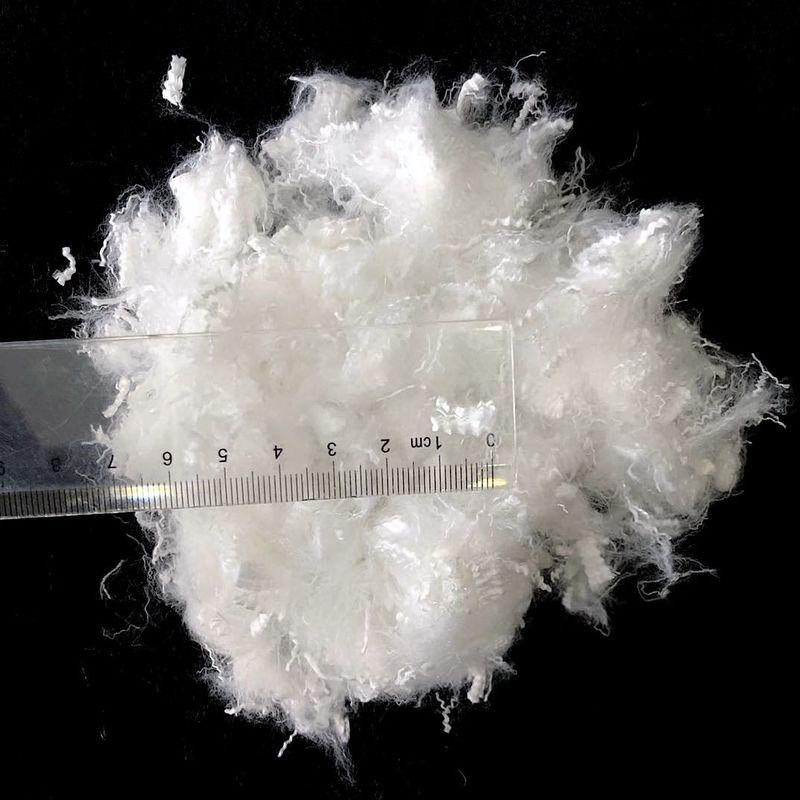
Cut length is the length to which continuous or processed fiber is cut to create staple fibers. It is usually expressed in millimeters.
Examples of cut lengths that buyers may encounter include:
- 32mm
- 38mm
- 51mm
- 64mm
- 76mm
- 90mm
These examples represent different nominal lengths. They should not be treated as interchangeable or assumed to be available in every denier or color.
3.1 Why cut length matters
Cut length must be considered in relation to the manufacturing process.
Different applications use different fiber-processing systems. A cut length suitable for one process may not be suitable for another.
For spinning, the fiber length must be compatible with the mill’s processing equipment and the requirements of the intended yarn.
For nonwoven manufacturing, fiber length may affect how the material is handled and formed into a web. The appropriate specification depends on the equipment, web-forming method and finished material.
For filling and padding applications, buyers should evaluate cut length alongside other fiber characteristics and the design of the final product.
These are general selection principles rather than guaranteed performance relationships. The appropriate cut length should be confirmed against the buyer’s actual process requirements.
3.2 How to specify cut length accurately
When requesting a quotation, state the required nominal cut length and ask the supplier to confirm the applicable tolerance.
A complete inquiry should clarify:
- Nominal cut length.
- Permitted variation, if specified.
- Whether the buyer has an approved reference sample.
- Any process-specific length requirements.
- The inspection method or documentation required, where applicable.
Avoid assuming that two products with the same nominal cut length necessarily have identical length distributions or tolerances.
If cut-length consistency is important to your manufacturing process, make the acceptance requirements explicit before sample approval or commercial ordering.
3.3 Common cut-length combinations
The following examples illustrate how buyers can identify a grade by combining denier and cut length.
| Example grade | Specification components |
|---|---|
| 1.4D × 38mm | Nominal denier 1.4D; cut length 38mm |
| 2.5D × 51mm | Nominal denier 2.5D; cut length 51mm |
| 3D × 51mm | Nominal denier 3D; cut length 51mm |
| 6D × 64mm | Nominal denier 6D; cut length 64mm |
| 15D × 76mm | Nominal denier 15D; cut length 76mm |
The table explains the notation; it does not establish that all combinations are available in every color, structure or finish. Buyers should confirm the actual product offering with the supplier.
For a product-specific review, see the 6D × 64mm recycled polyester fiber page and the 15D × 76mm recycled polyester fiber page.
4. How to Specify Fiber Color
Color is another important purchasing parameter, particularly when the fiber is visible in the finished product or when it is used in a process with specific color requirements.
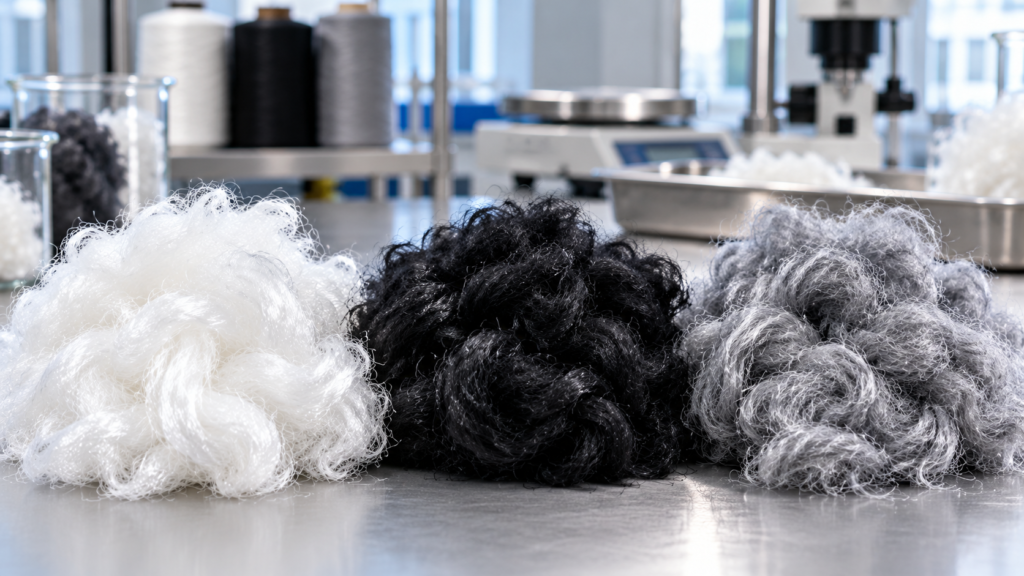
Depending on the product range, recycled polyester staple fiber may be supplied in colors such as white and black.
However, a basic color description does not define every aspect of color consistency.
4.1 White recycled polyester staple fiber
White fiber may be selected for applications where a light-colored material is required or where the fiber will undergo further processing.
Buyers should clarify whether they require a particular shade, whiteness level or color tolerance. If a precise visual appearance is important, request a representative sample and agree on the acceptance criteria.
Do not assume that the term “white” guarantees an identical shade across different suppliers or production lots.
4.2 Black recycled polyester staple fiber
Black fiber may be relevant to applications where a dark-colored fiber is required or preferred.
Buyers should confirm the acceptable shade and variation, along with the other required specifications. If the fiber is intended for a visible component, comparing representative samples under consistent viewing conditions can help clarify expectations.
The color name alone does not establish suitability for a particular technical application.
4.3 How to define color acceptance
For commercial procurement, the buyer and supplier should agree on how color will be assessed.
Depending on the application, this may include:
- A physical reference sample.
- An agreed visual acceptance standard.
- Instrumental color measurement, if required.
- Acceptable variation between production lots.
- Identification and handling of approved samples.
The appropriate method depends on the buyer’s quality system and the importance of color to the finished product.
4.4 Color and other technical requirements
Color should be considered alongside denier, cut length and other relevant properties.
A white fiber and a black fiber with the same nominal denier and cut length should not automatically be assumed to have identical characteristics in every other respect. Buyers should compare the actual product specifications and request the relevant technical information.
For more information, visit the white recycled polyester fiber and black recycled polyester fiber product pages, where available, and confirm the specific grade required.
5. How Denier, Cut Length and Color Work Together
Denier, cut length and color should be treated as separate but complementary elements of a fiber specification.
Consider a buyer requesting 6D × 64mm white recycled polyester staple fiber.
The specification communicates three things:
- Denier: The nominal linear mass is 6D.
- Cut length: The nominal staple length is 64mm.
- Color: The required color is white.
This description gives the supplier a clearer starting point than a request for “recycled polyester fiber” alone.
However, the three parameters do not necessarily provide all the information needed for a commercial order. The buyer may also need to specify fiber structure, finish, applicable tolerances, packaging and quality requirements.
A practical specification comparison
| Parameter | Question to ask | Why it matters |
|---|---|---|
| Denier | What nominal denier and tolerance are required? | Identifies the fiber’s linear-mass grade |
| Cut length | What nominal length and tolerance are required? | Helps match the material to the manufacturing process |
| Color | What color and acceptable variation are required? | Helps align the supplied material with the finished-product requirements |
| Structure | Is solid or hollow fiber required? | Distinguishes different fiber structures |
| Finish | Are any specific finish requirements necessary? | Helps address application-specific processing needs |
| Quality criteria | Which properties must be checked? | Defines the basis for sample approval and product acceptance |
The key is to make sure that the supplier’s quotation, approved sample and purchase order all refer to the same specification.
6. Other Specifications Buyers Should Consider
Denier, cut length and color are fundamental, but they may not be sufficient for every industrial application.
Depending on the end use, buyers may need to consider the following additional parameters.
6.1 Solid or hollow structure
Solid and hollow fibers have different cross-sectional structures and may be selected for different product designs.
Buyers should clearly identify the required structure instead of assuming that the denier and cut length define it.
For solid fiber requirements, see the solid recycled polyester fiber product page.
6.2 Crimp
Crimp refers to the waviness or three-dimensional configuration of a fiber.
Where crimp is relevant to the manufacturing process, buyers should confirm the applicable requirements and whether the supplier can provide supporting technical information.
6.3 Finish and siliconization
Some applications may require a particular fiber finish or siliconization. These requirements should be stated explicitly rather than inferred from the product’s general description.
Buyers should confirm whether the offered grade meets their process requirements before placing an order.
6.4 Mechanical properties and other test parameters
Depending on the application, relevant properties may include tensile behavior, elongation or other specified test parameters.
Do not assume that the same test requirements apply to every grade. The buyer should identify the properties that matter and agree on the applicable methods and acceptance criteria with the supplier.
6.5 Moisture, contamination and packaging
Requirements relating to moisture, contamination, packaging and labeling may also matter to industrial buyers.
These requirements should be defined in a way that is appropriate to the product and the buyer’s quality system. If a specific limit is required, include it in the technical specification or purchase agreement.
7. How to Select Specifications for Different Applications
The best starting point is the manufacturing process and the requirements of the finished product.
7.1 Yarn spinning
Spinning mills should begin with the requirements of their spinning system, target yarn and fiber-blending process.
Confirm the required denier, cut length and any additional characteristics specified by the mill. If the fiber is intended to replace an existing grade, provide the approved specification or a reference sample where possible.
A sample trial may help establish whether the proposed fiber is suitable for the intended production process.
7.2 Nonwoven manufacturing
Nonwoven manufacturers should describe the web-forming method, consolidation process and intended end product.
The required fiber grade depends on the equipment and the characteristics of the finished nonwoven. Denier and cut length are important inputs, but they should be assessed alongside any relevant structural, finish and quality requirements.
7.3 Mattress padding and filling
For mattress padding, wadding and filling, buyers should clarify the product construction and the required fiber structure.
Denier, cut length, color and other application-specific requirements should be considered together. Where solid fiber is required, specify it explicitly and confirm that the proposed product meets the intended use.
7.4 Automotive and technical textile applications
Automotive interiors and other technical textile applications may involve additional material and customer-approval requirements.
Buyers should communicate the intended component, applicable technical specifications and any documentation or testing requirements. A general-purpose grade should not be assumed to satisfy an application without appropriate evaluation.
7.5 Furniture, cushions and other filling products
For furniture and filling applications, buyers should identify whether the fiber will be used as loose filling, within a bonded structure or in another product construction.
The correct specification depends on the design, processing method and intended finished-product characteristics.
Across all applications, the supplier should confirm the exact offered grade rather than making assumptions based only on the product category.
8. How to Compare Supplier Specifications
When comparing quotations from different suppliers, buyers should first determine whether the quoted products are technically equivalent.
A structured comparison can include the following:
| Item | What to verify |
|---|---|
| Product identification | Same product type and intended structure |
| Denier | Same nominal grade and comparable tolerance |
| Cut length | Same nominal length and comparable tolerance |
| Color | Same color requirement and agreed acceptance criteria |
| Other technical parameters | Equivalent requirements for finish, crimp or relevant test properties |
| Supporting documents | Availability of the requested specification and test information |
| Packaging | Same or clearly stated packing requirements |
| Commercial terms | Comparable quantity, delivery basis, payment terms and shipment conditions |
If the offers differ in important parameters, they should not be treated as direct price equivalents.
For example, two quotations may both describe recycled polyester staple fiber but refer to different cut lengths or colors. The buyer should resolve those differences before deciding which quotation is more competitive.
The same principle applies to documentation. If a specific test report or certification is required, confirm its availability and scope rather than assuming that it is included.
9. Common Specification Mistakes
Mistake 1: Requesting only the denier
Denier alone does not identify the complete fiber grade. Include cut length, color and any other essential requirements.
Mistake 2: Assuming nominal values mean identical tolerances
Two products can share the same nominal denier or cut length while having different specified tolerances. Ask suppliers to clarify the actual specification.
Mistake 3: Describing color too broadly
Terms such as white and black may not communicate the required shade or acceptable variation. Provide a reference sample or define a suitable acceptance method when color consistency matters.
Mistake 4: Ignoring the intended application
A grade should be evaluated against the buyer’s manufacturing process and finished-product requirements, not simply selected because its denier appears suitable.
Mistake 5: Assuming the same grade is available in every configuration
Do not assume that every denier is available in every cut length, color, structure or finish. Confirm the specific product offering and availability with the supplier.
Mistake 6: Failing to document the approved specification
The agreed product details should be reflected in the quotation, sample approval and purchase order. This helps reduce ambiguity during delivery and inspection.
10. RPSF Specification Checklist for Buyers
Before sending an inquiry to a recycled polyester staple fiber supplier, prepare the information below.
Basic product identification
- Product type: recycled polyester staple fiber.
- Required denier.
- Required cut length.
- Required color.
- Solid or hollow structure, if applicable.
Additional technical requirements
- Finish or siliconization requirements, if applicable.
- Crimp or other relevant properties, if applicable.
- Required tolerances.
- Test parameters and acceptance criteria.
- Reference specification or sample, if available.
Commercial requirements
- Estimated order quantity.
- Intended application.
- Destination country or port.
- Preferred shipping terms.
- Required delivery schedule.
- Packaging and documentation requirements.
You do not need to know every technical detail before making contact. If you have an existing specification sheet, share it with the supplier. If some requirements are still under evaluation, explain the intended application and ask which information is needed to identify a suitable grade.
A complete inquiry helps the supplier review the request and clarify any missing information before preparing a quotation.

11. Frequently Asked Questions
What are the main specifications of recycled polyester staple fiber?
The basic specifications commonly include denier, cut length and color. Depending on the application, buyers may also need to specify fiber structure, finish, tolerances, relevant test parameters and packaging requirements.
What does 1.4D × 38mm mean?
It identifies a nominal denier of 1.4D and a cut length of 38mm. The notation does not independently define color, fiber structure, finish or all quality requirements.
Is higher denier always better?
No. Denier identifies the fiber’s linear mass, but suitability depends on the intended application and the complete fiber specification. Buyers should select a grade based on their process requirements rather than assuming that a higher or lower denier is universally preferable.
Is a longer cut length always better?
No. The appropriate cut length depends on the manufacturing process and intended end product. Buyers should confirm the required length and tolerance against their equipment and product specifications.
Can the same denier be supplied in different colors?
Product availability depends on the supplier’s actual range. Buyers should confirm whether the required denier and cut length are available in the requested color and whether any additional specification differences apply.
Do two fibers with the same denier and cut length have identical quality?
Not necessarily. Other properties, tolerances, raw materials, manufacturing conditions and finishing requirements may differ. Compare the complete specification and relevant supporting documentation.
How can I confirm whether an RPSF grade is suitable for my factory?
Share the intended application, equipment or processing method, target product requirements and existing fiber specification with the supplier. Review the proposed technical details and evaluate samples or conduct a production trial where appropriate.
What should I include in a quotation request?
At minimum, provide the required denier, cut length, color, intended application and estimated order quantity. Also state any structure, finish, quality, documentation or delivery requirements that are important to your purchase.
12. Request a Recycled Polyester Staple Fiber Quotation
Looking for recycled polyester staple fiber for yarn spinning, nonwoven production, mattress padding, furniture filling or another industrial application?
Eco Micro Fiber welcomes inquiries from international buyers who need to clarify product specifications and sourcing requirements.
When contacting us, please share:
- Required denier and cut length
- Required color
- Solid or hollow structure, if applicable
- Intended application
- Estimated order quantity
- Destination country or port
- Any specific technical, quality or documentation requirements
If you already have a specification sheet or reference sample, include that information in your inquiry. It can help clarify the product requirements and support a more accurate quotation.
Contact Eco Micro Fiber to discuss your requirements and request a quotation.
Email: [email protected]
Product specifications, availability, tolerances, documentation and commercial terms should be confirmed for each inquiry before an order is placed.