Fiber Selection, Nonwoven Manufacturing, Quality Requirements, and Sourcing Considerations for B2B Buyers
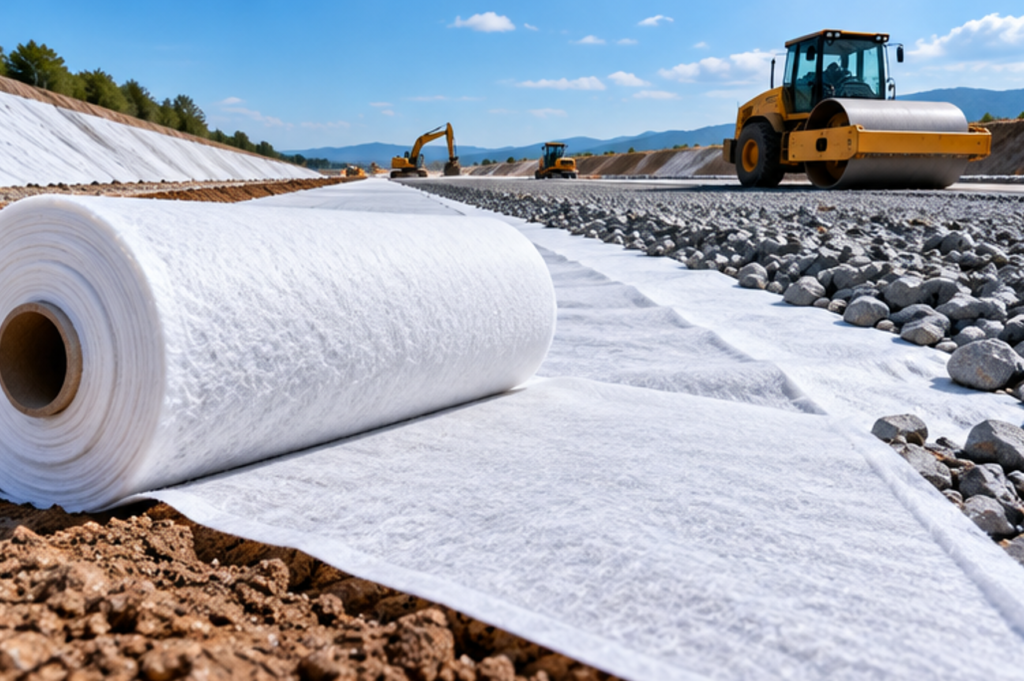
Geotextiles play an important role in civil engineering, infrastructure construction, drainage systems, and soil management. These technical textile materials are designed to perform specific functions such as separation, filtration, drainage, reinforcement, and protection.
For manufacturers producing nonwoven geotextiles, raw material selection is a critical part of achieving consistent production and meeting finished-product requirements.
Recycled polyester staple fiber (RPSF) can be evaluated as a raw material for selected geotextile applications, particularly where the manufacturing process is compatible with polyester staple fibers.
However, not every recycled polyester fiber grade is suitable for every geotextile product. The correct selection depends on fiber specifications, nonwoven production technology, environmental exposure, and the technical standards required for the finished material.
This guide explains how recycled polyester fiber can be used in geotextile manufacturing, which technical parameters buyers should consider, and how to evaluate potential fiber suppliers.
1. What Is Recycled Polyester Fiber for Geotextiles?
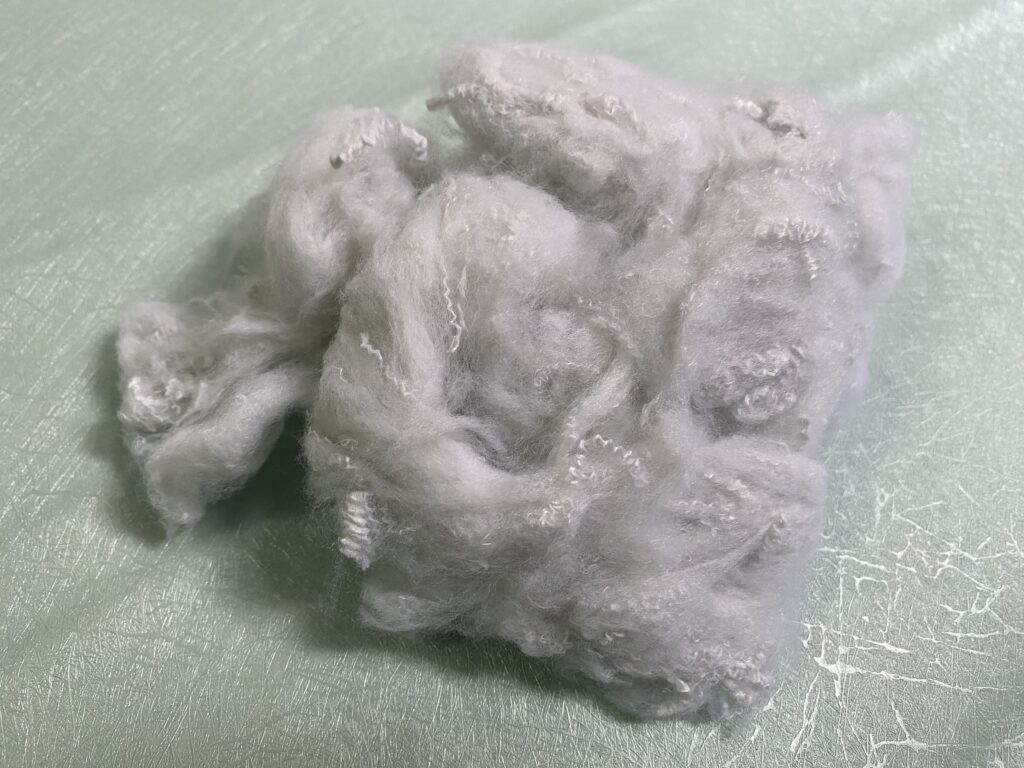
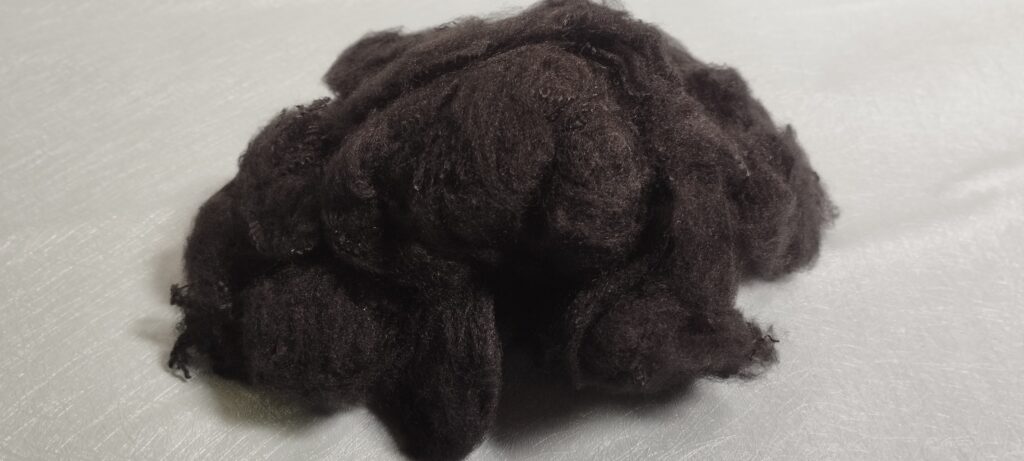
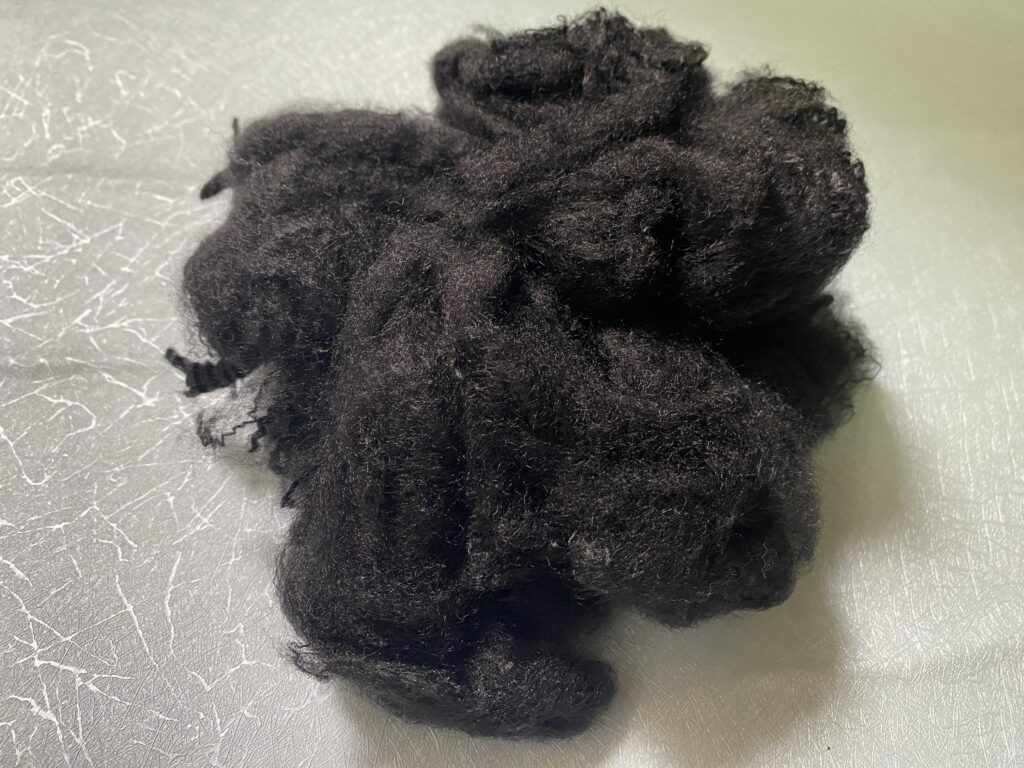
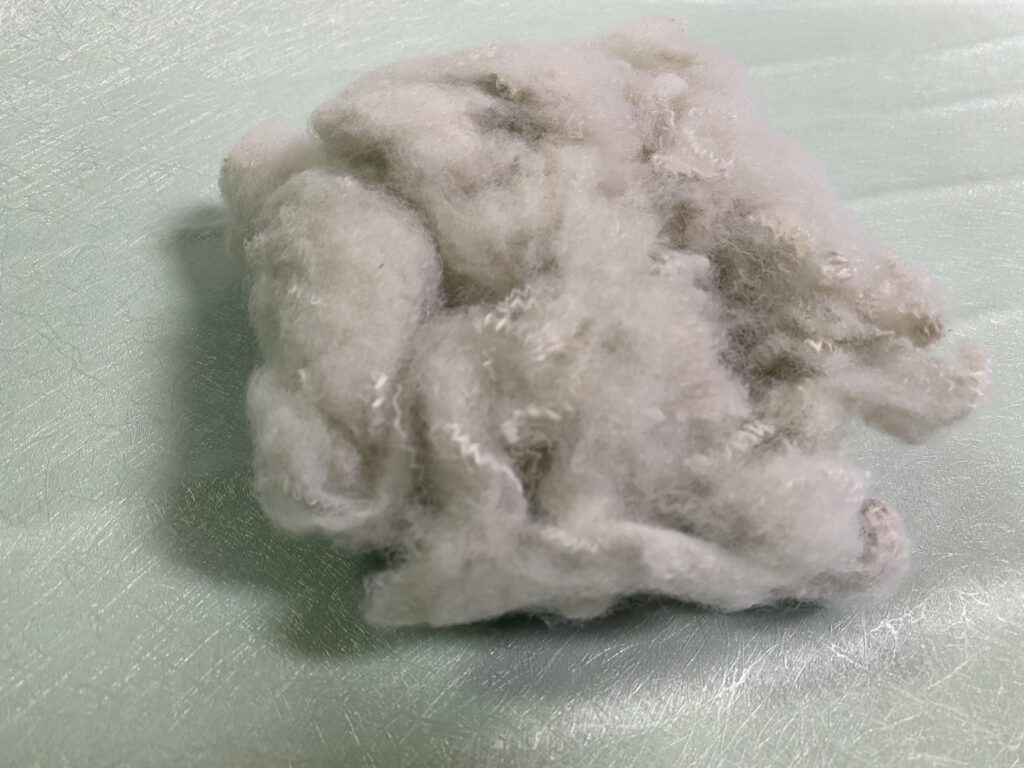
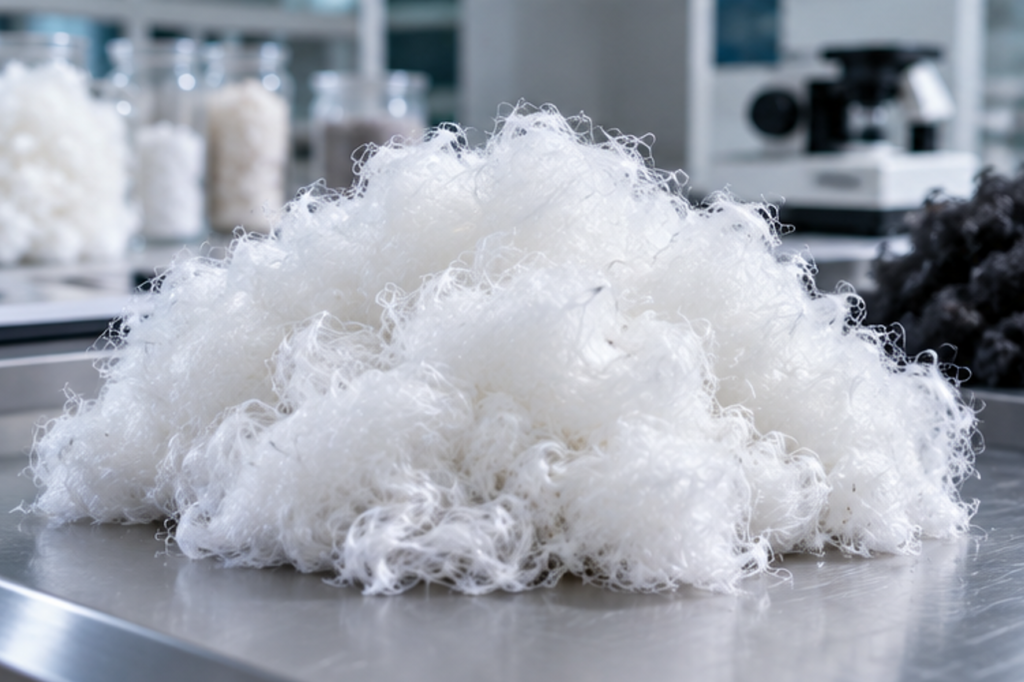
Recycled polyester staple fiber is a short-length polyester fiber manufactured from recycled polyester feedstock, which may include recycled PET materials.
Unlike continuous filament yarn, staple fiber consists of individual fibers cut to specified lengths.
These fibers can be opened, blended, carded, laid into a web, and bonded or mechanically entangled to form nonwoven materials.
In geotextile manufacturing, recycled polyester staple fiber may be used as a component of nonwoven structures when the fiber characteristics and finished-product performance satisfy the intended application.
Key characteristics that manufacturers may need to evaluate include:
- Fiber denier and cut length
- Tensile properties and elongation
- Crimp and fiber cohesion
- Fiber-opening and carding behavior
- Consistency between production lots
- Contamination and cleanliness
- Compatibility with the selected bonding process
The term “recycled polyester fiber” describes the raw material. It does not automatically establish the mechanical, hydraulic, durability, or compliance properties of a finished geotextile.
2. How Is Recycled Polyester Fiber Used in Geotextile Manufacturing?
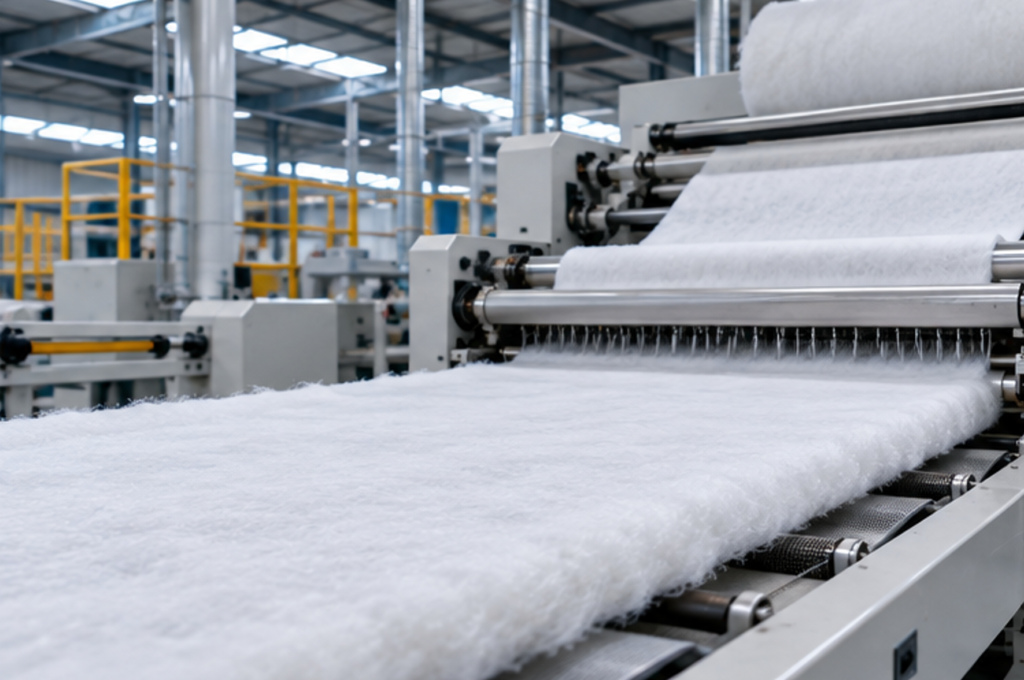
One potential manufacturing route is needle-punched nonwoven production.
In this process, staple fibers are mechanically entangled to form a textile structure.
A simplified production sequence includes the following stages.
Fiber Opening and Blending
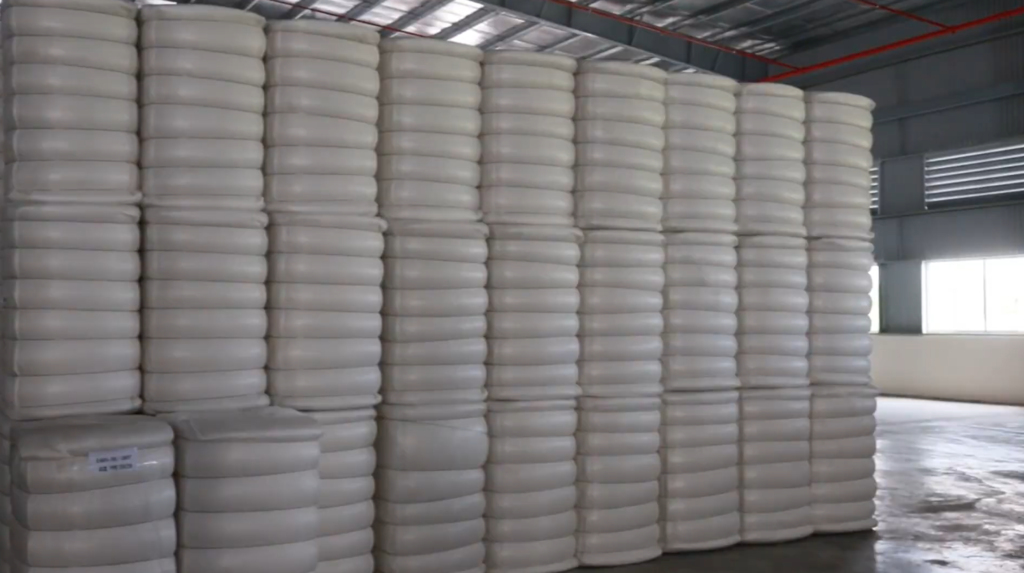
Compressed fiber bales are opened and loosened to prepare the material for downstream processing.
Where multiple fiber grades or raw materials are used, blending helps distribute the components through the production feed.
Manufacturers should evaluate opening efficiency, fiber separation, and contamination control.
Carding and Web Formation
The opened fibers pass through suitable web-forming equipment.
Depending on the production line, fibers may be arranged using carding, cross-lapping, or other web formation technologies.
Fiber length, crimp, and surface characteristics can influence web formation and processing stability.
Needle Punching
Barbed needles repeatedly penetrate the fiber web, mechanically entangling fibers to develop a coherent nonwoven structure.
Needling conditions, fiber characteristics, web weight, and product construction influence the properties of the resulting material.
Finishing and Inspection
The nonwoven may undergo additional processing, such as thermal treatment, calendaring, cutting, or winding, depending on the product design.
Finished geotextile rolls are then evaluated against the applicable technical specification.
Important: Successful fiber processing does not by itself demonstrate that the finished geotextile meets a project’s engineering requirements. Product testing and qualification remain necessary.
3. Geotextile Applications That May Use Polyester Nonwoven Materials
Geotextiles are used for several distinct engineering functions.
Each function places different demands on the textile structure.
Separation
Separation geotextiles are placed between dissimilar soil or aggregate layers to help limit unwanted mixing.
For example, a geotextile has used between a subgrade and an aggregate layer in certain road or construction designs.
Relevant finished-product characteristics may include tensile strength, puncture resistance, installation survivability, and hydraulic properties.
The fiber used in such a material have evaluated as part of the overall geotextile construction.
Filtration
Filtration geotextiles designed to allow water to pass while retaining soil particles according to the project’s design criteria.
Performance depends on factors such as characteristic opening size, permeability, soil conditions, and material structure.
Fiber selection may influence web formation and pore structure, but filtration suitability has established through finished-product testing.
Drainage
Certain geotextiles help convey water within or through a drainage system.
Relevant performance requirements can include water flow capacity, thickness under load, and long-term hydraulic behavior.
A suitable recycled polyester fiber must be compatible with the manufacturing process and the finished drainage product’s design requirements.
Protection
Geotextiles used as protective layers in engineered systems, including certain geomembrane protection applications.
These products can require specific puncture resistance, thickness, mass per unit area, and compression-related characteristics.
Fiber properties contribute to the material structure, but finished-product performance must be verified.
Erosion Control
Textile materials can be incorporated into erosion-control systems, depending on the design and environmental conditions.
The selection of polyester-based materials should consider exposure conditions, durability, installation requirements, and applicable project specifications.
Not every erosion-control application is appropriate for recycled polyester staple fiber.
Reinforcement
Some geotextile systems designed to provide reinforcement.
However, reinforcement applications often require specific tensile strength and stiffness characteristics that depend heavily on textile construction.
Buyers should not assume that a conventional needle-punched staple-fiber geotextile can replace a purpose-designed reinforcement geotextile.
The final material has evaluated against the engineering requirements.
4. Important Fiber Specifications for Geotextile Manufacturing
Selecting recycled polyester staple fiber involves more than choosing a product labeled “RPSF.”
Buyers should review the parameters that influence their specific production line and target material.
| Fiber Parameter | Why It Matters |
|---|---|
| Denier | Influences fiber fineness, web structure, and processing behavior |
| Cut length | Affects fiber handling, carding, web formation, and entanglement |
| Tensile strength | Relevant to fiber mechanical behavior during processing |
| Elongation | Influences fiber response to mechanical stress |
| Crimp | Can affect fiber cohesion, bulk, and web formation |
| Fiber finish | May influence friction, static behavior, and processing |
| Color | Relevant where appearance or customer specifications require control |
| Impurity level | Important for equipment operation and product cleanliness |
| Lot consistency | Supports more predictable production and quality management |
Denier
Denier is a measure of fiber linear density.
Different deniers can affect fiber count per unit mass, web structure, and manufacturing behavior.
A finer fiber does not automatically produce a better geotextile, and a coarser fiber is not necessarily more suitable for every industrial application.
The appropriate denier determined through process evaluation and finished-product testing.
Cut Length
Cut length describes the nominal length of individual staple fibers.
Fiber length influences handling, web formation, and mechanical entanglement.
Manufacturers should select cut length according to their equipment configuration, process conditions, and target material properties.
Crimp
Crimp refers to the waviness introduced into staple fibers.
It can influence fiber cohesion, handling, and web formation.
The appropriate crimp characteristics depend on the production process and product requirements.
Tensile Properties
Fiber tensile strength and elongation are relevant technical parameters, but they are not be confused with the tensile strength of a finished geotextile.
The finished material’s tensile performance depends on fiber properties, web architecture, bonding, needling conditions, and other production factors.
Fiber Cleanliness
Unwanted contamination can create problems during opening, carding, and downstream processing.
Manufacturers should define acceptable impurity levels and inspection procedures based on their equipment and customer requirements.
5. Which Recycled Polyester Fiber Denier and Length Are Suitable for Geotextiles?
There is no single denier and cut length that is universally suitable for all geotextile applications.
The correct specification depends on the manufacturing system and the intended finished product.
For example, a manufacturer may evaluate a fiber grade such as 6D × 64 mm for selected industrial nonwoven applications.
However, this specification should be treated as a candidate for technical evaluation, not as a guaranteed geotextile-grade standard.
Before approving any grade, manufacturers should consider:
- Fiber-opening equipment and feeding conditions
- Carding and web-forming compatibility
- Needle-punching requirements
- Target fabric mass per unit area
- Required thickness and mechanical properties
- Hydraulic properties, where relevant
- Finished-product testing standards
If the buyer currently uses virgin polyester fiber or another approved material, a trial with recycled fiber may help determine whether a substitution is technically feasible.
The trial should evaluate both processing behavior and the resulting geotextile’s performance.
6. Recycled Polyester vs Virgin Polyester Fiber for Geotextiles
Both recycled and virgin polyester fibers has considered for selected technical textile applications.
The main distinction is the origin of the polyester feedstock.
Virgin polyester is manufactured from newly produced raw materials, while recycled polyester incorporates recovered polyester feedstock.
However, raw material origin alone does not determine final fiber quality.
Relevant differences may arise from:
- Feedstock consistency
- Manufacturing and process controls
- Fiber dimensions and mechanical properties
- Contamination levels
- Surface finish
- Lot-to-lot variation
- Documentation and traceability
Recycled polyester can support recycled-content objectives when the relevant claims are properly documented.
Nevertheless, the environmental benefit of a particular product should not be quantified without appropriate supporting evidence, such as a credible lifecycle assessment.
Similarly, recycled content does not establish compliance with a geotextile performance standard.
For B2B procurement, the appropriate comparison is based on verified specifications, processing performance, finished-product testing, supply consistency, and total purchasing cost.
7. Quality Requirements for Geotextile Fiber Buyers
Geotextile manufacturers should distinguish between raw-fiber quality checks and finished-geotextile qualification.
Raw Fiber Quality Checks
Depending on the agreed specification, checks may include:
- Denier and cut-length consistency
- Tensile strength and elongation
- Crimp characteristics
- Color uniformity
- Contamination or foreign material
- Bale condition and packaging
- Production lot identification
The supplier should confirm which tests and records are available for the specific product.
Finished Geotextile Testing
Depending on the application and governing specification, relevant properties may include:
- Mass per unit area
- Thickness
- Tensile strength and elongation
- Static puncture resistance
- Dynamic perforation resistance
- Characteristic opening size
- Water permeability or permittivity
- In-plane water flow capacity
- Durability under expected exposure conditions
Applicable test methods and acceptance criteria vary by project, region, product function, and contractual requirements.
For example, a buyer may need to evaluate relevant ISO, ASTM, EN, or other project-specific test methods.
A raw polyester fiber supplier should not claim that its fiber alone meets a finished-geotextile standard unless the claim is technically applicable and supported by evidence.
The geotextile manufacturer remains responsible for validating its finished product against the relevant requirements.
8. Chemical Resistance and Long-Term Durability Considerations
Polyester is using in many technical textile applications, but chemical and environmental resistance must be assessed for the actual service conditions.
Potential concerns may include:
- Prolonged exposure to alkaline environments
- Hydrolysis under certain temperature, moisture, and chemical conditions
- Ultraviolet exposure before installation or during service
- Temperature-related aging
- Mechanical damage during installation
- Long-term loading and deformation
Polyester should not be assumed to perform equivalently to polypropylene or other geosynthetic polymers in every environment.
In particular, applications involving aggressive alkaline conditions may require careful assessment of polyester suitability.
For long-term civil engineering projects, material selection should follow the project engineer’s requirements and appropriate durability evaluation.
9. How to Evaluate a Recycled Polyester Fiber Supplier for Geotextile Production
International buyers should evaluate more than the quoted price per kilogram.
A supplier should be able to discuss the material specification and respond to the manufacturing requirements.
Technical Specification Review
Ask whether the supplier can provide the required denier, cut length, fiber structure, color, and other agreed characteristics.
Request technical data and clarify any unspecified values.
Quality Consistency
Discuss how the supplier identifies production lots, controls relevant parameters, and manages deviations from the agreed specification.
Where necessary, request samples or available quality records for evaluation.
Trial Order Support
Before placing large-volume orders, consider conducting production trials.
The trial should assess fiber opening, carding, web formation, needling, and finished-material performance.
Commercial Terms
Confirm:
- Minimum order quantity
- Quotation currency
- Incoterm and named delivery location
- Packaging arrangement
- Estimated loading quantity
- Production lead time
- Payment terms
- Required export documents
Repeat Supply
For recurring orders, discuss expected monthly consumption, order scheduling, and specification consistency.
A competitive offer should be evaluated in terms of overall supply reliability and manufacturing risk, not price alone.
10. What to Include in an RFQ for Geotextile Polyester Fiber
A clear Request for Fiber Quotation helps suppliers understand your manufacturing needs.
Use the following checklist.
Product and Application
- Recycled polyester staple fiber
- Intended geotextile function
- Needle-punched or other nonwoven production method
- Current fiber specification, if available
- Required denier and cut length
- Fiber structure, color, and finish
- Technical requirements or reference sample
Quality and Testing
- Required fiber test parameters
- Agreed tolerances
- Sample availability
- Technical Data Sheet
- Lot identification or quality documentation
- Any recycled-content or certification requirements
Commercial Requirements
- Initial order quantity
- Estimated monthly consumption
- Packaging requirements
- Destination country and port
- Requested Incoterm
- Delivery schedule
- Preferred payment terms
Example RFQ Email
Subject: RFQ – Recycled Polyester Staple Fiber for Needle-Punched Geotextile Production
Dear Sales Team,
We are sourcing recycled polyester staple fiber for our nonwoven geotextile production line.
Please review the following requirements:
Application: Needle-punched nonwoven geotextile
Fiber specification: [Required denier × cut length]
Color: [Required color]
Fiber structure: [Solid / Other / To be confirmed]
Current material: [Existing fiber grade, if applicable]
Initial quantity: [Quantity]
Monthly demand: [Estimated volume]
Destination: [Country and port]
Quotation basis: [Incoterm and named location]
Please advise your available specifications, technical documentation, sample options, packaging, lead time, and quotation terms.
We would also appreciate confirmation of any additional information required to evaluate the suitability of your fiber for our production process.
Best regards,
[Name]
[Company]
[Country]
11. Sourcing Recycled Polyester Staple Fiber From Vietnam
Vietnam is one of the sourcing locations international buyers may consider when evaluating recycled polyester staple fiber suppliers.
For geotextile manufacturers, the priority should be identifying a fiber grade that matches the production process and technical requirements.
At Eco Micro Fiber / GDI Textile, we support international inquiries for recycled polyester staple fiber and selected industrial textile applications.
Buyers can discuss:
- Required denier and cut length
- White or black fiber requirements
- Fiber structure and intended application
- Existing technical specifications
- Trial or commercial order quantities
- Packaging and export requirements
- Destination country and shipping arrangements
Specific product availability, test results, documentation, and application suitability should confirmed before an order is finalized.
Explore our recycled polyester staple fiber products or contact our team with your technical requirements.
Email: [email protected]
Website: https://ecomicrofiber.com/
Frequently Asked Questions
Can recycled polyester staple fiber be used to manufacture geotextiles?
Yes. Selected recycled polyester staple fiber grades has used in suitable nonwoven geotextile manufacturing processes. The fiber must be compatible with the equipment and the finished material must meet the applicable engineering requirements.
Is 6D × 64 mm recycled polyester fiber suitable for needle-punched geotextiles?
It may be evaluated as a candidate for certain industrial nonwoven processes. Suitability depends on the production equipment, geotextile construction, required performance, and trial results. It is not a universal geotextile specification.
What is the difference between geotextile fiber and finished geotextile fabric?
Geotextile fiber is a raw material use in manufacturing. Finished geotextile fabric is an engineered textile product whose mechanical, hydraulic, and durability properties depend on the entire manufacturing process and construction.
Can recycled polyester replace virgin polyester in geotextile production?
Replacement may be possible in selected applications, but it requires verification of fiber quality, process compatibility, and finished-product performance. Recycled content alone does not establish equivalence.
What quality parameters should geotextile manufacturers request from a fiber supplier?
Buyers may request denier, cut length, tensile properties, elongation, crimp, contamination criteria, and relevant lot information. Exact requirements has agreed according to the manufacturing process.
Is polyester geotextile suitable for alkaline soil conditions?
Polyester can be vulnerable to degradation under certain alkaline exposure conditions. Suitability depends on the chemical environment, temperature, exposure duration, and project requirements. Appropriate durability evaluation is essential.
Does recycled polyester staple fiber automatically have GRS certification?
No. Any certification claim must be supported by valid documentation covering the relevant organization, product, and transaction where applicable.
How can I request a quotation for recycled polyester fiber for geotextiles?
Send your intended application, manufacturing process, current fiber specification, required denier and cut length, order quantity, destination, and technical requirements to [email protected].

Conclusion
Recycled polyester fiber for geotextile applications offers a potential raw material option for manufacturers producing selected nonwoven technical textiles.
Successful sourcing requires more than choosing a recycled material. Manufacturers must evaluate fiber dimensions, mechanical properties, cleanliness, process compatibility, and consistency while ensuring that the finished geotextile meets its intended engineering requirements.
For international B2B buyers, a structured approach to fiber selection, production trials, quality verification, and supplier evaluation can help reduce purchasing uncertainty.
Looking for recycled polyester staple fiber for geotextile manufacturing?
Contact GDI Textile with your application, required specifications, estimated quantity, and destination to discuss available fiber options and request a quotation.