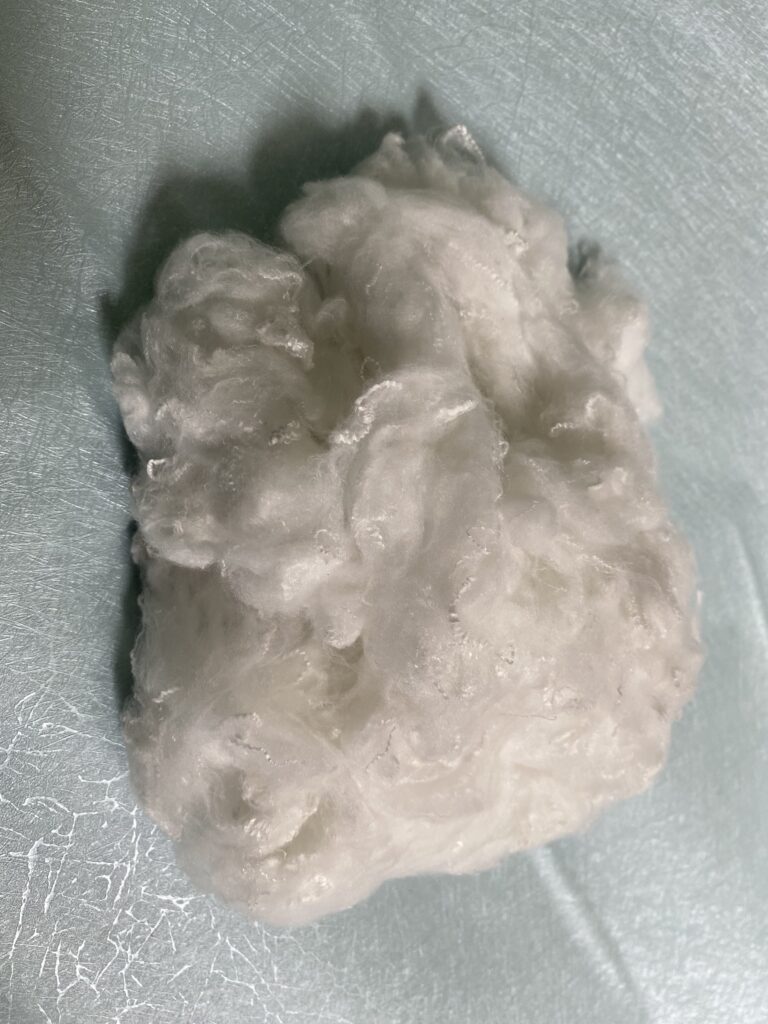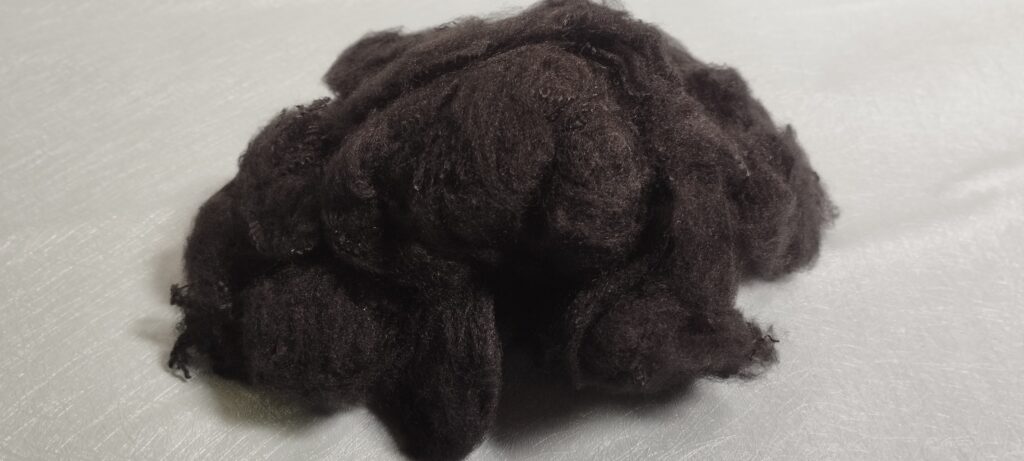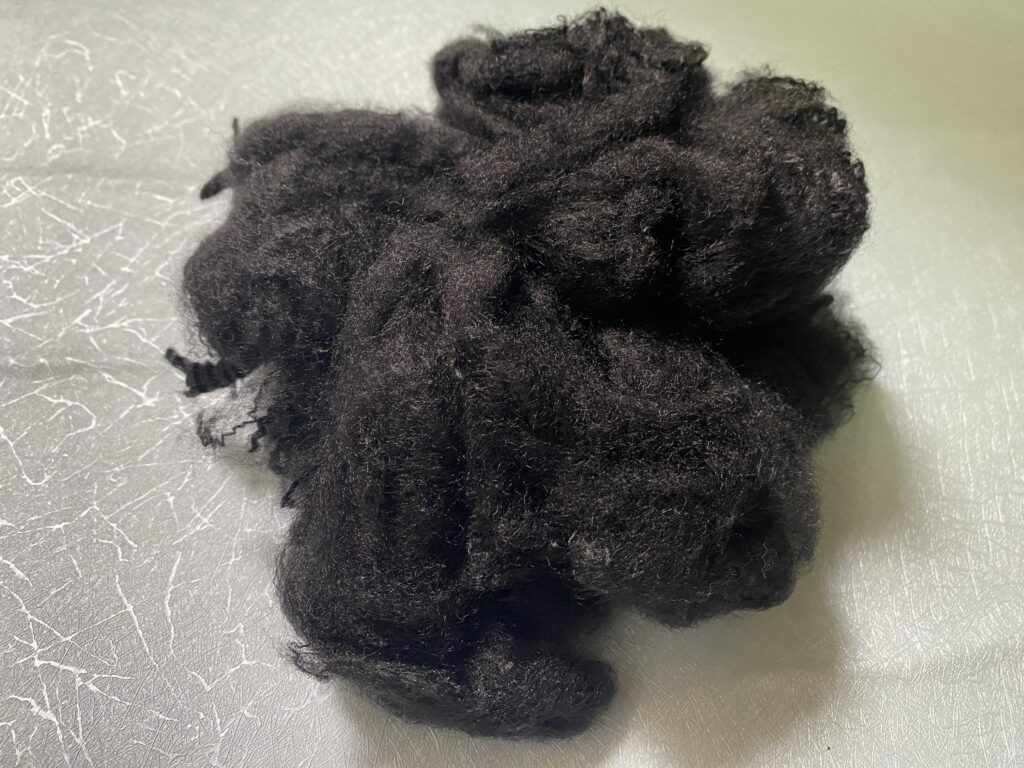
Choosing a recycled polyester fiber supplier is more than comparing prices per kilogram. For international buyers, the purchasing decision should also consider technical suitability, specification transparency, sample evaluation, quality documentation, order requirements and commercial terms.
A supplier may offer a product described as recycled polyester staple fiber (RPSF), but that description alone does not establish whether the material matches your manufacturing process or purchasing requirements.
Before placing an order, buyers should understand exactly which grade is being offered, how its specifications will be verified, what documentation is available and how the commercial agreement will be managed.
This guide provides a practical framework for evaluating a recycled polyester fiber supplier, comparing quotations and preparing a more complete request for quotation (RFQ).
Table of Contents
- Confirm the Supplier’s Product Range
- Check Technical Specifications
- Evaluate Samples Before Ordering
- Review Quality Control and Documentation
- Verify Sustainability and Certification Claims
- Assess Supply and Order Requirements
- Compare Quotations Beyond Price
- Evaluate Communication and Commercial Terms
- Red Flags to Watch For
- Recycled Polyester Fiber Supplier Checklist
- Frequently Asked Questions
- Request a Quotation from Eco Micro Fiber
1. Confirm the Supplier’s Product Range
The first step is to determine whether the supplier offers the type of fiber your business needs.
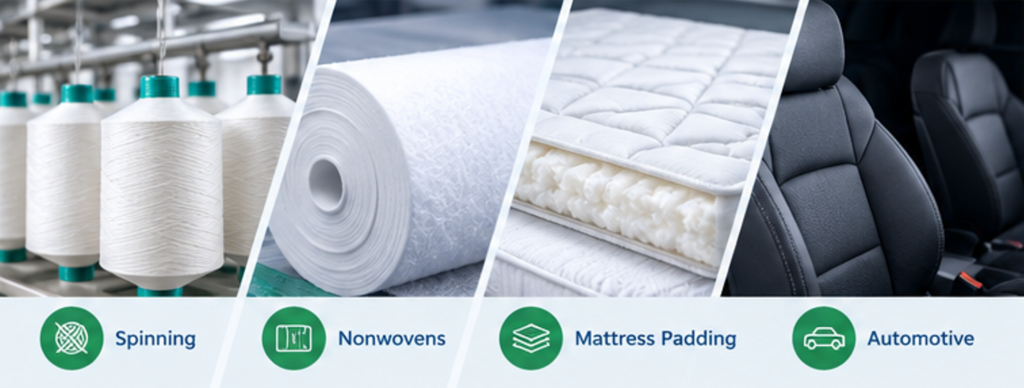
Recycled polyester staple fiber can serve different manufacturing applications, including yarn spinning, nonwoven production, mattress padding, furniture filling and selected technical textiles. However, not every supplier offers every grade, color, structure or specification.
Start by describing your intended application and asking the supplier to identify the relevant product options.
Questions to ask
- Which fiber grades are available for my application?
- What denier and cut lengths can be offered?
- Are white and black options available for the required grade?
- Is solid or hollow fiber required, and which structure is offered?
- Are there specific finishing or processing requirements?
- Is the requested specification currently available for quotation?
Ask for product information that identifies the actual grade rather than relying on a general company brochure.
For example, a request for 6D × 64mm fiber should specify the required color, structure and other relevant properties. The nominal denier and cut length alone may not define the complete product.
You can begin by reviewing the recycled polyester staple fiber product range and then checking the individual product pages for the specifications relevant to your inquiry.
2. Check Technical Specifications
A reliable purchasing decision starts with a clear, documented specification.
Before comparing suppliers, establish the parameters your production process requires. Then check whether each offer describes a comparable product.

2.1 Denier and cut length
Denier describes the linear mass of a fiber. Cut length identifies the nominal length of staple fiber, commonly expressed in millimeters.
Both parameters matter, but neither should be evaluated in isolation.
Ask the supplier to confirm:
- Nominal denier.
- Nominal cut length.
- Applicable tolerances.
- The method used to identify or verify the relevant parameters, where applicable.
If your factory currently uses an approved grade, provide its specification or a reference sample. This gives the supplier a clearer basis for assessing whether the proposed material is comparable.
For further technical detail, read our guide to recycled polyester staple fiber specifications: denier, cut length and color.
2.2 Color and fiber structure
If color is important to your application, state whether you require white, black or another defined color requirement.
Where consistency matters, establish the acceptance criteria before approving the sample or order.
Also specify whether you need solid or hollow fiber. These structures are not interchangeable by default, and the required structure should be explicitly identified in the product specification.
2.3 Additional properties
Depending on the application, buyers may need to consider finishing, crimp characteristics, mechanical properties, contamination limits or other technical parameters.
Not every property applies to every product. Identify the characteristics that matter to your process and agree on how they will be assessed.
Avoid accepting a quotation that simply says “standard quality” when your production process depends on specific, measurable requirements.
2.4 Specification consistency across documents
Check that the product description in the quotation, technical data sheet, sample identification and purchase order refers to the same grade.
If the supplier proposes an alternative, request a written explanation of the differences. Review those differences with your production or quality team before approving the substitution.
3. Evaluate Samples Before Ordering
A product description and specification sheet are useful, but they may not establish suitability for every manufacturing process.
Where practical, request a representative sample before committing to a commercial order.
Step 1: Confirm the sample identity
Ask the supplier to identify the sample by product grade and relevant specifications.
Record the denier, cut length, color, structure and any other agreed parameters. If the sample represents a specific commercial grade, confirm this with the supplier.
Step 2: Compare the sample with your requirements
Review the material against your approved specification or reference sample.
Use suitable inspection or testing methods for the parameters that matter to your application. For visual characteristics such as color, compare samples under consistent conditions where possible.
Step 3: Conduct a production trial if needed
For applications where processing compatibility is critical, consider evaluating the material under representative production conditions.
Define the evaluation criteria before the trial. Depending on the application, these may include process compatibility, finished-product requirements and relevant quality parameters.
Do not assume that a sample is suitable for every process simply because its nominal denier and cut length match your existing grade.
Step 4: Document approval
Record the approved sample identity, specification and any conditions attached to the approval.
If a trial identifies a required change, ensure that the revised specification is documented before proceeding.
Step 5: Confirm the commercial order
Sample approval does not automatically confirm production availability, quantity, packaging or delivery timing.
Those details should be confirmed separately in the supplier’s quotation and commercial agreement.
4. Review Quality Control and Documentation
A buyer should understand how the supplier defines the product, documents its specifications and handles quality requirements.
The purpose is not simply to collect documents. It is to establish whether the supplier can provide the evidence needed for your purchasing process.

4.1 Request a product specification sheet
The specification sheet should identify the offered grade and include the parameters relevant to that product.
Depending on the application, this may include denier, cut length, color, structure, applicable tolerances and other agreed characteristics.
Check whether the document identifies test methods or acceptance criteria where required.
4.2 Clarify quality inspection requirements
Ask which parameters are checked and how the results are assessed.
If your company requires particular inspection procedures, test methods or acceptance limits, communicate those requirements before placing the order.
The acceptance criteria should be specific enough for both parties to understand what constitutes conformity with the agreed specification.
4.3 Ask for relevant supporting documents
Depending on the product and purchasing requirements, relevant documents may include:
- Technical data sheets.
- Applicable test reports.
- Inspection records.
- Product or lot identification records.
- Required shipping or commercial documents.
- Certification or recycled-content evidence, where applicable.
Confirm which documents are available for the specific product and order. Do not assume that a document covering one product, facility or business entity automatically applies to another.
4.4 Discuss production-lot identification
For repeat purchases, ask how the supplied material will be identified and linked to the agreed product specification.
If variation between lots is a concern, identify the critical parameters and establish suitable acceptance criteria.
This makes it easier for both parties to refer to the same product requirements when reviewing subsequent orders.
4.5 Agree on handling deviations
Before ordering, clarify how a potential specification deviation will be reported and reviewed.
The commercial agreement should explain the applicable inspection, notification and claims procedures where relevant. This is especially important when the material is used in a process with strict customer requirements.
5. Verify Sustainability and Certification Claims
Recycled materials may be purchased under specific environmental, traceability or certification requirements. Buyers should distinguish between a general product description and a claim that can be supported by relevant documentation.
5.1 Define what your business requires
Your procurement team may require evidence relating to recycled content, chain of custody, facility certification or another defined standard.
State the exact requirement rather than asking only whether the supplier is “certified.”
Different certifications cover different subjects, scopes and entities. A certificate should be checked for its validity, scope, issuing body and applicability to the product and transaction being considered.
5.2 Request evidence before making assumptions
If certification or recycled-content verification is mandatory, request the relevant documentation before placing an order.
Check that the document corresponds to the supplier, facility, product and claim in question.
If the requirement cannot be verified, treat it as unresolved until appropriate evidence is provided.
5.3 Keep sustainability statements specific
A product being described as recycled polyester does not, by itself, establish every detail of its feedstock, recycled content, traceability or environmental impact.
Buyers should ask for the evidence required by their own procurement policy and avoid relying on broad environmental claims without supporting information.
For suppliers, transparent documentation is also important because international customers may need to review material claims internally or pass them to downstream customers.
6. Assess Supply and Order Requirements
A technically suitable product must also fit the buyer’s commercial and operational requirements.
Before placing an order, confirm the specific grade, quantity, availability and delivery conditions rather than relying on general statements about a supplier’s capabilities.
6.1 Confirm the exact order specification
Ensure that the supplier’s offer clearly identifies the product being quoted.
The quotation should distinguish the required grade from any proposed alternatives and identify the relevant product parameters.
If a particular color, structure or finish is essential, include it in the confirmed order specification.
6.2 Clarify quantity and packaging
Provide the estimated order quantity and ask the supplier to confirm the quantity they can offer for the required grade.
Discuss packaging, labeling and handling requirements where these affect your receiving or production process.
Do not assume that the minimum order quantity or packaging format is the same across every grade.
6.3 Confirm production and shipment timing
If your manufacturing schedule depends on a particular delivery date, communicate the required timing early.
Ask the supplier to confirm the applicable schedule for the specific product and order. Distinguish between estimated production timing, shipment timing and arrival at the destination.
A schedule should be documented and agreed upon rather than inferred from a general statement about lead time.
6.4 Establish communication arrangements
For international orders, clarify who will communicate order confirmations, specification questions, shipment updates and any potential changes.
Agree on how changes to the product specification or delivery schedule will be communicated and approved.
6.5 Consider repeat-order requirements
If the fiber will be purchased regularly, discuss how repeat orders will be placed and how the approved grade will be identified.
For critical applications, consider documenting the approved specification and the process for reviewing any changes before the next order.
7. Compare Quotations Beyond Price
Price per kilogram is an important purchasing factor, but it is meaningful only when the offers cover comparable products and commercial terms.
A lower-priced offer may differ in specification, documentation, packaging, delivery conditions or payment terms. Buyers should normalize these factors before making a decision.
Use the following comparison framework.
| Evaluation factor | What to check |
|---|---|
| Product identity | Same grade and intended application |
| Denier and cut length | Same nominal values and comparable tolerances |
| Color and structure | Requirements match the requested product |
| Other technical properties | Relevant finish and additional parameters are specified |
| Quality evidence | Required documents and inspection criteria are identified |
| Quantity and packaging | Comparable order quantity and packaging basis |
| Price basis | Currency, unit and quoted Incoterm |
| Delivery terms | Named place or port and included costs |
| Payment conditions | Method, timing and other applicable terms |
| Order schedule | Proposed timing confirmed for the specific order |
| Claims procedure | Inspection and deviation-handling arrangements clarified |
Compare total sourcing costs
Depending on the transaction, the purchasing cost may include more than the quoted material price.
Consider applicable freight, insurance, duties, handling, inspection, testing and other costs that are relevant to the agreed delivery terms. Use actual quotations and the correct Incoterm when comparing landed costs.
Also consider the operational consequences of a material that does not meet the required specification. Where relevant, use production-trial results, actual inspection data and documented acceptance criteria to inform the decision.
The goal is not necessarily to select the most expensive supplier or the lowest offer. It is to identify an offer that meets the technical requirements and provides commercially acceptable terms.
8. Evaluate Communication and Commercial Terms
The supplier’s response to your inquiry can help reveal whether the product and transaction requirements are being understood clearly.
8.1 Does the supplier ask relevant questions?
A useful quotation process begins with understanding your application and specification.
If essential details are missing, a supplier may need to ask about denier, cut length, color, structure, quantity or destination before preparing a meaningful offer.
8.2 Are limitations explained clearly?
If the exact grade is not available or an alternative is proposed, ask for the differences to be explained in writing.
Clear communication allows the buyer to evaluate the option without confusing it with the original specification.
8.3 Are commercial terms complete?
Review the quotation for currency, unit, Incoterm, destination, quantity, payment terms, delivery schedule and validity period where applicable.
Confirm any points that are missing or ambiguous before accepting the offer.
8.4 Are responsibilities clearly documented?
For a cross-border transaction, the buyer and supplier should understand their respective responsibilities for the agreed delivery terms, documentation, inspection and handling of potential deviations.
The exact arrangements will depend on the contract and Incoterm. They should not be left to assumptions.
9. Red Flags to Watch For
The following situations do not automatically prove that a supplier is unsuitable, but they deserve clarification before a purchasing commitment.
Vague product specifications
The offer uses a broad product name without identifying the relevant grade or technical parameters.
What to do: Request a specification sheet and confirm the exact product being offered.
Unclear or unsupported certification claims
The supplier claims certification or traceability without providing applicable evidence.
What to do: Request the relevant document and verify its scope and applicability.
Pressure to skip sample evaluation
The supplier discourages testing even though the material is critical to your production process.
What to do: Explain your approval requirements and agree on a suitable evaluation process.
Unexplained specification substitutions
The offered product differs from the requested grade, but the difference is not documented.
What to do: Request a written comparison and approve any alternative only after reviewing its suitability.
Incomplete commercial terms
The quotation does not clearly state the price basis, delivery conditions, payment terms or order schedule.
What to do: Ask for a complete quotation before comparing offers or placing an order.
Unconfirmed availability or delivery promises
The supplier makes a general promise without confirming the specific grade and order.
What to do: Request confirmation of availability and timing for your actual order requirements.
Inconsistent documents
The product description or specification differs between the quotation, sample identification and order documents.
What to do: Resolve the inconsistency before approving the order.
10. Recycled Polyester Fiber Supplier Checklist
Use this checklist to compare potential suppliers before moving to a commercial order.
Product and technical fit
- The intended application has been explained.
- The offered grade is clearly identified.
- Denier and cut length match the requirement.
- Color and fiber structure are specified where relevant.
- Additional technical parameters and tolerances are clarified.
- Any proposed alternative has been reviewed.
Quality and verification
- A relevant product specification has been received.
- Required inspection and acceptance criteria are defined.
- A sample has been evaluated where appropriate.
- Supporting test reports or other documents have been reviewed.
- Certification and recycled-content requirements have been verified where applicable.
- Product and lot identification requirements are clear.
Supply and commercial terms
- The specific grade and order quantity have been confirmed.
- Packaging and labeling requirements are clear.
- The delivery schedule has been discussed and documented.
- Price, currency, unit and Incoterm are stated.
- Payment conditions are understood.
- Shipping documentation requirements have been identified.
- The procedure for handling deviations or claims is understood.
Not every item applies to every purchase. Use the checklist according to your company’s requirements and the intended application.

11. Frequently Asked Questions
What should I check first when choosing a recycled polyester fiber supplier?
Start by confirming that the supplier can offer a grade relevant to your application. Then review the technical specification, sample-evaluation requirements, supporting documents and commercial conditions.
How can I compare two RPSF suppliers fairly?
Ensure that both offers cover comparable grades, nominal specifications, tolerances, quality requirements, quantities, Incoterms and payment terms. Then compare the documented evidence, sample results and overall commercial suitability.
Should I request a sample before placing an order?
A sample is useful when you need to evaluate material characteristics or production compatibility. For applications with critical process requirements, a controlled production trial may also be appropriate.
What documents should a recycled polyester fiber supplier provide?
The required documents depend on the product and your purchasing policy. They may include a technical specification sheet, applicable test reports, inspection records, lot identification information and relevant certification or recycled-content evidence.
Does every recycled polyester fiber supplier have the same certifications?
No. Certification requirements, scope and applicability vary. If a particular standard is mandatory, request evidence that applies to the supplier, facility, product and transaction concerned.
What information should I include in an RFQ?
Include the intended application, required denier, cut length, color, fiber structure, estimated quantity, destination and any technical, quality or documentation requirements. State your preferred delivery schedule and other commercial requirements where known.
Is the lowest quotation always the best choice?
Not necessarily. First confirm that the product specification and commercial conditions are comparable. Then assess price alongside technical suitability, supporting evidence, delivery requirements and the costs relevant to your transaction.
Can Eco Micro Fiber review a specification-based inquiry?
International buyers can send their required grade, application, quantity and destination details to begin a product inquiry. Product availability, technical specifications and commercial terms should be confirmed for each request.
12. Request a Quotation from Eco Micro Fiber
Are you evaluating recycled polyester staple fiber for yarn spinning, nonwoven production, mattress padding, furniture filling or another industrial application?

Eco Micro Fiber welcomes inquiries from international buyers who want to discuss product specifications and sourcing requirements.
To help us review your inquiry, please include:
- Application: Describe the finished product or manufacturing process.
- Required grade: State the denier and cut length, if known.
- Color and structure: Specify white or black, and solid or hollow where applicable.
- Quantity: Provide the estimated order quantity.
- Destination: Include the destination country or port.
- Technical requirements: List applicable tolerances, testing or acceptance criteria.
- Documentation: Identify any required test reports, certifications or recycled-content evidence.
- Commercial requirements: State the preferred delivery schedule and shipping terms, if known.
If your specification is not yet finalized, describe your current material and the application it serves. This information can help establish which product details need to be confirmed.
Contact Eco Micro Fiber to discuss your requirements and request a quotation.
Email: [email protected]
Product availability, specifications, quality documentation, certification status and commercial terms must be confirmed for each inquiry before an order is placed.