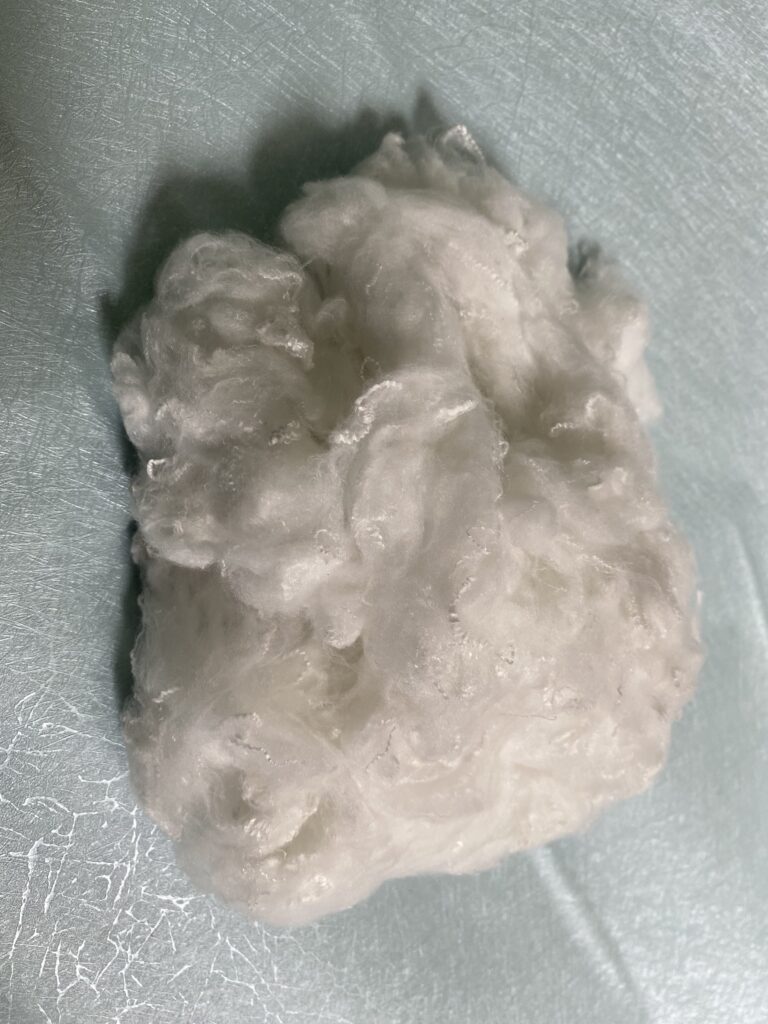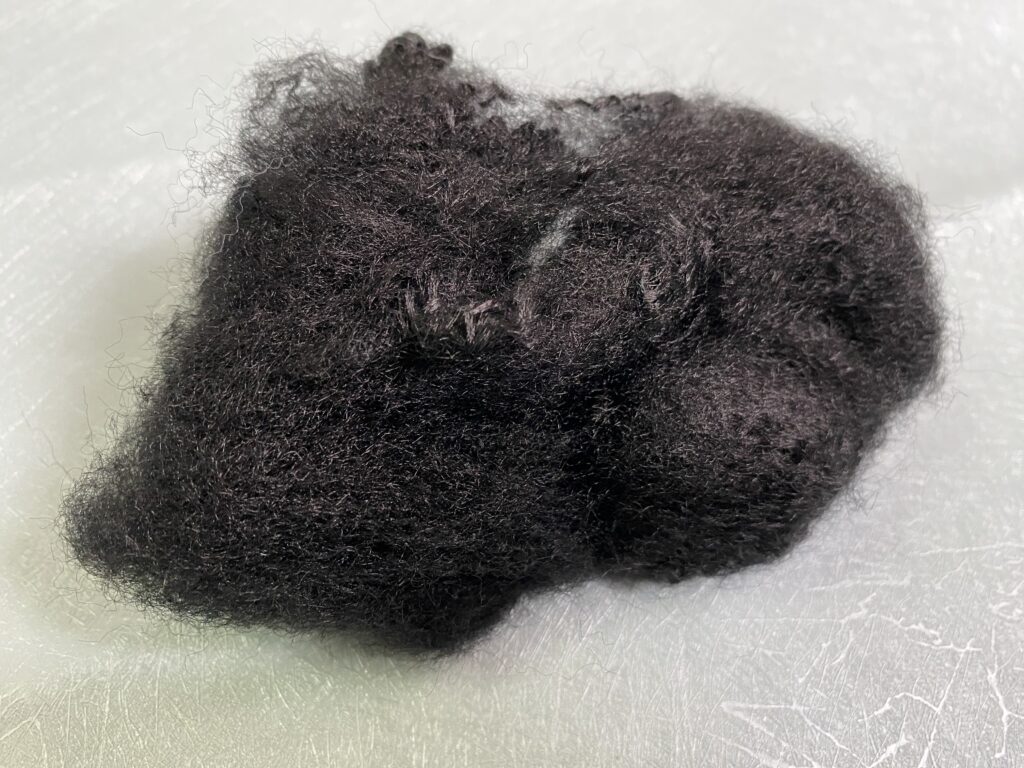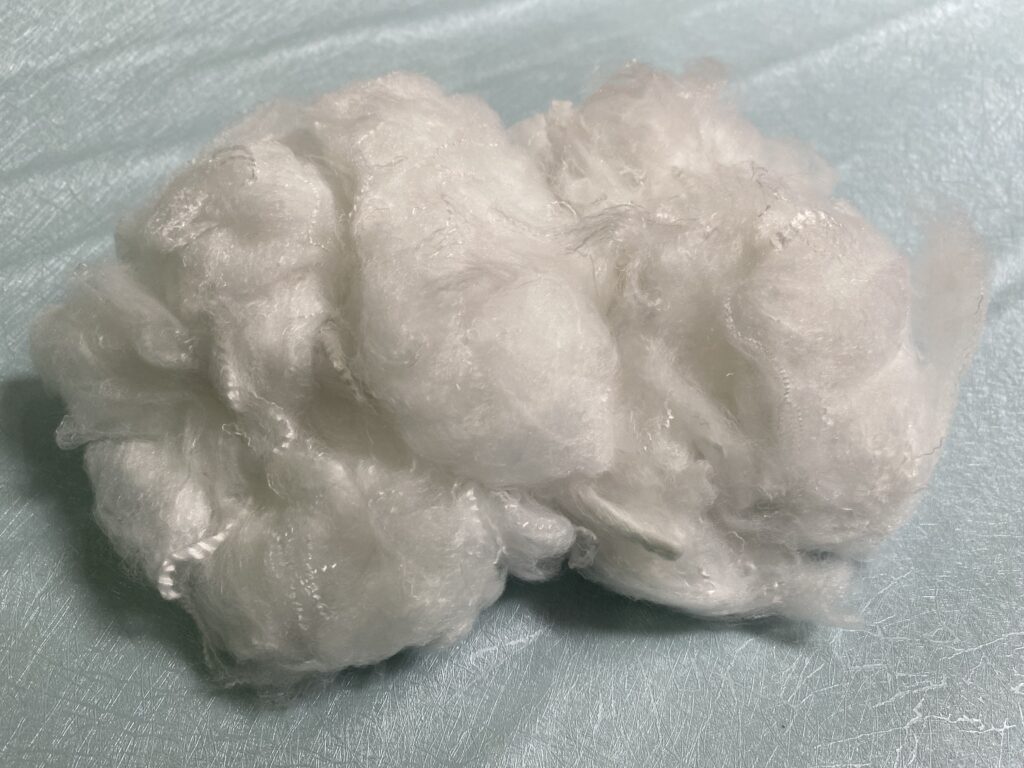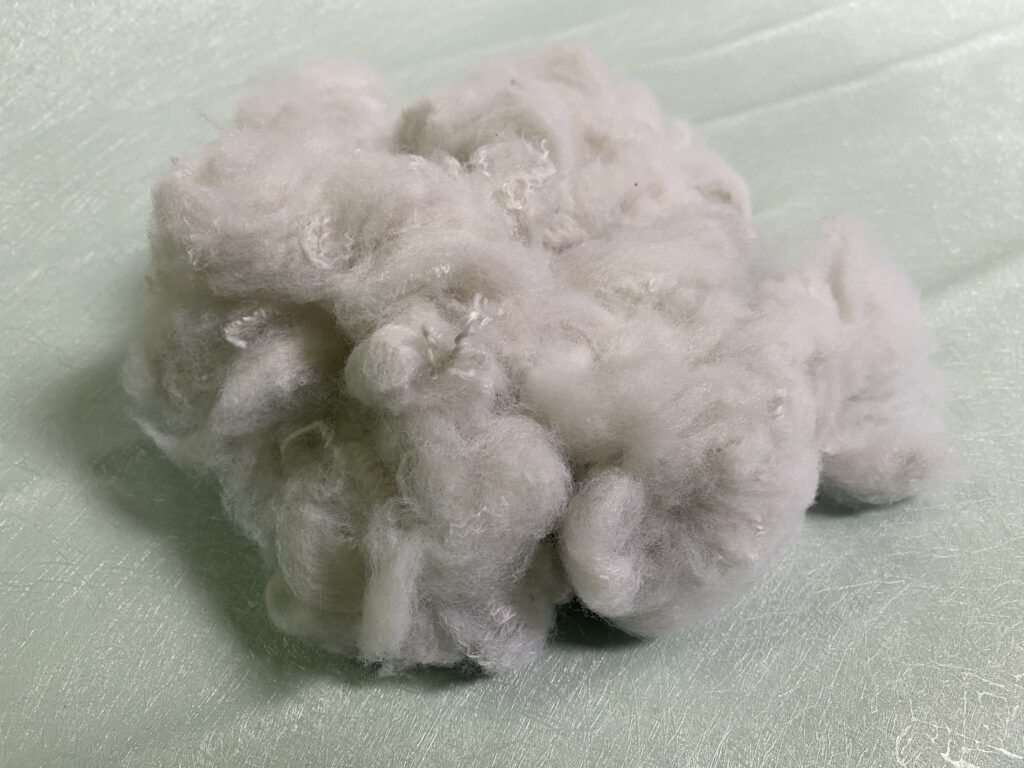
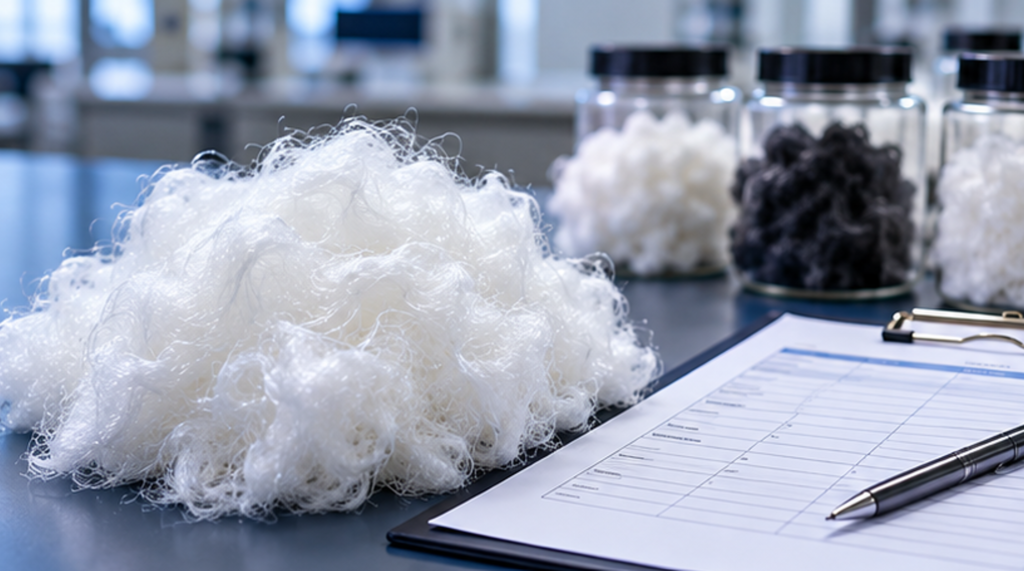
A recycled polyester fiber Technical Data Sheet (TDS) is one of the first documents international buyers should review before approving a new fiber supplier.
However, receiving a TDS does not automatically mean that the material meets your production requirements.
Two suppliers may offer recycled polyester staple fiber (RPSF) with the same nominal denier and cut length, yet their products may differ in tensile properties, crimp, fiber finish, cleanliness, and batch consistency.
For spinning mills, nonwoven manufacturers, mattress producers, and automotive textile suppliers, these differences can influence processing efficiency and finished-product quality.
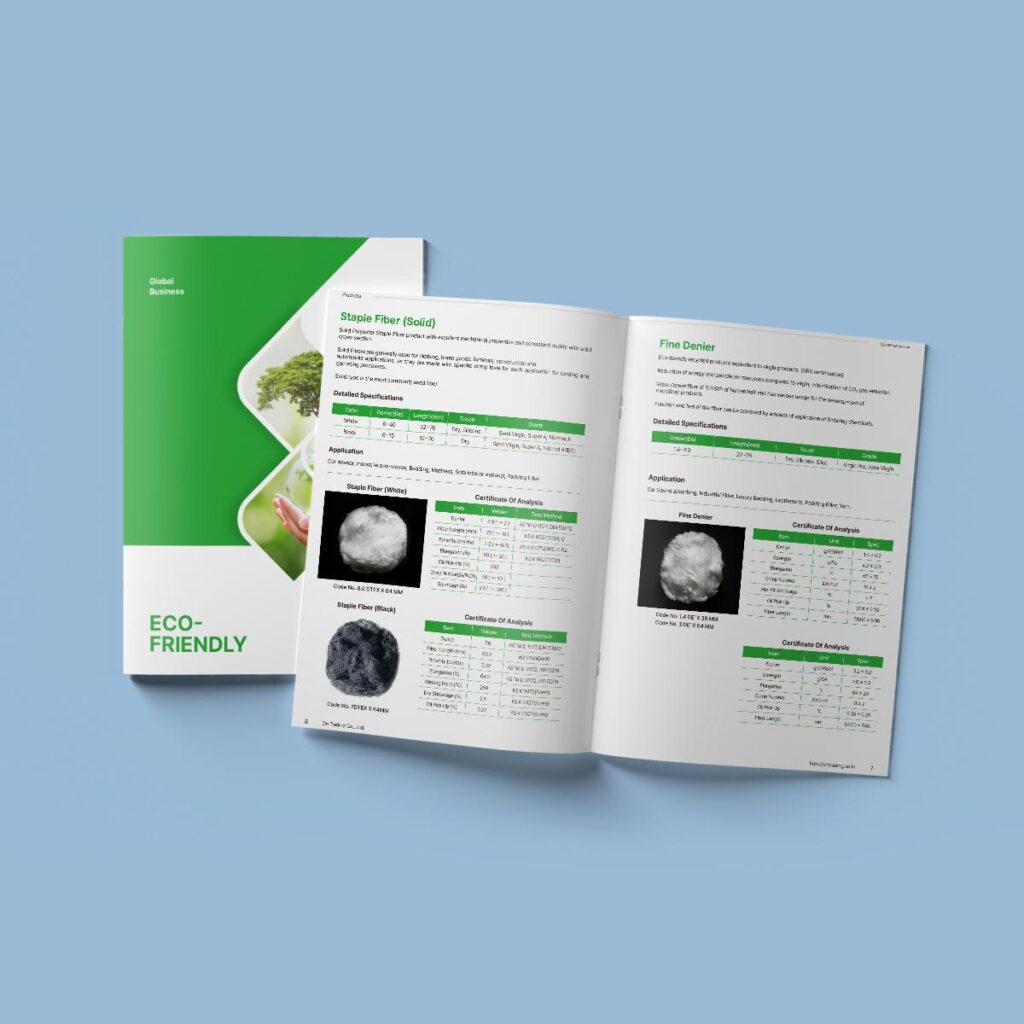
A useful TDS should help buyers answer three questions:
- What exactly is the fiber being offered?
- How are its technical properties measured and controlled?
- Does the specification match the intended manufacturing process?
This guide explains how to review a recycled polyester staple fiber TDS, identify missing technical information, and prepare the right questions before requesting samples or placing a bulk order.
1. What Is a Recycled Polyester Fiber TDS?
A Technical Data Sheet is a document describing the technical characteristics of a material.
For recycled polyester staple fiber, a TDS commonly includes information about fiber identity, dimensions, mechanical properties, surface characteristics, and other relevant quality parameters.
Depending on the supplier and fiber grade, the document may include:
- Fiber type and structure
- Nominal denier or dtex
- Cut length
- Tenacity
- Elongation at break
- Crimp characteristics
- Moisture content
- Fiber finish
- Color or whiteness
- Shrinkage
- Test methods and specification tolerances
Not every parameter is necessary for every application. However, the TDS should provide enough information for a buyer to evaluate the proposed fiber against the intended production requirements.
TDS vs. COA vs. SDS: What Is the Difference?
These documents serve different purposes.
| Document | Main Purpose |
|---|---|
| Technical Data Sheet (TDS) | Describes the material’s technical characteristics and specification |
| Certificate of Analysis (COA) | Reports test results for an identified batch or lot |
| Safety Data Sheet (SDS) | Communicates applicable chemical hazard, handling, and safety information |
A TDS may describe a standard product grade, while a COA can provide evidence of actual results for a specific production lot.
An SDS should not be used as a substitute for technical quality documentation.
Buyer takeaway: Request the appropriate documents for your purchasing decision rather than assuming one document provides all necessary information.
2. Check Fiber Identity Before Reviewing Test Results
The first step is confirming that the TDS describes the exact fiber you intend to purchase.
A document labeled only “Recycled Polyester Fiber” may be insufficient because recycled polyester staple fiber is available in different structures and finishes.
Important Identification Details
Buyers should check:
- Material composition
- Recycled polyester designation
- Solid or hollow structure
- Single-component or conjugated structure
- Siliconized or non-siliconized finish, where applicable
- Fiber color
- Product grade or identification code
- Intended application, if stated
For example, a 6D × 64mm solid recycled polyester fiber and a 6D × 64mm hollow recycled polyester fiber are not interchangeable simply because they have identical nominal denier and cut length.
Their structures may result in different bulk, resilience, and processing characteristics.
What About Recycled Content?
A TDS may identify the material as recycled polyester, but that statement alone does not independently verify its recycled content percentage or chain of custody.
If recycled content verification is required, buyers should request supporting documentation appropriate to their purchasing requirements.
3. Review Fiber Denier and Its Tolerance
Denier describes the linear density of an individual fiber.
One denier equals one gram per 9,000 meters of fiber.
The lower the denier, the finer the fiber.
Examples of nominal polyester staple fiber grades include:
- 1.4D
- 2.5D
- 3D
- 6D
- 15D
Fiber fineness can influence processing behavior, yarn structure, web formation, fabric hand feel, and other properties.
Why Nominal Denier Is Not Enough
Suppose a supplier offers 1.4D × 38mm recycled polyester staple fiber.
The nominal specification identifies the intended fineness, but it does not explain how much variation is permitted.
Buyers should ask:
- Is 1.4D a nominal target or an actual measured result?
- What tolerance applies to fiber fineness?
- Is the tolerance expressed in absolute units or percentage?
- Which test method is used?
- How is variation between production lots evaluated?
Denier vs. Dtex
Some suppliers express fiber fineness in dtex rather than denier.
The relationship is:
1 denier ≈ 1.111 dtex
Therefore, 1.4D corresponds to approximately 1.56 dtex.
Buyers should confirm the measurement unit before comparing specifications from different suppliers.
4. Check Cut Length and Length Uniformity
Cut length is another fundamental parameter in a polyester staple fiber TDS.
Common commercial cut lengths include 38mm, 51mm, 64mm, and 76mm.
The appropriate length depends on the manufacturing equipment and intended application.
For example:
- Spinning mills require fiber lengths compatible with their drafting and spinning systems.
- Nonwoven manufacturers must consider opening, carding, and web formation.
- Filling manufacturers may prioritize bulk, fiber separation, and processing behavior.
Look Beyond the Nominal Cut Length
A TDS showing 38mm does not necessarily describe the complete length distribution.
Buyers should determine whether the supplier provides information about:
- Average or nominal cut length
- Cut-length tolerance
- Short-fiber content, where relevant
- Overlength fibers
- Fiber length distribution
Uncontrolled variation can affect downstream processing.
For critical applications, buyers may need additional length-distribution information beyond the standard TDS.

5. Understand Tenacity and Elongation at Break
Mechanical properties are important when evaluating polyester staple fiber for yarn spinning, nonwoven production, and other industrial applications.
Tenacity
Tenacity describes breaking force relative to the linear density of a fiber.
It may be expressed in units such as cN/dtex or cN/den.
When comparing supplier documents, buyers should confirm that the units are consistent.
A numerical comparison without checking units can lead to incorrect conclusions.
Elongation at Break
Elongation at break describes the extension of a fiber before it breaks, usually expressed as a percentage of its original test length. It can influence how the fiber behaves during processing and under mechanical stress.
Why Both Properties Matter
Higher tenacity is not automatically better for every application.
Similarly, lower or higher elongation should not be treated as a universal quality indicator.
The appropriate balance depends on the manufacturing process and the final product.
Buyers should review:
- Reported tenacity
- Elongation at break
- Applicable tolerances
- Test conditions
- Testing method
- Consistency across production lots
Buyer takeaway: Compare mechanical properties against an approved reference material or application-specific requirements, not isolated numbers.
6. Evaluate Crimp Characteristics
Crimp refers to the wave-like shape introduced into staple fibers during production.
It influences fiber cohesion, opening, carding, bulk, and other processing characteristics.
A polyester fiber TDS may describe crimp using parameters such as:
- Crimp frequency
- Crimp percentage or contraction
- Crimp stability or related recovery characteristics
The terminology and measurement methods may vary between suppliers.
Why Crimp Matters for Different Applications
Yarn spinning: Crimp can affect fiber cohesion and drafting behavior.
Needle-punched nonwovens: Crimp can influence web formation, entanglement, and bulk.
Mattress padding: Crimp and fiber structure can affect loft and resilience.
Automotive felt: Crimp can influence processing and the resulting nonwoven structure.
Buyers should not compare crimp values from different suppliers unless the measurement definitions and test methods are compatible.
7. Check Fiber Finish and Surface Characteristics
Polyester staple fiber may receive a surface finish to support processing.
The finish can influence:
- Fiber-to-fiber friction
- Fiber-to-metal friction
- Static electricity
- Opening and carding
- Fiber handling
- Processing stability
Some TDS documents include a finish-content value, sometimes described as oil pickup or finish-on-fiber.
However, the amount of finish does not fully describe its chemistry or performance.
Questions Buyers Should Ask
- Is the fiber siliconized or non-siliconized?
- Is the finish suitable for the intended process?
- Is finish content controlled within a defined range?
- Are additional surface-property tests available when required?
A fiber designed for filling applications may have different surface requirements from a fiber intended for spinning or thermal bonding.
Therefore, surface finish should be evaluated according to the intended manufacturing process.
8. Review Moisture, Color, and Cleanliness
These characteristics are sometimes overlooked when comparing polyester staple fiber specifications.
Moisture Content
Moisture content may affect received material weight, storage conditions, and certain processing considerations.
Buyers should check whether moisture is specified and how it is measured.
Color and Whiteness
For white recycled polyester staple fiber, visual appearance alone may not provide sufficient information about color consistency.
Where appearance is critical, buyers may request:
- Whiteness or color measurement
- Approved reference samples
- Color tolerance
- Batch-to-batch comparison procedures
For black recycled polyester fiber, shade uniformity may be important for visible or appearance-sensitive products.
Cleanliness and Impurity Control
Recycled polyester feedstock can introduce contamination risks if sorting and processing are insufficient.
Potential concerns include:
- Foreign fibers
- Plastic fragments
- Hard particles
- Dust
- Colored contamination
- Other unwanted materials
A TDS may not fully describe contamination levels.
Buyers should ask whether the supplier has a defined inspection method and acceptance criteria for impurities.
For sensitive spinning or nonwoven applications, additional sample inspection may be necessary.

9. Check Shrinkage and Thermal Behavior When Relevant
Shrinkage can be important for applications involving heat exposure.
Examples include:
- Thermal-bonded nonwovens
- Automotive textile processing
- Heat-setting operations
- Certain technical textile applications
When shrinkage data is provided, buyers should check:
- Test temperature
- Exposure time
- Test method
- Reported shrinkage
- Acceptance tolerance
A shrinkage percentage without its testing conditions has limited value.
What About Melting Point?
Polyester thermal characteristics may also be relevant, particularly when evaluating specialized fibers or bonding applications.
However, buyers should distinguish conventional polyester staple fiber from specialty low-melt or bicomponent fibers.
Do not assume that all polyester staple fiber grades have identical thermal behavior.
10. Verify Test Methods, Units, and Specification Limits
One of the most important parts of reviewing a TDS is understanding how the reported values were obtained.
A technical value is more useful when accompanied by a clear test method and reporting basis.
Questions to Ask About Testing
- Which standard or internal test procedure is used?
- Is the value a nominal specification, typical result, or guaranteed limit?
- Are upper and lower acceptance limits defined?
- Are the results based on multiple measurements?
- What sampling procedure is used?
- Can lot-specific test results be provided?
Example: How to Read a TDS Correctly
The following table is an illustrative purchasing checklist, not actual GDI Textile product data.
| Parameter | Example TDS Entry | What Buyers Should Verify |
|---|---|---|
| Fiber fineness | 1.4D nominal | Actual results and tolerance |
| Cut length | 38mm nominal | Length distribution and tolerance |
| Tenacity | Value in cN/dtex | Test method and acceptance range |
| Elongation | Value in % | Test conditions and tolerance |
| Crimp | Crimps per unit length | Measurement definition and method |
| Moisture | Percentage | Measurement method and limit |
| Finish | Finish content % | Finish type and suitability |
| Color | White | Reference standard and color tolerance |
| Shrinkage | Percentage | Temperature, time, and test method |
The objective is not to request every possible test from every supplier.
Instead, buyers should identify the parameters that materially affect their production and establish clear acceptance criteria.
11. TDS vs. Actual Batch Quality: Why Lot Consistency Matters
A TDS describes the intended technical characteristics of a fiber grade.
It does not necessarily prove that every production lot meets the same specification.
This distinction is particularly important for buyers purchasing recycled polyester staple fiber on a recurring basis.
What Should Buyers Request for Bulk Orders?
Depending on the purchasing agreement, buyers may request:
- Production lot identification
- Lot-specific COA or inspection results
- Agreed specification tolerances
- Sample retention arrangements
- Procedures for handling out-of-specification material
- Quality complaint and corrective-action procedures
Why Batch Consistency Matters
Variation between shipments may lead to:
- Additional machine adjustments
- Increased production waste
- Yarn quality variation
- Nonwoven web inconsistency
- Changes in filling performance
- Additional quality inspections
For long-term procurement, repeatability can be as important as the performance of the initial approved sample.
12. What a Recycled Polyester Fiber TDS Cannot Prove
A TDS is useful, but buyers should understand its limitations.
It Does Not Automatically Verify Recycled Content
A product description stating “recycled polyester” is not, by itself, independent evidence of recycled content.
Buyers requiring verification should request appropriate supporting documents.
It Does Not Replace a Production Trial
A fiber may meet its published technical specification but still perform differently in a customer’s equipment.
It Does Not Guarantee Every Shipment
Unless supported by agreed contractual requirements and lot-specific verification, a standard TDS should not be treated as proof of every shipment’s actual quality.
It Does Not Automatically Establish Regulatory Compliance
A TDS is not a substitute for application-specific regulatory declarations, safety documentation, or compliance testing.
It Does Not Prove Certification
Where certification is required, buyers should verify the relevant certificate scope, validity, product coverage, and transaction documentation as applicable.
Buyer takeaway: A TDS is one part of supplier qualification, not a complete substitute for testing, traceability, or quality assurance.
13. Application-Specific TDS Checklist
Different industries should prioritize different fiber characteristics.
| Application | Priority TDS Parameters | Additional Evaluation |
|---|---|---|
| Yarn spinning | Denier, cut length, tenacity, elongation, crimp, finish | Yarn evenness, strength, breaks, drafting |
| Needle-punched nonwoven | Denier, cut length, crimp, tenacity, cleanliness | Carding, web formation, needle-punch performance |
| Mattress padding | Fiber structure, denier, cut length, crimp, finish | Loft, resilience, compression recovery |
| Automotive felt | Denier, length, crimp, strength, thermal behavior | Felt performance and customer-specific requirements |
| Geotextile | Fiber dimensions, mechanical properties, consistency | Finished geotextile testing |
| Cleaning textiles | Fiber fineness, length, color, cleanliness | Fabric softness, lint, cleaning performance |
This table is a starting point. Buyers should establish final requirements based on their own production process and finished-product specifications.
14. Red Flags Buyers Should Look for in a Fiber TDS
A recycled polyester fiber TDS deserves closer review when:
1. The product is not clearly identified.
The document does not specify whether the fiber is solid, hollow, siliconized, or another relevant grade.
2. Units are missing.
Mechanical properties or fiber dimensions are listed without clear measurement units.
3. No specification limits are provided.
The document gives nominal or typical values but no agreed acceptance range.
4. Test methods are unclear.
The buyer cannot determine how the reported values were measured.
5. The document is outdated or lacks revision identification.
There is no clear indication of the document version or the product grade to which it applies.
6. Samples and bulk material cannot be linked.
The supplier cannot explain how the approved sample relates to the intended commercial production grade.
7. Sustainability claims lack supporting documentation.
Recycled content or certification claims are made without appropriate evidence when verification is requested.
These issues do not always mean the material is unsuitable. However, they should be clarified before supplier approval.
15. Practical Purchasing Process: From TDS Review to Bulk Order
A structured qualification process can reduce sourcing risk.
Step 1: Define Your Production Requirements
Confirm the application, manufacturing equipment, target fiber grade, and critical quality parameters.
Step 2: Request the Correct TDS
Ensure that the document matches the exact product grade being offered.
Step 3: Compare Technical Specifications
Review nominal values, units, tolerances, test methods, and application suitability.
Step 4: Clarify Missing Information
Ask the supplier for additional technical details where necessary.
Step 5: Request Representative Samples
Confirm that the samples correspond to the intended commercial grade.
Step 6: Conduct a Production Trial
Evaluate performance under actual manufacturing conditions.
Step 7: Agree on Acceptance Criteria
Document the specifications, tolerances, inspection requirements, and quality procedures that will apply to commercial orders.
Step 8: Review Initial Production Lots
Compare actual batch results with the agreed specification and approved sample.
This process creates a clearer basis for repeat orders and long-term supplier evaluation.
16. Questions to Send a Recycled Polyester Fiber Supplier
Procurement teams can use the following questions when reviewing a new TDS:
- Can you confirm the exact fiber grade and structure?
- Are the reported values nominal, typical, or guaranteed specifications?
- What tolerances apply to denier and cut length?
- Which test methods are used for tenacity and elongation?
- How do you measure and control crimp?
- Can you confirm the fiber finish and its intended application?
- How do you inspect impurities and color consistency?
- Can you provide lot-specific test results where required?
- Can you supply representative samples for production trials?
- What supporting documentation is available for recycled content claims?
The supplier’s responses can help buyers determine whether the technical information is sufficient for their purchasing decision.
17. Discuss Recycled Polyester Staple Fiber Requirements with GDI Textile
GDI Textile supplies recycled polyester staple fiber for industrial textile applications.
Buyers evaluating grades such as 1.4D × 38mm, 6D × 64mm, or other available specifications should confirm that the proposed material matches their production requirements.
Before requesting a quotation, it is helpful to share:
- Intended application
- Required fiber denier and cut length
- Color or whiteness requirements
- Current fiber specification or reference sample
- Critical technical parameters
- Estimated purchasing quantity
- Destination country or port
Where applicable, buyers can also discuss the technical information and sample evaluation needed for their approval process.
Looking for Recycled Polyester Staple Fiber from Vietnam?
Contact GDI Textile to discuss available fiber grades, technical requirements, samples, and export supply options.
Website: https://ecomicrofiber.com/
Frequently Asked Questions
What does TDS mean in recycled polyester fiber purchasing?
TDS stands for Technical Data Sheet. It describes the technical characteristics and specifications of a fiber grade, helping buyers evaluate its suitability for manufacturing.
What are the most important parameters in a polyester staple fiber TDS?
Important parameters commonly include fiber identity, denier, cut length, tenacity, elongation, crimp, finish, and relevant quality tolerances. Additional parameters depend on the application.
Is a TDS the same as a Certificate of Analysis?
No. A TDS generally describes a product grade, while a COA reports results associated with an identified production lot or batch.
Should buyers request a COA for every shipment?
This depends on the purchasing agreement, product criticality, and supplier qualification requirements. For applications requiring strict quality control, lot-specific results can be valuable.
Can a TDS prove that polyester fiber is recycled?
A TDS may identify a product as recycled polyester, but the statement alone does not independently verify recycled content. Buyers should request suitable supporting documentation when verification is required.
Why should buyers check denier tolerance?
Nominal denier describes the target fiber fineness, while tolerance helps define the acceptable variation. Both are relevant when evaluating consistent processing performance.
Can two suppliers with the same fiber TDS produce different results?
Yes. Even when headline specifications are similar, differences in fiber distribution, finish, cleanliness, manufacturing control, and other characteristics may influence processing performance.
Is a production trial necessary after reviewing the TDS?
A production trial is strongly recommended for new suppliers, unfamiliar grades, or critical applications. It helps confirm whether the material performs as expected in actual manufacturing conditions.
Conclusion
A recycled polyester fiber TDS is an essential starting point for technical purchasing, but it should be evaluated carefully.
International buyers should look beyond nominal denier and cut length to understand mechanical properties, crimp, finish, testing methods, specification tolerances, and batch consistency.
The most effective approach combines three elements:
Technical Data Sheet + Representative Sample Testing + Lot-Specific Quality Verification
Together, these provide a stronger basis for selecting recycled polyester staple fiber that meets production requirements and supports reliable long-term purchasing.
For manufacturers sourcing recycled polyester staple fiber from Vietnam, clear technical communication and agreed quality requirements are important steps toward building a dependable supply relationship.